
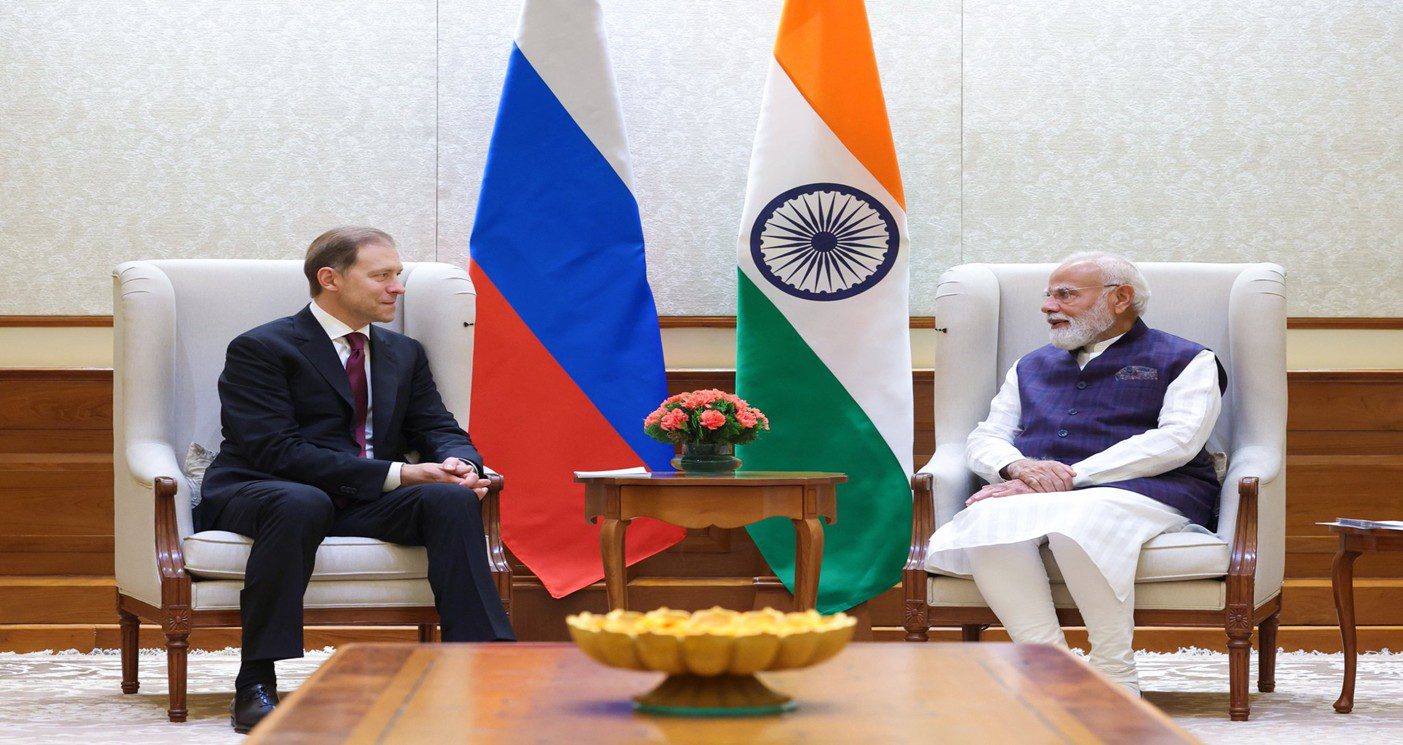
Source: Narendra Modi [@narendramodi] (April 3, 2026). X
Welcome to the first edition of Trade Tiffin!
This month’s stories are tied together by a single thread: India is simultaneously pulling every lever of economic statecraft by opening doors to investment, arguing for its voice at the World Trade Organization (WTO), exporting its digital stack to the world, scrambling to secure energy amid a regional war, and quietly stacking up free-trade agreements across four continents.
The ongoing conflict in West Asia has disrupted shipping lanes through the Strait of Hormuz, the critical artery for nearly half of India’s oil and gas imports, driving up energy costs, squeezing packaging supply chains, and threatening to push inflation higher at home. Simultaneously, an unpredictable global tariff environment, led by Washington’s shifting posture toward allies, has added fresh uncertainty to India’s export outlook and forced a hard rethink of supply chain dependencies.
We aim to provide you with a comprehensive understanding of India’s current trade priorities. New Delhi is diversifying energy sources by reopening liquified natural gas (LNG) negotiations with Russia while seeking United States’ (US) sanctions waivers to keep options open on both sides. On trade, it is accelerating a clutch of Free Trade Agreement (FTA) negotiations from Australia to Israel to the Eurasian Economic Union to reduce dependence on any single market. At the WTO, it is defending the multilateral rules-based order as a safeguard against the arbitrary use of trade as a geopolitical weapon. And through its Digital Public Infrastructure (DPI) diplomacy, it is building new forms of economic partnership that bypass traditional trade friction entirely.
Unlocking the neighbourhood
For the first time since the pandemic-era Press Note 3 put the brakes on investment from countries sharing India’s land borders, the Cabinet has recalibrated the rules, making it easier for global funds with limited exposure to China, Nepal, or Bangladesh to invest without having to navigate government approval on every occasion.
Press Note 3 (2020) required any entity from a land-border country or any fund whose beneficial owner was a citizen of such a country to invest only through the government approval route. On 10 March 2026, the Cabinet approved two important amendments. First, investors with non-controlling beneficial ownership of up to 10 per cent from land-border countries may now invest through the automatic route, subject to sectoral caps and other conditions. Second, a 60-day fast-track approval process was introduced for investments in strategic manufacturing sectors, including capital goods, electronics, and polysilicon.
Many global private equity and venture capital funds have diverse investor bases that include small minority stakeholders from land-border countries. Under the earlier framework, even minimal indirect ownership required government approval, leading to delays and regulatory uncertainty for many transactions. This reform clears the path, particularly for Private Equity (PE) / Venture Capital (VC) funds backing India’s startup and deep-tech ecosystem.
India at WTO MC-14
At the 14th Ministerial Conference in Yaoundé, Cameroon, India used its platform to draw a sharp line: reform of the WTO is welcome, but not if it bypasses consensus or sidelines developing-country priorities.
Commerce and Industry Minister Piyush Goyal led the Indian delegation at MC-14. Speaking on the issue of “Decision making including past mandates“, he emphasized that consensus-based decision-making is the bedrock of WTO’s legitimacy, and that it is important for WTO not to ignore the sovereign right of each member to not bind itself to rules which they do not agree to. India stressed that the reform process should begin with a transparent, inclusive stocktaking of the current institutional impasse and its underlying causes, with an open, development-oriented approach. The delegation cautioned that plurilateral approaches risk fragmenting the integrated multilateral framework, which has provided a platform for balanced participation by developing economies.
India also flagged the continued dysfunction of WTO’s dispute settlement system, noting that without effective adjudication, rules lose enforceability and disproportionately impact smaller economies. For India, which has historically been both a beneficiary and a critic of the rules-based trading order, a weakened dispute settlement body is a legitimate concern and not just a diplomatic talking point.
India’s digital stack goes global
India’s Aadhaar-to-UPI digital infrastructure is quietly becoming one of its most exportable products. Partnerships with 23 countries and live UPI payments in eight signal a new kind of soft power.
India has signed MoUs and agreements with 23 countries to share and cooperate on its Digital Public Infrastructure (DPI), reinforcing its growing role as a global leader in digital governance and fintech innovation. The agreements facilitate the replication and adoption of India’s digital platforms under the India Stack framework, covering digital identity, digital payments, data exchange, and service delivery platforms. India’s flagship digital payments platform, UPI, is now operational in more than eight countries, including the United Arab Emirates (UAE), Singapore, Bhutan, Nepal, Sri Lanka, France, Mauritius, and Qatar. Officials say the international rollout is facilitating cross-border remittances, enhancing financial inclusion, and strengthening India’s position in the global fintech ecosystem.
UPI saw 28 per cent year-on-year growth in transaction count in January 2026, reaching 21.70 billion transactions, alongside 21 per cent annual growth in transaction value. A system of this scale, offered as a global public good rather than a commercial product, is a genuinely novel form of economic diplomacy. Smaller nations gain readymade digital infrastructure and India gains influence, adoption benchmarks, and goodwill.
Russia back on the table
After months of trimming Russian crude imports to keep Washington happy, India has been forced by geopolitical realities to reverse course. A new liquified natural gas (LNG) deal with Moscow is being negotiated, and India is simultaneously seeking a US sanctions waiver to make it work.
A verbal agreement to negotiate an LNG deal was reached during a 19 March meeting in Delhi between Russian Deputy Energy Minister Pavel Sorokin and Indian Petroleum and Gas Minister Hardeep Singh Puri. The two officials also agreed to further increase crude oil sales to India, which could double from January’s levels to at least 40 per cent of India’s total imports within about a month. India’s calculus quickly changed after the US and Israel attacked Iran on 28 February. Tehran’s retaliation included targeting ships in the Strait of Hormuz, effectively closing the narrow strip through which about half of India’s crude oil and LNG supplies pass. Long lines were seen outside some Indian gas stations, while some restaurants ran out of cooking gas.
Russia’s Deputy Prime Minister called upon Prime Minister Modi and External Affairs Minister S. Jaishankar to discuss trade, industry, energy, fertilisers, connectivity and mobility in addition to new opportunities in technology, innovation, and critical minerals.
According to a government document, some Indian policymakers have lamented that Delhi cut Russian crude imports as a concession to the US. A cabinet briefing of 20 March warned that prolonged disruption of Middle Eastern oil flows could lead to higher inflation, a weaker currency, and rising foreign debt and that export growth could take a hit of 2 to 4 per cent.
FTA Campaign
India’s free-trade agenda is arguably the busiest it has ever been. Six ongoing negotiations, two recently signed deals, and two concluded agreements across four continents signal a new phase of commercial ambition.
India is currently negotiating Free Trade Agreements (FTAs) with Australia, Sri Lanka, Peru, Chile, the Eurasian Economic Union (EAEU), and Israel. Among these, the India-Australia Comprehensive Economic Cooperation Agreement has seen 11 rounds of talks since February 2023. India has also signed FTAs with the United Kingdom (July 2025) and Oman (December 2025), both of which are currently under ratification. Negotiations with New Zealand and the European Union have already been concluded. India and the US announced a framework for an interim trade agreement on 7 February 2026.
The negotiations span both developed and emerging markets, reflecting India’s push to deepen economic engagement across geographies. The talks aim to enhance market access, reduce tariffs, and facilitate greater investment and technology exchange across sectors. The EAEU negotiations, covering Russia, Kazakhstan, Belarus, Armenia, and Kyrgyzstan, are particularly notable given the current energy landscape. A deal there would open Central Asian markets to Indian auto, engineering, and pharmaceutical exports.
Wait, what? Not enough beer this summer?
Global trade stories are usually civilised and focus on tariff percentages, diplomatic statements, and WTO panels. But sometimes a faraway conflict reaches into something as personal as the cold bottle in your hand. This is one of those times!
Global brewers operating in India, including Heineken, Anheuser-Busch InBev, and Carlsberg, are warning of price increases and supply disruptions as gas shortages driven by the war in Iran push up the cost of glass bottles, while shipping delays hit imports of aluminium needed by can makers.
India is the world’s fourth-largest importer of natural gas and is especially vulnerable to such disruptions. Iranian attacks on Qatar’s gas facilities have significantly reduced Qatari exports, leaving less gas to go around for Indian producers. Gas is the foundation of the glass furnace. No gas, no bottles. No bottles, no beer.
The Brewers Association of India has revealed that glass bottle prices have risen by around 20 per cent. Packaging materials, such as beer cartons, has doubled in cost, while labels and tape have also become more expensive. Gas shortages are forcing some glass bottle makers to slow down or stop operations.
The association is seeking price increases of 12-15 per cent from state governments. India’s alcohol market is tightly regulated and companies need approval to raise retail prices. Brewers may find it difficult to maintain supplies in states that do not allow price increases. With summer, the peak beer season around the corner, the timing could not be worse.
Recommended Reads
- Rhea Mogul, 2026. Trump wanted India off Russian oil: His war with Iran is now undermining that goal. CNN, 10 March. https://edition.cnn.com/2026/03/10/india/india-russia-oil-middle-east-war-intl-hnk
- Krishna N. Das, Nidhi Verma and Saurabh Sharma, 2026. Trump’s Iran war pushes India to rekindle old friendship with Russia. Reuters, 27 March. https://www.reuters.com/business/energy/trumps-iran-war-pushes-india-rekindle-old-friendship-with-russia-2026-03-27/
- PIB, 2026. India signs MoUs with 23 countries to promote Digital Public Infrastructure. Government of India, 6 March. https://www.pib.gov.in/PressReleasePage.aspx?PRID=2235812®=3&lang=2
- India’s full position paper at WTO MC-14. World Trade Organization. https://www.wto.org/english/thewto_e/minist_e/mc14_e/ngo_position_papers_e/Great%20Mission%20Consultancy%20-%20Cultural%20Entrepreneurship%20through%20Geographical%20Indications.pdf
- Rajeshwari Ganeshan, 2026. Iran war reshapes India’s energy play as LNG talks with Russia return to the table. NewsNine, 27 March. https://www.news9live.com/opinion-analysis/iran-war-reshapes-indias-energy-play-as-lng-talks-with-russia-return-to-table-2948561