

Strategic Advantage: From the Korean Peninsula to Operation Sindoor
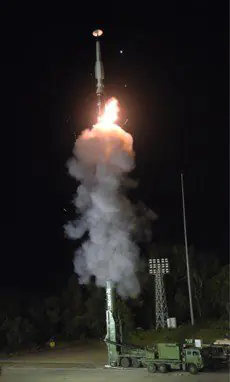
Long-range hypersonic missile Source: PIB
Nuclear deterrence as an instrument of statecraft and strategic craft was not born as a refined doctrine; it was discovered, haltingly and with considerable danger, in the chaos of limited war. When United Nations (UN) forces found themselves pressed against the Chinese border in late 1950, Commander of the theatre on the UN side, General Douglas MacArthur, lobbied actively for extending the conflict into Chinese territory explicitly floating the use of atomic weapons against Chinese industrial centres. US President Harry Truman ultimately dispatched nuclear capable B-29 bombers to Britain, placing them within striking distance of Soviet territory, not as an operational plan but as a form of gunboat diplomacy in the atomic age.
What Korea established was a template for managed escalation that would define the next seven decades of Great Power confrontation. The lesson absorbed by Washington, Moscow, and eventually Beijing was that nuclear weapons were most useful not when used, but when acknowledged and threatened with sufficient credibility. Eisenhower concluded that nuclear coercion had worked in Korea; China concluded that it needed its own bomb to prevent such coercion from working against it in future crises. The strategic weapons of the Cold War were therefore shaped by this mutual lesson – that they need to be survivable, diverse arsenals capable of absorbing a first strike and still delivering catastrophic retaliation where the foundation on which all conventional military freedom of action rested.
The evolution from the Korean-era bomber-centric nuclear posture to the great power nuclear triad model of the 1960s and 1970s was itself driven by the recognition that no single delivery system could be both credible and survivable. When the Soviet Union deployed Multiple Independently Targetable Re-entry Vehicles (MIRV), American planners understood that numerical superiority in warheads was less important than guaranteed second-strike viability. Survivability and not numerical dominance became the true bedrock of deterrence. The same intellectual arc eventually bent toward precision. As guidance technology improved, the ability to hold specific high-value targets at risk with fewer warheads made smaller, more accurate arsenals strategically viable in ways the crude city-busting weapons of the 1950s were not.
India’s military response to the Pahalgam terrorist massacre which killed 26 civilians codenamed Operation Sindoor, was deliberately calibrated to sit below the nuclear threshold while visibly degrading Pakistan’s conventional and strategic infrastructure. India struck eleven major Pakistani airbases across a four-day campaign, effectively neutralising its adversary’s capacity to deliver a nuclear warhead through the air vector while the Indian Navy contained the Pakistani fleet in the Arabian Sea. What Pakistan had long considered its strategic insurance, the ability to escalate to nuclear use if pressed conventionally, was exposed as a shield with structural holes.
The decisive weapons were not nuclear; they were the precision standoff tools that made granular discrimination between strategic and tactical targets possible, BrahMos supersonic cruise missiles, French-origin SCALP-EG cruise missiles launched from Rafale fighters, HAMMER precision glide bombs, and loitering munitions.
The strategic logic here traces directly back to the lesson that the Korean war first taught – the existence of nuclear weapons on both sides does not freeze conflict; it reshapes its grammar. Pakistan’s longstanding doctrine held that its nuclear capability would deter Indian conventional action allowing Islamabad to sustain cross-border terrorism with impunity. Operation Sindoor methodically dismantled that assumption, demonstrating that India could impose severe conventional costs without triggering nuclear retaliation, provided objectives were narrowly defined, escalation thresholds were transparent, and neither side made the other’s regime survival an explicit target. What the B-29 was to Eisenhower’s deterrence coercion in 1953 – as visible tool of threatened punishment, the BrahMos and SCALP became for India in 2025, weapons precise enough to punish without triggering apocalypse.
The Case for the Back Seater: Why the Weapons Officer Survives the AI Era
The back seat of a combat aircraft has always been, in a specific sense, the more intellectually demanding position. While the pilot wrestles with the physical demands of flight congenitally and occupied with managing propulsion, orientation, and the physiological assault of sustained high-G manoeuvre, the Weapons Systems Officer (WSO) sitting behind or alongside them faces a cognitive problem of a different order – interpreting a compressed, contested, electronically noisy battlefield picture and translating it in seconds into weapons release decisions that will have irreversible effects. Modern aircraft have made this harder, not easier. The battle space a contemporary combat aircraft must understand is multi domain, data-dense, and increasingly adversarial to the sensors themselves. The aircraft that has brought this question to a head most sharply is the Northrop Grumman B-21 Raider, the US Air Force’s next-generation stealth bomber currently in flight testing at Edwards Air Force Base. The US Air Force and Navy, beginning with the F-4 Phantom, adopted the WSO role as a standard across their two-seater fleet owing to the emerging combat needs of a Beyond Visual Range (BVR) threat-rich environment as well as precision strike munitions becoming the primary form of effective ordnance.
The Soviet Union arrived at the same conclusion about division of labour of the crew through an entirely different operational problem. The MiG-25 Foxbat, the single-seat interceptor that entered service in 1970 and briefly panicked Western intelligence with its Mach 2.8 top speed, was fundamentally a blunt instrument. In 1970, it was fast enough to intercept anything flying, but its vacuum-tube avionics and limited radar could not manage the emerging threat of low-altitude cruise missiles flying beneath the Soviet air defence network. When the Mikoyan bureau began designing the MiG-31 as the Foxbat’s replacement in the early 1970s, Soviet planners made a deliberate architectural choice, the new aircraft would carry a dedicated WSO in a second cockpit specifically to operate a radar system too complex and too data-intensive for a single pilot to manage simultaneously with flying. The result, when the MiG-31 entered service in 1981, it was the world’s first operational fighter equipped with a passive electronically scanned phased array, the N007 Zaslon S-800, and was operated entirely from the rear seat. The WSO’s cockpit was designed with deliberate intent; it had only two small side windows offering almost no external visibility because the Soviet engineers wanted to ensure the rear-seat occupant had no choice but to focus entirely on the electronic battle unfolding across their radar displays.
India’s own integration of the BrahMos nuclear capable cruise missile in the form of an air-launched version with the SU-30MKI fighter aircraft (which is the most numerous dual-seater platform the Indian Air Force operates) also requires a skilled WSO in the back seat of the plane to be effective.
The WSO’s survival in the AI era is not a failure of advancement in automation. It is an acknowledgement that in the most consequential moments of air warfare when discharging authority, target discrimination, and escalation management all converge in a single cockpit, it demands human presence and intervention not because machines lack processing speed; it is because algorithms for accountability, judgment under ambiguity, and legal and ethical frameworks governing the use of force have not yet been developed. The back seat remains because the battle space it has to to manage is becoming complex faster than the AI designed to simplify it.
Upgrading a Missile: The Endless Arms Race of Beyond Visual Range Combat
The original AIM-9 Sidewinder entered US Navy service in 1956 with a guidance system conceptually borrowed from German wartime infrared research, a single photocell behind a spinning reticle that detected the heat signature of an aircraft engine and turned a missile’s rudders toward it. The engagement envelope was narrow, the missile required a near-tail-aspect shot, the target had to be in clean air with no background heat confusing the seeker, and effective range stretched barely to 5 kilometres at best. In the 1958 Taiwan Strait crisis, Sidewinders fired by Taiwan’s Air Force F-86s at China’s MiG-17s achieved a kill rate estimated at roughly 10%, the first guided air-to-air missile combat in history. The weapon worked, but barely, and only under specific geometric conditions that a competent opponent could exploit.
What followed was a cycle that has since become the template for every missile system in every domain – the weapon reveals its limitations in combat, the enemy adapts their tactics or countermeasures to exploit those limitations, and the designer responds with an upgraded seeker, a more energetic motor, a wider engagement envelope, or entirely new guidance physics. The AIM-9D variant introduced the Hercules Mk 36 solid-propellant motor, substantially improving range. The AIM-9L, fielded in the late 1970s, broke the tail-aspect-only constraint with an all-aspect infrared seeker, a development that fundamentally changed air combat geometry by making a turning engagement dangerous from any angle. British subsonic Harrier jets used the AIM-9L to lethal effect in the 1982 Falklands War. The AIM-9X Block II, the current production variant, incorporates a data link that enables off-boresight lock-on against targets outside the pilot’s forward hemisphere – meaning a fighter can fire a Sidewinder at an adversary behind it by simply cueing the missile with a helmet-mounted sight.
Russia’s path with the Iskander system illustrates the same iterative logic applied to ballistic precision-strike. The Iskander began development in the late 1970s as a replacement for the Scud-B and was accelerated when the Intermediate Nuclear Forces (INF) arms control treaty forced Moscow to retire the SS-23 Spider in 1988. Brought into operational service in 2006, the Iskander-M carries warheads of up to 700 kilograms at speeds between Mach 6 and Mach 7 to a maximum range of 500 kilometres. The missile employs a maneuverable re-entry vehicle and decoys to defeat theatre ballistic missile defence, while its guidance combines inertial navigation, Russia’s own GLONASS satellite positioning, and an optical correlation seeker that can achieve accuracies measured in single-digit metres. Russia has since also fielded the Iskander-K variant which is estimated to have a range of 1,500-2,000 kilometres. Combat experience over Ukraine drove these upgrades; the war demonstrated that coordinated salvos arriving from multiple directions simultaneously stressed Ukrainian Patriot air defence batteries beyond their processing capacity, validating both the tactical approach and the need for even greater standoff range against more capable future opponents.
BrahMos, the Indo-Russian supersonic cruise missile that became a decisive weapon in Operation Sindoor, traces its own upgrade arc from the joint venture established in 1998 between India’s DRDO and Russia’s NPO Mashinostroyeniya. The original range of 290 kilometres at Mach 2.8 reflected the INF Treaty constraints that bound its Russian design lineage. A 2016 agreement to double the missile’s range began the extended-range programme that ultimately produced variants with operational reach of up to 800 kilometres depending on the platform, air-launched from Su-30MKI fighters, sea-launched from naval vessels, and ground-launched from mobile transporter-erector-launchers.
The next iteration is also in development – tentatively designated BrahMos-II, and reportedly aims for speeds of Mach 7 to Mach 8 and ranges up to 1,500 kilometres using scramjet propulsion technology. As evident from all three cases from the US, Russia, and India, missile upgrades are not a straight line of progression; it is a continuous game of catching up between capability and countermeasure.
Dhvani: How India's Hypersonic Glide Vehicle will Reshape its Strategic Posture
Although there is an intentional lack of specific official information about it, Dhvani is likely a boost-glide system developed by the Defence Research and Development Organisation (DRDO) and derived from India’s Agni ballistic missile family’s propulsion heritage. It is likely to be initially launched via a rocket booster which takes the vehicle to near-space altitudes, after which it separates and begins a glide through the upper atmosphere at speeds between Mach 5 and Mach 6, approximately 6,200 to 7,400 kilometres per hour. With an estimated range of 6,000 to 10,000 kilometres, the system could deliver intercontinental-class reach considerably beyond the Agni-V ICBM’s capability, placing targets across Asia, Europe, and portions of North America within India’s strike envelope. The vehicle’s waverider profile likely rides its own shockwaves to maximise aerodynamic efficiency, while the terminal guidance system integrates inertial navigation, satellite tracking, terrain-matching, and radio frequency (RF) seekers to maintain accuracy during the plasma blackout that hypersonic re-entry generates. The vehicle likely operates at approximately 60 kilometres altitude, executing lateral manoeuvres in its terminal phase that reduce adversary reaction time to under five minutes, shorter than the detect-track-compute-launch cycle of any existing theatre missile defence system.
The strategic logic connecting these systems to India’s nuclear posture is direct. India’s declared no-first-use nuclear doctrine requires a credible assured-retaliation capability that can survive an adversary’s first strike and still penetrate missile defences to reach meaningful targets. As China deploys the HQ-19 anti-ballistic missile system and continues developing layered air and missile defence networks, India’s existing ballistic arsenal which is based on Agni-series missiles flying predictable parabolic arcs becomes progressively more vulnerable to interception across its current trajectory. A hypersonic glide vehicle that maneuvers unpredictably at the edge of the atmosphere defeats this calculus; it cannot be intercepted by systems that rely on predicting where a projectile will be in 60 seconds because a hypersonic glide vehicle at 60 kilometres altitude is still turning. Dhvani’s probable 10,000-kilometre maximum range, combined with the hypersonic LR-AShM‘s maritime strike capacity, gives India a strategic toolkit that speaks to threats on both the Chinese continental and naval axes simultaneously.
Check these out:
1. Amy Woolf, ‘Beyond New START: What Happens Next in Nuclear Arms Control?’ 21 October 2025. Royal United Services Institute (RUSI). URL: https://www.rusi.org/explore-our-research/publications/commentary/beyond-new-start-what-happens-next-nuclear-arms-control
- Harrison Kass, ‘Why Does the F-15E Strike Eagle Have a “Weapons Systems Officer”?’ The National Interest, 7 April 2026. URL: https://nationalinterest.org/blog/buzz/why-does-f-15e-strike-eagle-have-weapons-systems-officer-hk-040726
- Cameron L. Tracy and David Wright, ‘Don’t Believe the Hype about Hypersonic Missiles’. IEEE Spectrum, 5 February 2021. URL: https://spectrum.ieee.org/hypersonic-missiles-are-being-hyped
- Catherine Dill, et. al., ‘(Just Like) New START Is Over’. Arms Control Wonk Podcast, 7 February 2026. URL: https://www.armscontrolwonk.com/archive/1221400/just-like-new-start-is-over/
- ‘The Cuban Missile Crisis, October 1962’. Office of the Historian, US State Department. URL: https://history.state.gov/milestones/1961-1968/cuban-missile-crisis
- Abhinav Yadav, ‘Evolution of cruise missiles: From Tomahawk to BrahMos-II’. WION, 2 November 2025. URL: https://www.wionews.com/photos/evolution-of-cruise-missiles-from-tomahawk-to-brahmos-ii-1762072073227
- ‘Exploring Iran’s Nuclear Program’. Center for Arms Control and Non-Proliferation. URL: https://armscontrolcenter.org/exploring-irans-nuclear-program/
Thank you for taking the time to read our Command Chain this month. Stay tuned for our next edition.