
Tech Tactics
As nations vie for supremacy in critical and emerging technologies, geopolitics and high-tech innovations intersect to shape global dynamics. Technological advances, from artificial intelligence (AI) to space exploration, not only revolutionise industries but also redefine global power and strategic alliances. This edition explores how Indian earth observation startups are positioned, the global hunt for novel AI regulation frameworks, how the right to repair movement fares in India and the West, and how turbulent it is to regulate Web3 technologies.
India's Satellite Startups are Shooting for the Stars
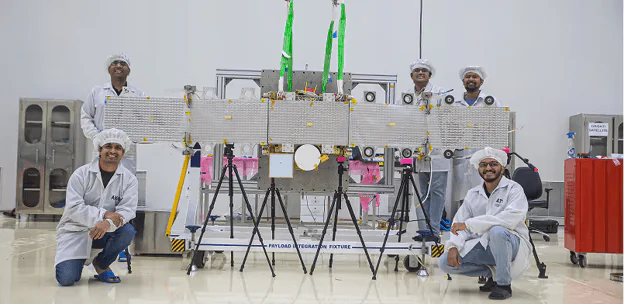
When a 190-kilogram spacecraft built by a Bengaluru-based startup separated from a SpaceX Falcon 9 rocket over California earlier this month, it marked something more than another successful launch. GalaxEye’s Mission Drishti, the world’s first satellite to combine optical sensors and synthetic aperture radar on a single platform, represented a quiet declaration that India’s privately-owned space sector has arrived, and that it intends to compete on its own terms.
The satellite can image the Earth’s surface in high resolution regardless of cloud cover or time of day, a capability previously requiring two separate spacecraft. Prime Minister Narendra Modi called it “a major achievement,” and in the context of Indian private space history, it genuinely is. The Bengaluru startup, founded by IIT Madras alumni in 2021, plans to expand Mission Drishti into a constellation of eight to twelve satellites by 2029, delivering near-real-time Earth observation to governments, defence agencies, and commercial clients worldwide.
Pixxel, another Bengaluru-based venture has already deployed six hyperspectral satellites in sun-synchronous orbit, capturing data across more than 135 spectral bands at five-metre resolution, enabling applications from agricultural monitoring to mining and environmental tracking. In August 2025, a Pixxel-led consortium that also includes maritime surveillance startup PierSight, geospatial analytics firm SatSure, and satellite infrastructure company Dhruva Space, won an INR 1,200 crore government contract to build and operate India’s first commercially-run Earth observation satellite constellation, 12 satellites over five years, under a public-private partnership framework administered by the Indian National Space Promotion and Authorisation Centre (IN-SPACe).
The project is explicitly designed to reduce India’s dependence on foreign satellite data, addressing long-standing vulnerabilities in areas from border surveillance to crop yield forecasting. According to the latest available data from India’s Department of Space, the country held only around 2% of global space market valued at US$ 8.4 billion in 2023, a figure that the current wave of startups, policy liberalisation, and government investment is positioning to change.
Globally, the companies these Indian startups must contend with are formidable. Planet Labs operates the largest commercial constellation in existence, with hundreds of satellites providing daily revisit coverage of the entire Earth. Maxar Technologies supplies sub-50 cm resolution imagery to governments and intelligence agencies. Europe’s Airbus Defence and Space and the French firm Thales Alenia Space bring decades of engineering heritage. Against these giants, Indian firms are newer, smaller, and less capitalised.
But the gap is narrowing in ways that raw size does not capture. GalaxEye’s OptoSAR fusion technology is genuinely novel; no established player has put that capability on a single bus at this cost point. Pixxel’s hyper spectral resolution sits at the frontier of what commercial satellites offer anywhere. SatSure has built deep expertise in translating raw satellite data into actionable intelligence for agricultural lenders and insurers, a niche that global players have barely touched. These are not attempts to replicate what already exists; they are bets on where the market is heading.
The more interesting strategic question is whether Indian startups should position themselves against Western and Chinese competitors at all, or whether complementarity rather than conventional rivalry offers a faster path to global relevance. The Pixxel consortium model offers a template: firms with distinct specialisations in imaging hardware, platform infrastructure, maritime sensing, and data analytics combining their capabilities rather than duplicating them. That consortium logic could extend internationally. Indian Earth observation firms bring cost-competitive manufacturing and strong AI-driven analytics talent; their counterparts in Europe or Southeast Asia may offer established distribution networks, regulatory access, and customer relationships that Indian startups lack.
The Global Hunt for AI Regulation Frameworks that Actually Work
The race to build ever more powerful AI systems is outpacing the world’s ability to govern them. Competition may even be actively undermining AI safety as cutting edge technology and accuracy is constantly in search of token optimisations and monetary savings. When Anthropic recently walked back on its industry-leading safety guarantee for new model releases, the company acknowledged that unilateral commitments made little sense while competitors were pressing ahead without similar constraints. OpenAI has faced comparable pressures, reportedly trimming pre-deployment safety testing windows to stay competitive. The pattern reveals an uncomfortable truth, asking companies to police themselves when their rivals are not, creates a structural race to the bottom.
That insight has given rise to an unconventional policy proposal gaining traction in legal and governance circles. Rather than relying on government regulators who typically lack the technical expertise and move too slowly or trusting companies to self-impose meaningful standards, the idea is to make AI firms regulate one another through a formal, government-certified peer oversight system.
The model draws on a long-established mechanism from financial services regulation. Under the proposal, private governing bodies certified by a government authority would set binding safety rules for member firms. Companies that opt-in would receive a form of liability protection, but that shield would be collective; if one member’s safety failure caused the entire governing body to lose its certification, every firm inside it would suffer the consequences.
The elegance of the idea lies in its incentive structure, if your competitor cuts corners on safety and costs you your operating licence, you have a very powerful reason to care about their practices. Such pledges amount to little more than reputation management; voluntary disclosures can encourage superficial compliance without substantive change, functioning essentially as marketing rather than accountability.
While Washington has moved steadily away from federal AI oversight as is evident in President Trump’s Executive Order 14179, issued in January 2025, which revoked the previous administration’s flagship AI safety directive and directed policymakers toward a pro-innovation, pro-competitiveness agenda. With a comparatively smaller federal role the burden of governance has fallen piecemeal onto states and, increasingly, on the other side of the Atlantic, on the EU.
Yet Europe’s much-heralded regulatory blueprint is proving harder to implement than its architects anticipated. The EU AI Act came into force in August 2024 and was intended to be fully applicable two years later, with a phased rollout assigning obligations to different categories of AI systems at staggered intervals. That orderly timetable is now in serious jeopardy.
As recently as late April 2026, the European Parliament, the Council of the EU, and the European Commission met for a second political trilogue on a proposed Digital Omnibus package intended to simplify the Act’s implementation and they were unable to reach an agreement. A further trilogue has been scheduled for later in May. Should negotiations collapse before the August 2026 deadline, the original, unamended obligations will snap into place automatically.
By pushing back high-risk AI rules while keeping the law non-retroactive, the bloc risks leaving some of the most sensitive AI applications permanently beyond oversight’s reach.
One of the more contested flashpoints has been the Code of Practice for general-purpose AI models, the guidance document that was supposed to give developers of large foundation models a clear framework for compliance. Reports indicate that disagreements over its scope and enforceability, particularly around transparency and systemic risk, have stalled its finalisation well beyond its original deadline.
The cumulative picture, a deregulatory US, a fragmented European framework struggling under its own weight, and a global absence of any coordinating mechanism is precisely what makes the peer-regulation proposal so timely. It does not require an international treaty. It asks only that governments certify oversight bodies with sufficient membership requirements to make defection costly, and then step back.
Although there are calls for government-mandated oversight conducted by professional AI auditors, arguing that it could deliver accountability without stifling innovation. The peer-regulation model goes further, embedding accountability within the competitive dynamics of the industry itself, turning the profit motive that currently undermines safety into a mechanism that enforces it.
Whether governments have the political will to structure such a system, and whether AI firms would accept meaningful peer scrutiny of their most valuable trade secrets remains an open question. But with the US’s state-level patchworks proliferating and Brussels negotiations faltering, the pressure for a workable alternative has rarely been greater.
The Right to Repair — From EU to India
For most of the last decade, replacing a smartphone battery meant either booking an expensive manufacturer service appointment or voiding your warranty by visiting a third-party technician. That may be about to change, at least in Europe, and possibly in ripple effects everywhere else.
From February 2027, every smartphone sold in the European Union’s 27 member states must be designed with a battery that can be removed and replaced without specialised tools or professional assistance. Under Article 11 of the EU Batteries Regulation, manufacturers will also be legally required to keep compatible replacement batteries available for at least five years after a model’s last sale. Failure to comply will put devices in legal jeopardy across one of the world’s largest consumer electronics markets.
The regulation carries meaningful caveats. Devices subject to the separate Ecodesign Regulation which covers waterproofing and battery longevity standards may be partly exempted from user-replaceability requirements if they meet those alternative durability criteria. Right to Repair Europe, a coalition of advocacy groups, has been sharply critical of this carve-out, arguing that it undermines the regulation’s core purpose and creates a false conflict between making devices durable and making them repairable. The group contends that a device can be both waterproof and serviceable, something intelligent design manufacturers have never been legally required to achieve simultaneously.
This criticism cuts to the heart of a practice that consumer advocates have spent years documenting and naming – planned obsolescence. The deliberate shortening of a product’s useful lifespan through glued-in batteries, proprietary screws, software lockouts, or simply the withdrawal of spare parts is not a conspiracy theory. It is a documented business model and its costs are borne overwhelmingly by consumers and the environment. According to the UN’s Global E-Waste Monitor, the world generated over 53 million metric tonnes of electronic waste in 2019, of which less than a fifth was formally collected and recycled.
India is grappling with this problem at a significant scale. As one of the world’s largest and fastest-growing smartphone markets, with a population that has historically stretched device lifespans out of economic necessity rather than ecological consciousness, India has both a strong consumer interest in reparability and a structural dependency on informal repair markets that already provide millions of livelihoods.
In 2025, India’s Department of Consumer Affairs took a notable step forward by introducing a Reparability Index framework for consumer electronics and mobile devices. Under the index, products would receive a score based on criteria such as availability of spare parts, cost of repair, software update continuity, and access to technical documentation. The framework is explicitly modelled on similar initiatives in France where a reparability index has been mandatory on product labels since 2021. India has not yet codified a right to repair into law in the way the EU, US, or UK have approached it, but the index represents a meaningful shift in policy intent.
The differences between the Indian and Western approaches reveal contrasting philosophies. India’s model has historically favoured manufacturer-authorised channels, with limited legal support for independent third-party repair. The US, by contrast, has seen a rash of state-level right-to-repair laws, and the Biden administration directed the FTC to scrutinise anti-repair practices across industries. The EU’s approach is the most structurally ambitious, embedding reparability requirements into product law rather than relying on consumer choice or market pressure.
What the EU’s 2027 battery rule may accomplish that domestic Indian advocacy has not yet managed is a supply chain shift. Because the economics of global hardware manufacturing make it prohibitively expensive to produce fundamentally different device architectures for different markets, OEM compliance in Europe is likely to produce more repairable designs that flow through to other markets, including India, whether local law requires it or not. The Brussels Effect, as scholars of regulatory diffusion have termed it, has reshaped global product standards in chemicals, data privacy, and food labelling. Consumer electronics repairability may be next.
For India, the more urgent domestic task is giving legal teeth to the reparability index, ensuring it informs purchasing decisions, creates genuine competitive pressure on manufacturers, and expands rather than restricts the role of the country’s enormous informal repair ecosystem.
Who Rules the Chain? The Turbulent Politics of Web3 Regulation
In the autumn of 2024, a prediction market called Polymarket became globally famous. During the US presidential election, it accumulated over US$ 3.3 billion in wagers on the outcome, outperforming conventional polls in its final predictions. For millions of people, it was the first time they had encountered a decentralised, blockchain-based platform operating at genuine scale outside the control of any government or exchange. What followed was a regulatory storm that illustrated, with unusual clarity, how unprepared the world’s legal systems were for what decentralised finance had become.
Polymarket had already settled a case with the US Commodity Futures Trading Commission in 2022 and suspended access in the US. Yet it continued operating globally through block chain infrastructure that no single jurisdiction could easily shut down. By late 2025, it had attracted a US$ 2 billion investment from Intercontinental Exchange, the operator of the New York Stock Exchange, valuing the company at US$ 8 billion. Simultaneously, it was being blocked in Belgium, Poland, Singapore, Portugal, and Bulgaria, each of which classified it as an unlicensed gambling platform. India’s Promotion and Regulation of Online Gaming Act 2025 explicitly targeted platforms of this type, banning online money games and directing internet service providers to block access to Polymarket’s domain, while the Enforcement Directorate (ED) monitored outgoing crypto transactions for capital flight violations.
The jurisdictional absurdity is almost elegant in its complexity. A platform built on smart contracts deployed to the Polygon block chain, settling trades in USDC stablecoin, operating without a head office that could be raided or a licence that could be revoked, facing simultaneous attempts to regulate it as a gambling site, a futures exchange, a money transmitter, and an unregistered foreign exchange service depending on which country’s lawyers were writing the brief.
The broader Web3 regulatory landscape has moved considerably in the past two years. The European Union’s Markets in Crypto-Assets regulation (MiCA) came into full effect in 2025, providing the most comprehensive legal framework yet for crypto-asset issuers and service providers operating in Europe. It creates licensing requirements, capital adequacy rules, and consumer protection obligations modelled on existing financial regulation, and it applies to stablecoins with particular stringency. For companies operating regulated crypto exchanges in Europe, MiCA has provided the legal clarity the industry had long demanded. For genuinely decentralised protocols, applications with no identifiable operator, no company, no licence to apply for, it has provided nothing, because it was not designed for them.
In the US, the GENIUS Act and the advancing CLARITY Act have created clearer pathways for stablecoin issuers and digital asset exchanges. The CFTC has asserted jurisdiction over event contracts, the legal instrument that underlies prediction markets and based on it Polymarket has been navigating a re-entry into the US market under federal oversight.
For India, the regulatory picture remains among the most restrictive in the world. Crypto transactions are taxed at a flat rate with no basic exemptions or loss set-offs permitted. The Reserve Bank of India’s posture on crypto currency has remained wary. And the classification of prediction markets as online money games, regardless of whether they involve genuine skill, information aggregation, or speculative gambling, reflects a broad legislative preference for control over ambiguity.
The deeper question, which no regulatory framework anywhere has yet satisfactorily answered, is what prediction markets and decentralised exchanges actually are. The US election cycle in 2024 established that there can be more accurate forecasting tools than traditional polling. Regulating them as gambling ignores their information-aggregation function. Regulating them as commodity futures ignores their decentralised architecture. The technology, as it so often does, arrived before the conceptual vocabulary needed to govern it.
Check these out:
- Tom Wheeler, ‘The three challenges of AI regulation’. Brookings Institution, 15 June 2023. URL: https://www.brookings.edu/articles/the-three-challenges-of-ai-regulation/
- Technical Standards specifying certain requirements of Markets in Crypto Assets Regulation (MiCA), second consultation paper, 5 October 2023. European Securities and Markets Authority (ESMA). URL: https://www.esma.europa.eu/sites/default/files/2023-10/ESMA75-453128700-438_MiCA_Consultation_Paper_2nd_package.pdf
- ITU Space Connect Fundamentals – Coverage benefits, LEO trends, sustainability
- EOS Data Analytics Guide. URL: https://eos.com/blog/satellite-constellation/
- Press Information Bureau (Research Unit), ‘The Drone Rules 2021: Realising our Collective Vision on Atmanirbhar Bharat (Ministry of Civil Aviation)’, 28 January 2022. New Delhi: Ministry of Information and Broadcasting, Government of India. URL: https://static.pib.gov.in/WriteReadData/specificdocs/documents/2022/mar/doc202232932501.pdf
- Competition and Markets Authority, UK DRCF Insight Paper on Web3 regulation, 3 February 2023. London: Government of the United Kingdom. URL: https://www.gov.uk/government/publications/insight-paper-on-web3
- George Goognin, ‘Intro to Legal in Web3’, 10 February 2022. Web3 University. URL: https://www.web3.university/article/intro-to-legal-in-web3
Thank you for taking the time to read our Tech Tactics this month. Stay tuned for our next edition.
