
Intersect: India–Africa
Introduction
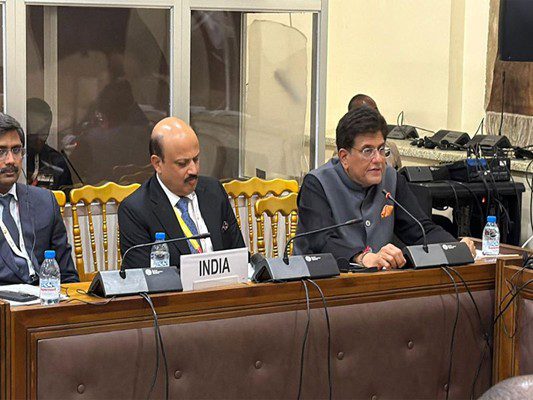
Welcome to this edition of the Intersect: India-Africa newsletter. Against the background of the US-Israel-Iran war, New Delhi is moving full steam ahead on deepening ties with African nations. Last week, EAM Jaishankar, in a consultative meeting in New Delhi, emphasised on New Delhi’s outreach to African countries, in trade and investment, grants, capacity building especially in education and skilling, in defence, and cooperation in regional and multilateral fora. This came barely days after Commerce Minister Piyush Goyal, in Cameroon for a WTO ministerial in Yaoundé, took the moment to consolidate ties with the Africa Group, using the WTO stage to signal alignment with African interests.
Developments this year alone show the way. A government railway company will build a foreign ministry’s digital infrastructure. A frozen energy project with Indian state money locked inside came back to life. An African insurance giant announced it expects to make more money in India than at home.
The India–Africa relationship has long operated quietly in a landscape overshadowed by China’s infrastructure juggernaut and West’s development finance architecture. But in 2026, that story has been changing in ways concrete and consequential.
Three developments capture the deep texture of this shift.
- A state-owned Indian railway company won its first African contract – a data centre for Ethiopia, part of the broader thrust on exporting India’s digital public infrastructure.
- A $20bn liquefied natural gas (LNG) project in Mozambique – five years in cold storage – has been revived, in which three Indian PSUs hold a 30% stake.
- Africa’s largest insurer, South Africa’s Sanlam, noted that India could overtake its home market as its biggest earnings engine within a decade.
Taken together, it is clear the India-Africa relationship is entering a more operational phase of deals, data centres, and dividends. Dive in to understand what’s happening.
1. Small Deals, Big Signals
What Happened?
In January 2026, Indian Railways’ Navratna PSU, RailTel Corporation of India Ltd, was awarded a contract to build a greenfield data centre in Addis Ababa for Ethiopia’s foreign affairs ministry.
The project, worth around Rs 19.84cr (approx $2.2mn), part of MEA’s support for Digital Ethiopia Strategy, will see RailTl complete construction within a year, followed by three years of operation and maintenance support. The data centre will be housed in Ethiopia’s foreign ministry.
Why It Matters?
The financial value of this contract may appear modest, but what it represents is anything but. RailTel, a stat-held telco infrastructure provider, whose core business is managing fibre optic networks along Indian railway lines, winning ICT contracts in Africa is far-reaching as part of New Delhi’s strategy to internationalise homegrown DPI (digital public infrastructure).
This follows the pattern established by India’s UPI payments system, Aadhaar identity stack and MOSIP digital identity platform, all of which built for domestic use, now being adopted or explored across Africa. As RailTel said, its strategy is to replicate India’s end-to-end digital transformation journey in emerging economies. The Ethiopia data centre is the latest building block in that architecture.
The geopolitical context matters too. Ethiopia hosts the African Union Commission, making it a central node in continental diplomacy. The project is also a statement about digital standards and sovereign cloud platforms African governments are choosing. At a time when Chinese tech companies dominate broadband and data infrastructure across much of the continent, India is quietly positioning itself as an alternative.
What to Look Out For?
RailTel has explicitly stated it is scouting for opportunities across Africa, the Caribbean and Southeast Asia. This Ethiopia contract, its first in Africa, is likely to be followed by others. Watch for MEA-backed mandates to other Indian PSUs in the digital infrastructure space. India may even opt for a broader DPI for Africa initiative ahead of the India–Africa Forum Summit expected in 2026.
2. India’s 30 Per Cent Stake in Mozambique’s LNG
What Happened?
Weeks before the US-Israel-Iran war disrupted oil and gas supplies from west Asia, on January 29, 2026, TotalEnergies CEO Patrick Pouyanné and Mozambican President Daniel Chapo announced the full restart of Mozambique’s LNG project – a $20bn development frozen since April 2021 when Islamic State-linked insurgents attacked the town of Palma in Cabo Delgado province, forcing a force majeure declaration.
Construction has now resumed both onshore and offshore, with over 4,000 workers mobilised on site. First LNG production is expected in 2029. The consortium includes TotalEnergies (26.5%, operator), Japan’s Mitsui (20%), Mozambique’s state-owned ENH (15%), Thailand’s PTTEP (8.5%), and, critically, three Indian PSUs: ONGC Videsh (10%), Bharat Petroleum (10%), and Oil India (10%). India’s combined 30% stake makes it the second-largest national bloc in the project after France.
Why It Matters?
The West Asia war has made it abundantly evident that, for India, that imports over half its natural gas needs, widening its sources of supply is more than necessary. Mozambique’s Rovuma Basin holds around 75 trillion cubic feet of recoverable gas, roughly a 120-year supply at initial production rates of 12.88 million tonnes per year. It’s a strategic hedge for India against supply concentration in the Persian Gulf and the crippling chokepoint of Strait of Hormuz.
The geography is compelling. Mozambique, off India’s west coast, is a three-day voyage, compared to longer routes from the Gulf or Americas. India has multiple LNG terminals. When production begins in 2029, this project will no doubt shift India’s gas import geography, as it also becomes a cornerstone of Mozambique’s sovereign wealth and export economy. The Mozambique LNG Foundation, announced in 2023 with a budget of $200mn, has already supported 7,000 farmers and fishermen in Cabo Delgado province.
For Africa watchers, this restart is also an understanding of how large-scale resource investment in conflict-affected zones can be sustainably managed. The Rwandan troops and SADC forces that helped stabilise Cabo Delgado are a reminder that regional security cooperation, beyond bilateral energy deals, underpins this project’s viability.
Look Out For
ExxonMobil’s adjacent Rovuma Venture – an even larger 18 MTPA facility – is expected to reach investment decisions later this year. If that proceeds, Mozambique’s LNG sector could attract a second wave of Indian participation. India’s engagement with Mozambique could also expand beyond energy into infrastructure, digital connectivity, and local content manufacturing that Mozambique’s government is prioritising.
3. Africa’s Biggest Insurer Bets India Will Overtake South Africa as Its Top Earner
What Happened?
On March 12, 2026, Abigail Mukhuba Sanlam, CFO of Africa’s largest insurance and financial services group, headquartered in Cape Town, made a striking admission: India could surpass South Africa as the group’s largest single contributor to earnings within the next decade.
India already accounts for 10-15% of Sanlam’s earnings. This is driven primarily by its growing stake in the Shriram Finance ecosystem – a vast Indian credit and insurance conglomerate serving truck drivers, small businesses and rural borrowers. By early 2026, Sanlam’s effective holdings in Shriram General Insurance and Shriram Life Insurance had exceeded 50%.
Why It Matters?
The Sanlam story inverts the conventional India-Africa narrative – of Indian companies investing in Africa pharmaceuticals, infrastructure, IT. Here’s a major African financial institution making India its primary growth vector, placing a multi-billion rand bet on Indian households, credit markets, and insurance penetration. Africa is investing in India – at scale.
The context is significant. South Africa is a mature insurance market with high penetration rates. India has over a billion people with low insurance coverage, a fast-growing middle class, and an increasingly formalised economy. The Shriram ecosystem which spans credit, insurance, wealth management, and broking gives Sanlam a ready-made distribution network reaching deep into India’s non-metro economy. This matters for the India-Africa relationship because it normalises the idea of African capital as commercial investment.
Look Out For
Will other pan-African financial institutions Old Mutual, Stanbic, Absa follow Sanlam into India’s financial services sector. More broadly, could Sanlam’s India strategy become a template for African capital seeking growth outside the continent? Mitsubishi UFJ Financial Group has already made a strategic capital injection into Shriram Finance, suggesting that Sanlam is not alone in recognising the opportunity.
4. WTO Stage, Vibing With Africa
What Happened?
On March 29, 2026, commerce minister Piyush Goyal met with ministers and ambassadors of the Africa Group on the sidelines of the 14th WTO Ministerial Conference (MC14) in Yaoundé, Cameroon. Their meeting focused on deepening trade and investment ties. Goyal described the discussions as covering new pathways to expand India’s investments in Africa. He reaffirmed India’s support for African development. The talks also touched on alignment on the MC14 agenda, including common positions on food security, fisheries subsidies, and intellectual property issues.
The Cameroon venue was itself significant. It was the first time a WTO ministerial was held in Africa. Goyal made headlines by taking a solitary stand against the Investment Facilitation for Development (IFD) Agreement, refusing to support its incorporation into the WTO framework, on the grounds that it risked eroding the foundational principles of the institution.
Why It Matters?
The optics of MC14 were powerful for India. Engaging the Africa Group directly, and couching his IFD objection in the language of Gandhian principle – Goyal explicitly invoked Gandhi – India positioned itself as Africa’s fellow traveller in the struggle for a more equitable multilateral order.
It was not about vision. India-Africa bilateral trade surpassed $100bn in FY 2024-25, a 17% year-on-year increase. India has set an ambition to reach $200bn by 2030. The WTO engagement is part of a broader effort to remove non-tariff barriers to Indian exports in sub-Saharan markets. Nigeria, Ethiopia and Ghana have been identified as priority markets for trade facilitation. India’s Duty-Free Tariff Preference scheme already grants 98.2% tariff-free access to 38 African LDCs.
India’s IFD stand is more nuanced than it might appear. Many African nations share India’s concerns about rich-country investment facilitation frameworks that embed asymmetric obligations. By breaking ranks with the majority on this issue, India was arguably doing more to represent African interests, than the more diplomatically compliant messaging around trade solidarity.
Look Out For
The India-Africa Forum Summit (IAFS IV), the first since 2015, is expected to take place in 2026. The WTO meeting in Yaoundé can be viewed as a diplomatic warm-up. The summit is likely to produce concrete trade facilitation commitments, refreshed Lines of Credit framework, and new digital cooperation architecture – all of which cited as priorities in preparatory discussions.
5. Wait, What? Uganda Chimp Civil War Heats Up: Sticks, Stones, and Savage Squads in Kibale Forest Blood Feud
Forget human headlines- Uganda’s Kibale Forest is ground zero for the wildest “civil war” since Caesar vs. apes: rival chimp troops are duking it out with spears, stones, and sheer simian spite. It’s less Lord of the Flies, more Lord of the Fleas, with chimps turning the canopy into a furry fight club.
The Rivalries: Gang Warfare, Primate Edition
Alpha bully Jackson, the scar-faced boss of the Beach Troop, has been raiding Ngogo Troop turf like a caffeinated landlord. Real deal: Jackson’s crew wields sharpened sticks as spears—first documented in 2016 BBC footage—and they’ve speared bushbabies for snacks, but now it’s troop-on-troop terror. Last week, they ambushed a Ngogo patrol, chasing them 200 meters with rock barrages that sound like hail on a tin roof.
Ngogo’s defender, the grizzled Gus, isn’t backing down. His squad counters with “poop precision strikes” and branch-whips, reclaiming a prime fig tree hotspot. Eyewitness chimps (via hidden cams) report Gus howling, “This grove’s ours—you want it? Primate it!” Feuds trace to 1990s border skirmishes, escalating yearly—up to 20% of males die in these brawls, as per primatologist Dr. David Watts.
Fight Night Funnies: Kibale’s Greatest Hits
- Spear Shenanigans: Jackson’s goons jab at rivals from trees, missing 9/10 times but scoring epic slow-mo fails on video.
- Stone Age Siege: Ngogo hurls fist-sized rocks; one bonked a drone, sending rangers into hysterics.
- Chase Chaos: Patrols flee at 30km/h, screeching like bad brakes, tourists pay $500 for “authentic war tours” (safely distant).
Park wardens are chimp-wrangling with dart guns and banana bribes, but troops ignore “cease-vines.” “They’re smarter than some politicians,” jokes ranger Sarah Nakato. With tourism booming (war whoops > lion roars), Uganda mulls “Chimp Clash Safaris.”
Bottom line: In Kibale, it’s kill or be killed for figs and females. Humans? We’re just monkeys watching monkeys.
Check These Out
Recommended further readings on the topics covered this month:
- India, Africa and Critical Minerals: Towards a Green Energy Partnership CSEP Working Paper. A rigorous policy analysis of how India can build strategic mineral partnerships across Africa, with nine actionable pathways. Read here
- IAFS 2026: A Co-Development Inflection Point Observer Research Foundation. A sharp assessment of what the India–Africa Forum Summit needs to deliver to be more than a photo opportunity. Read here
- Why Africa Is Key to New Delhi’s Strategic Autonomy Foreign Policy Research Institute. Examines how Africa fits into India’s broader strategic calculus, from energy security to maritime routes. Read here
- Africa in 2026: Global Uncertainty Demands Regional Leadership Chatham House. A panoramic view of Africa’s geopolitical and economic landscape in 2026, contextualising the stories in this newsletter. Read here
- What Will Drive African Copper in 2026? The Africa Report. An essential primer on why the DRC and Zambia’s copper output is a global swing factor and why India’s mineral diplomacy is converging on this corridor. Read here
Conclusion
The four stories in this edition share a common thread: the India-Africa relationship is becoming less declaratory and more operational. They are the quieter evidence of a partnership slowly and durably being built deal by deal. With IAFS IV expected later this year, the question is whether India and Africa can translate this operational momentum into an institutional architecture worthy of the relationship’s true potential.
Thank you for taking the time to read our newsletter this month. Stay tuned for our next edition, where we will continue to explore the evolving India–Africa relationship.