

From framework to force multiplier: the real test of the EU–India defence pact
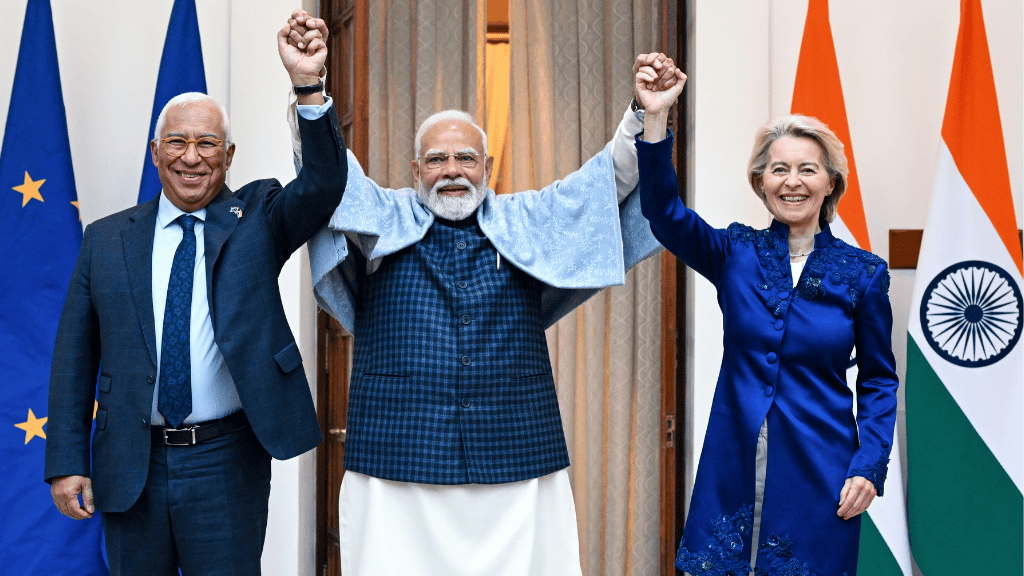
The signing of the EU–India Security and Defence Partnership at the January 26-27 2026 bilateral summit marks the formal consolidation of a security relationship that has long existed in practice but remained structurally underdeveloped. The agreement codifies a broad spectrum of cooperation spanning maritime security, cyber threats, counterterrorism, defence dialogue, industrial consultation, emerging technologies, multilateral coordination, and capacity building. It situates this cooperation within a shared commitment to the principles of the UN Charter, a rules-based international order, freedom of navigation, and strategic stability across the Indo-Pacific and Europe. Yet the pact is deliberately non-binding and non-prescriptive. It establishes mechanisms for dialogue and exchange rather than obligations for integration, reflecting political caution on both sides.
This design choice reveals a central tension. Operational cooperation between India and European navies, particularly in the western Indian Ocean, has matured into a high-trust, high-competence relationship. At the same time, institutional, industrial, and technological integration remains shallow. The pact formalises the architecture for interaction, but leaves unresolved whether cooperation will remain transactional or evolve into structural interdependence. The real test of the agreement will therefore not lie in its diplomatic symbolism, but in whether it catalyses a shift from episodic coordination to enduring strategic integration.
Operation Atalanta, the European Union Naval Force mission launched in December 2008 and continuing into early 2026, provides the clearest lens through which to examine this question. Atalanta represents both the most mature expression of EU–India operational cooperation and the clearest illustration of its structural limits. Conceived in response to a dramatic escalation of Somali piracy that threatened one of the world’s most critical maritime corridors, the mission initially focused on protecting vulnerable shipping, escorting humanitarian convoys, and deterring pirate activity in the Gulf of Aden and western Indian Ocean. Over time, it evolved into a more complex maritime security architecture incorporating surveillance, maritime domain awareness, intelligence sharing, capacity building, and coordination with parallel naval task forces.
The mission’s operational footprint has been sustained through rotational deployments of frigates, destroyers, maritime patrol aircraft, and logistics vessels contributed by EU member states. These deployments have been complemented by structured coordination mechanisms, most notably the Shared Awareness and Deconfliction framework, which enables participating navies to share operational information and align patrol patterns without formal integration of command structures. Atalanta’s longevity is not merely a function of persistent threat. It reflects the institutionalisation of a multinational naval presence that blends deterrence, reassurance, and cooperative security.
For India, the western Indian Ocean occupies a central place in strategic planning. Not connected to the launch of Atalanta, the Indian Navy had initiated independent anti-piracy patrols in the Gulf of Aden, driven by the vulnerability of India’s trade flows and energy imports to disruption along these sea lanes. This early engagement reflected a broader doctrinal shift in Indian naval strategy, which increasingly emphasised forward presence, sea lane security, and regional maritime stability. Formal interaction with European naval forces intensified after 2015, when structured joint exercises, coordinated patrol protocols, and information-sharing arrangements were established. These engagements produced a high degree of tactical interoperability, enabling Indian and European vessels to operate in proximity with shared situational awareness despite differing command chains, legal mandates, and political oversight.
Measured in operational terms, Atalanta has delivered tangible outcomes. Piracy incidents off the Somali coast declined sharply from their peak in the early 2010s. Insurance premiums stabilised. Shipping routes regained predictability. More broadly, the mission demonstrated that sustained multinational naval presence could suppress non-state maritime threats without escalating regional tensions. For India, participation reinforced its credentials as a net security provider in the Indian Ocean. For European navies, cooperation with India offered exposure to a capable regional partner possessing deep familiarity with local maritime dynamics and operating environments.
The newly signed Security and Defence Partnership explicitly acknowledges this record. It commits both sides to deepen maritime security cooperation, enhance operational coordination, conduct joint exercises and port calls, exchange maritime domain awareness information, and strengthen engagement between the Indian Navy and EU naval operations such as Atalanta and Aspides. It also identifies emerging maritime threats, including risks to critical submarine infrastructure, and calls for expanded cooperation in addressing them. These provisions consolidate existing practices and extend them across a broader threat spectrum.
Yet Atalanta also exposes the deeper structural limitations of EU–India defence cooperation. The mission has generated continuity, but not accumulation. Deployments are rotational, exercises episodic, and coordination mechanisms confined largely to the tactical level. Cooperation resets with each operational cycle rather than compounding into enduring institutional structures. There is no standing framework for joint planning, capability development, or integrated logistics. The relationship remains one of synchronised parallelism rather than fused integration.
This pattern extends well beyond maritime operations. Despite shared interests in maritime stability, freedom of navigation, and upholding international law, the broader defence relationship remains compartmentalised. The partnership establishes dialogues across multiple domains, including cyber security, counterterrorism, space security, non-proliferation, and emerging technologies. However, these dialogues are primarily consultative. They facilitate information exchange, policy coordination, and confidence building, but they do not commit either side to shared capability development or institutional convergence.
This structural shallowness is most evident in the defence industrial domain. Indian and European forces have demonstrated that they can operate together effectively at sea, share situational awareness, and deconflict operations across congested maritime spaces. These achievements require substantial trust in each other’s command-and-control systems, professional standards, and rules of engagement. In effect, the trust deficit that often constrains defence cooperation has been largely overcome at the operational level. Yet this trust has not migrated into the industrial ecosystem.
India continues to acquire advanced platforms and subsystems from European suppliers through conventional procurement arrangements. These transactions are typically structured as government-to-government deals or commercial sales, supplemented by offset obligations intended to generate local economic activity. While such arrangements may deliver short-term industrial benefits, they do not embed Indian firms within European defence supply chains in a manner that creates mutual dependency or long-term integration. Design authority, intellectual property(IP) ownership, and control over high-value subsystems remain concentrated within European primes. Indian entities are often relegated to assembly, component manufacture, or maintenance roles.
From the European perspective, India remains primarily a market rather than a strategic production partner. European firms prioritise commercial certainty, IP protection, and technological advantage. The partnership reflects this posture. While it commits both sides to consult on defence initiatives and industry-related matters, and to explore India’s participation in relevant EU defence initiatives, it does so within existing legal and regulatory frameworks. There is no indication of a willingness to recalibrate export controls, technology transfer regimes, or industrial licensing practices to facilitate deeper integration.
This approach increasingly sits at odds with Europe’s own strategic imperatives. Defence production has emerged as a central constraint on European military readiness. In response to heightened security threats across Europe’s eastern and southern neighbourhoods, EU member states have sharply increased defence spending. Yet output has not scaled proportionately. Production lines remain constrained by shortages of skilled labour, long lead times for critical components, and supply-chain dependencies exposed during the COVID-19 pandemic and exacerbated by sanctions regimes and geopolitical fragmentation.
Europe’s defence industrial base is technologically sophisticated but structurally fragile. It is optimised for efficiency rather than surge capacity. Supply chains are geographically concentrated, with many critical inputs sourced from a narrow supplier base. Market fragmentation, driven by parallel national programmes and limited standardisation, further constrains scalability. While initiatives such as Permanent Structured Cooperation and the European Defence Fund aim to address these challenges, progress has been incremental and uneven.
India presents a contrasting industrial profile. It possesses a large engineering workforce, expanding manufacturing capacity, and a political commitment to defence industrialisation under its self-reliance agenda. Over the past decade, India has progressively tightened restrictions on defence imports, expanded domestic procurement mandates, and restructured its defence public sector to encourage private sector participation. These reforms have increased domestic production of armoured vehicles, artillery systems, naval platforms, and selected aerospace components. Defence exports, while modest relative to major exporters, have grown steadily.
India’s objective is not autarky but strategic autonomy, which in this context practically means the ability to sustain critical military capabilities without excessive external dependence. Yet the ambition to move from buyer and licence producer to full-spectrum Original Equipment Manufacturer(OEM) faces structural constraints. Advanced propulsion systems, high-end sensors, electronic warfare suites, and next-generation materials require sustained investment, long development cycles, and access to global knowledge networks. In these domains, partnerships with technologically mature defence industries are not optional but essential.
Joint Research and Development(R&D) programmes, shared testing infrastructure, and co-ownership of IP could accelerate India’s learning curve while distributing financial and technological risk. However, such arrangements require a level of trust and regulatory flexibility that goes beyond traditional buyer-seller relationships. They also demand adjustments to export control regimes, technology transfer policies, and data protection frameworks, areas where progress has been uneven.
European firms have often been cautious, citing concerns over IP protection, regulatory predictability, and the commercial viability of long-term partnerships in India. India, in turn, remains wary of arrangements that replicate historical dependency patterns under the guise of collaboration. The result has been a proliferation of limited-scope joint ventures and offset-driven partnerships that deliver incremental gains without altering the underlying structure of the relationship.
This dynamic is evident in existing case studies. The Dassault Reliance Aerospace joint venture, established in 2017 as part of offset obligations linked to India’s Rafale acquisition, was intended to integrate Indian manufacturing into Dassault’s global supply chain. While the venture has produced components and contributed to skill development, its scope remains limited. Design authority and high-value subsystems remain firmly in France, and the venture’s role in future platform development remains uncertain.
More ambitiously, Project 75I which is to supply the Indian Navy with advanced diesel-electric submarines, involves Indian state owned Mazagaon Dock and Germany’s ThyssenKrupp Marine Systems under technology-transfer obligations. Valued at approximately $7–8bn, it reflects both the technological complexity of the platforms and the depth of knowledge transfer required. Yet its slow progress underscores the difficulty of negotiating technology transfer terms that reconcile India’s autonomy objectives with European commercial and security concerns.
Crucially, such projects remain exceptions rather than templates. They are driven by specific operational requirements rather than embedded within a broader strategic vision of industrial integration. Without institutional mechanisms to replicate these models across multiple domains, their systemic impact remains limited.
The Security and Defence Partnership gestures towards addressing these constraints. It includes provisions on defence industry dialogue, cooperation on emerging and disruptive technologies, and exploration of India’s participation in EU defence initiatives. It also emphasises supply chain resilience, reflecting growing awareness of industrial vulnerability. However, these commitments are framed as consultations and explorations rather than as binding pathways towards integration.
This reflects a deeper strategic ambivalence. On one hand, both sides recognise the benefits of closer cooperation. On the other, both remain cautious about the political, regulatory, and strategic implications of deep integration. The result is a partnership that is dense in dialogue but thin in commitment.
Beyond industry, this pattern extends to emerging technology domains. The agreement highlights Artificial Intelligence(AI), cyber security, hybrid threats, space security, and critical infrastructure protection as priority areas. It commits both sides to deepen dialogue, exchange best practices, and coordinate positions in multilateral forums. Yet here too, cooperation remains largely consultative. Joint development, shared platforms, and integrated operational concepts remain aspirational rather than institutionalised.
This is particularly consequential in the maritime domain. Modern maritime security increasingly depends on integrated sensor networks, real-time data fusion, autonomous systems, and space-based surveillance. Atalanta has demonstrated the operational value of information sharing and coordinated response, but it has not catalysed joint development of the enabling technologies that underpin these capabilities. The partnership creates space for such collaboration, but it does not mandate it.
The broader geopolitical environment adds urgency to this dilemma. The Indo-Pacific and Europe are increasingly interconnected in strategic terms. Maritime security in the Indian Ocean, stability in the Red Sea, and freedom of navigation across key chokepoints are no longer regional concerns. They directly affect European economic and energy security, just as European strategic posture increasingly shapes the balance of power in Asia. The partnership acknowledges this interdependence, explicitly linking European security to developments in the Indo-Pacific and vice versa.
In this context, the ability to pool industrial capacity, technological expertise, and operational capabilities becomes a strategic multiplier. For India, deeper integration with European defence industries would diversify partnerships, reduce overreliance on any single supplier, and reinforce its role as a central node in regional security architectures. For Europe, partnership with India would extend strategic reach into the Indo-Pacific while mitigating industrial constraints at home.
Yet translating this logic into policy requires overcoming entrenched institutional habits. Defence cooperation has traditionally been framed in transactional terms such as procurement, offsets, exercises, and dialogue. Structural integration, by contrast, demands a reconceptualisation of partnership. It requires viewing industrial interdependence, shared capability development, and joint production not as risks to be hedged, but as strategic assets to be cultivated.
Operation Atalanta underscores both the feasibility and the limitations of this transformation. It shows that sustained operational cooperation is possible, effective, and mutually beneficial. It also shows how easily such cooperation can remain compartmentalised, failing to generate enduring institutional or industrial integration. The partnership now signed provides the scaffolding to move beyond this pattern, but it does not compel that movement.
Whether the EU–India defence relationship evolves from managed convergence to genuine strategic integration will depend on decisions taken outside the text. Export control reform, industrial policy alignment, joint research funding, co-development frameworks, and long-term production planning will determine whether cooperation accumulates or merely recurs.
In this sense, the pact represents a necessary but insufficient condition for transformation. It formalises political intent, institutionalises dialogue, and legitimises deeper engagement. What it does not do is resolve the structural contradictions that have historically constrained EU–India defence cooperation.
The operational trust built at sea must now be translated into institutional trust at the grassroots level in factories, laboratories, design facilities, and strategic planning cells. Without this shift, the partnership risks becoming an exercise in managed expectations, offering reassurance without resilience, symbolism without substance.
The stakes extend beyond bilateral relations. In a more contested international system, the ability of democratic, like minded actors to pool resources and capabilities will shape the balance of power. Maritime security, defence supply chain resilience, and technological leadership are no longer separate arenas. They are interconnected theatres of strategic competition.
The EU–India Security and Defence Partnership has set the frame. Whether it becomes a force multiplier or remains a diplomatic artefact will depend on whether both sides are willing to confront the political, regulatory, and strategic costs of genuine integration. Operation Atalanta shows what is possible. The challenge now is to ensure that its lessons are institutionalised, not merely commemorated.
Note :- Source for the image: European Union