1. The Context
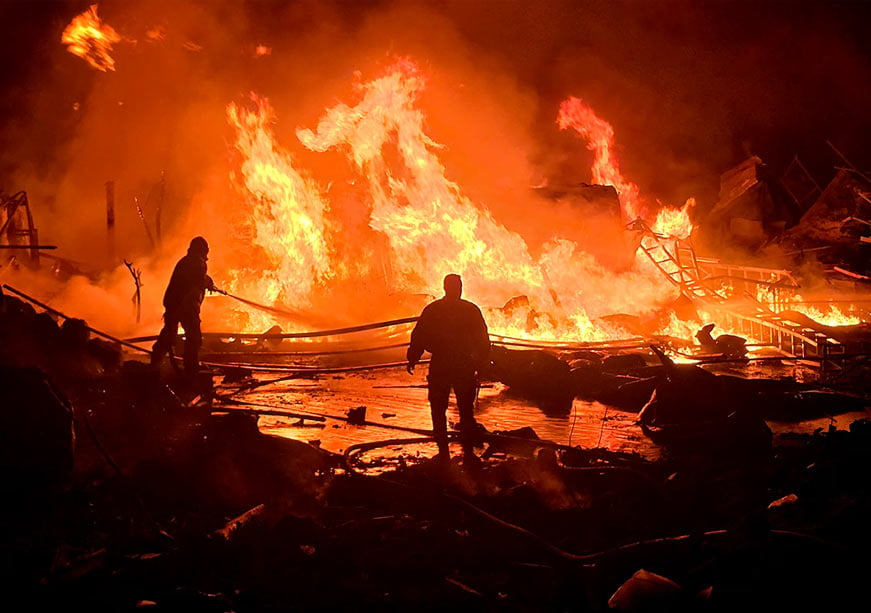
As we near the completion of the nineth month of US-Israel-Iran hostilities, the scope of the conflict appears to be shifting from kinetic action to economic attrition. The White House seems to have learned the hard way that military dominance over Iran does not automatically manifest itself in either regime change or capitulation, and Tehran still retains sufficient firepower to harm Israel and the US allies in the region. As the midterm poll debacle has demonstrated, growing popular unease over the prolonged Iran war has had adverse political consequences for President Trump, his Republican Party and the MAGA support base. Similarly, recent Knesset elections have delivered a serious blow to Israeli Prime Minister Netanyahu, an Iran hawk, who is currently fighting to retain his two decades of primacy over Israeli politics. Further, the negative fallout of the nine months of hostilities has convinced the pro-US Gulf states that a further bout of war would harm their well-being. Accordingly, they have urged the US to avoid military action against Iran. They have also sought to diversify their defence alliances to reduce their dependence on the US security umbrella. These anti-war factors, coupled with a continued stalemate in negotiations due to a lack of trust, fundamental differences in positions, and sequencing, have created a veritable impasse that has defied mediation by Qatar, Pakistan and others.
2. Current US Economic Offensive
Thus, the dynamics of the US strategy against Iran have recently been transformed: from a shooting war interspersed with negotiation to an outright attempt at economic strangulation. While Iran has been under increasingly stringent economic sanctions under the “maximum pressure” doctrine unveiled in 2018, on August 20, 2026, Washington launched its “Operation Economic Outcast”, imposing a strict maritime blockade on Iran. This has prevented the export of Iranian hydrocarbons, Tehran’s main source of revenue, as well as imports of most goods by sea. This trade embargo denies vital national requirements by physical means, as well as by the erosion of its paying capacity due to diminished oil income. In addition, the US has recently also imposed a ban on civilian air traffic and unveiled the “Iron-Gate” regime to monitor and cut down trade across Iran’s land borders. In a social media post on November 12, President Trump said, “We don’t need a deal with Iran. Those days have long since passed…” He implied that as the US maritime blockade and economic sanctions were working, neither a military escalation nor diplomacy is needed. He publicly directed his vice president, who has been engaged in the revival of the peace process with Iran, to focus “his complete and total attention” on domestic issues.
3. Iranian Economic Responses
Behind its calm exterior and continuing braggadocio, Iran realises the seriousness of the challenge posed by the new US strategy of economic strangulation over time. Iranian leadership has made progressively bellicose statements about the maritime embargo being an act of war and asserted Iran’s determination to foil it. It has responded to this blockade through an economic strategy comprising offensive as well as defensive components. Taking an offensive approach, Iranian supreme leader Mujtaba Khamenei has repeatedly called upon the country’s authorities to end the “No-Peace, No-War” situation by all possible means. In a statement on October 31, he ordered the country’s armed forces to respond immediately to any enemy threat and without “geographic limits.” He also asserted that Iran would determine the timing and conditions for ending any renewed military or “terrorist attacks by its enemies”. He also ordered an update of the military target list to bring US and Israeli “physical and non-physical” assets within the reach of Iranian forces. It has strengthened its own blockade on passage through the Strait of Hormuz. A record number of 35 ships have been attacked in October for trying to flout the self-imposed Iranian blockade (see Graphics annexed). There are uncorroborated reports about Iran informally collecting tolls from ships “permitted” to cross the Strait of Hormuz. Iran also hopes that the high energy inflation in the US and the West would force their governments to be less aggressive toward Iran. Further, declining oil prices and higher outflow on insurance and freight would reduce the revenues of the Gulf oil exporters, making them more interested in calming the troubled waters.
On the defensive side, Iran has sought to intensify its trade with neighbouring countries. Iran has land borders with 7 countries[1] that are all still open. Moreover, despite bilateral tensions, some of the traditional dhow-based informal commerce across the Gulf waters also continues[2]. Trade contacts with Russia across the Caspian Sea and with China by land and air routes are being ramped up. Moreover, a vigorous import substitution drive is being undertaken. Some Iranian oil is reportedly being smuggled through the US maritime blockade either as a proxy or after blending with other oil cargoes. Rising use of the so-called Cryptocurrencies to defy financial sanctions is also rumoured.
4. Impact on Iran
While such exchanges can partially mitigate the impact of the maritime blockade, the country’s economy has suffered palpably. Annual inflation is currently at over 90%, and the value of the rial, the national currency, has plummeted to 2.5 million to a US Dollar from 811,000 a year ago. At a macroeconomic level, the next year’s budget is likely to reflect the economic stringency. While the US hopes that the economic penury would result in public disaffection against the Mullahs’ regime, break the national will and make it more amenable to the US conditions for settlement, so far there is little sign of this happening.
5.Statistical Analysis for Regional Economy:
With enhanced focus on economic survival and recovery, the IMF’s Regional Economic Outlook (REO) for the Middle East, North Africa, Afghanistan and Pakistan (MENAP)[3] published in October 2026, acquires added relevance and significance. Its authentic socio-economic data and projections are largely factual and non-political, even as its byline, “Steering through uncertainty: Strengthening Resilience through Challenging Times”, suggests the arduous task ahead. The data contained therein offers the following main takeaways for the MENA region, which largely coincides with WANA for us:
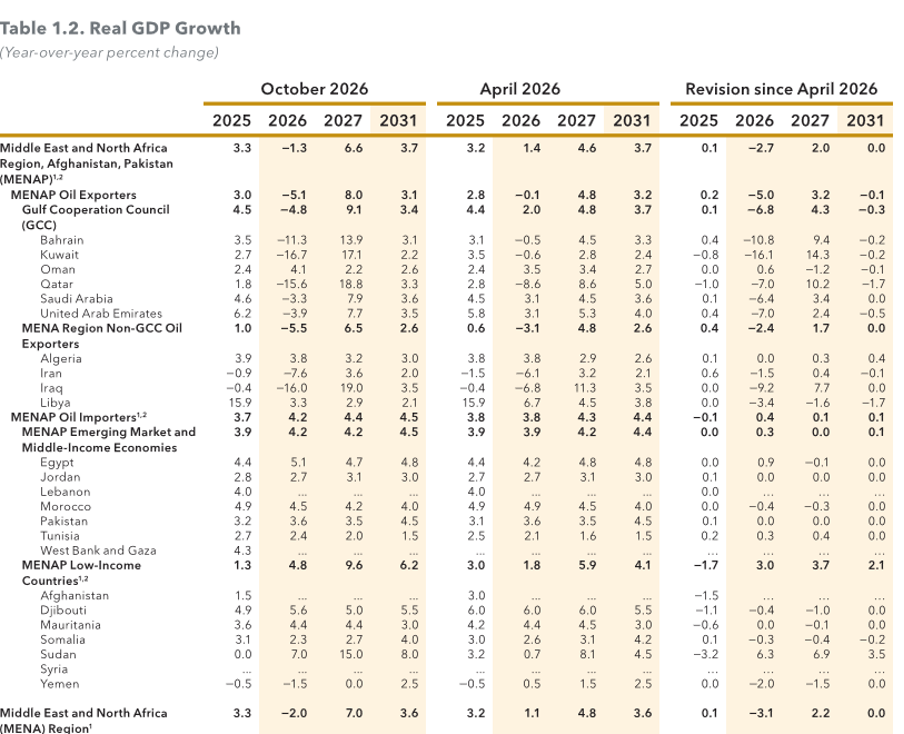
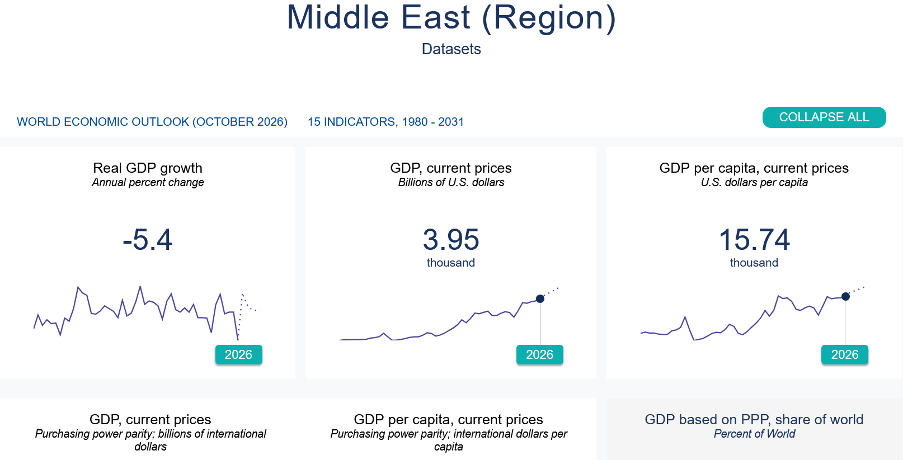
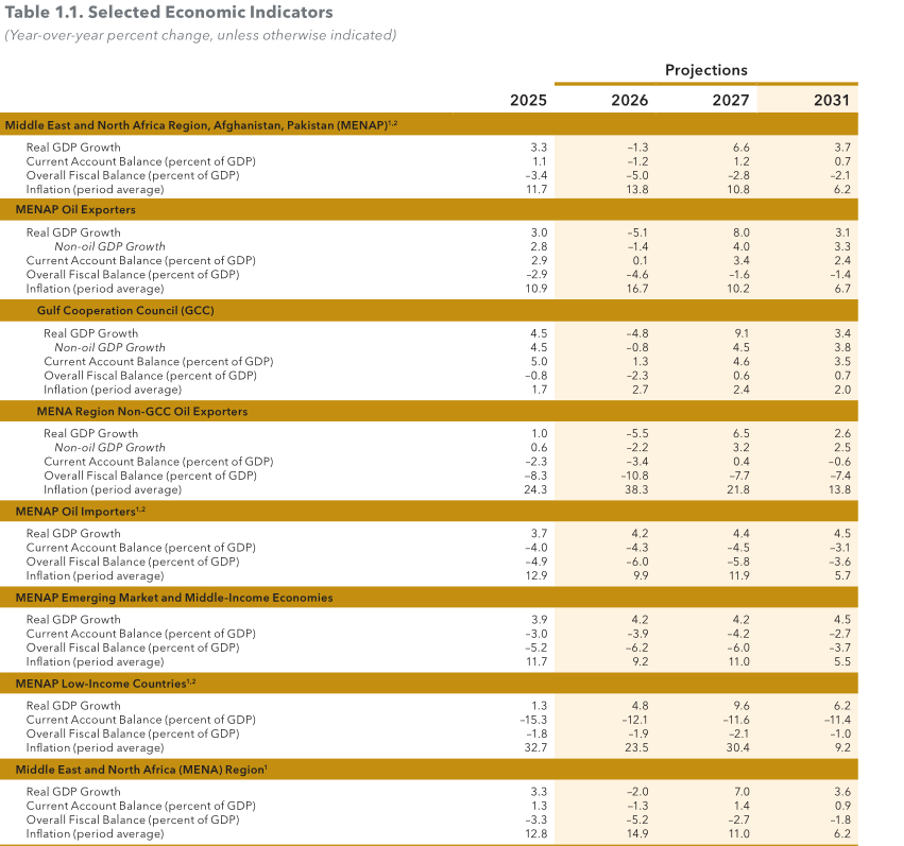
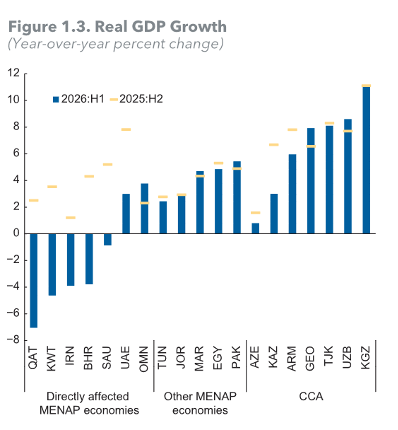
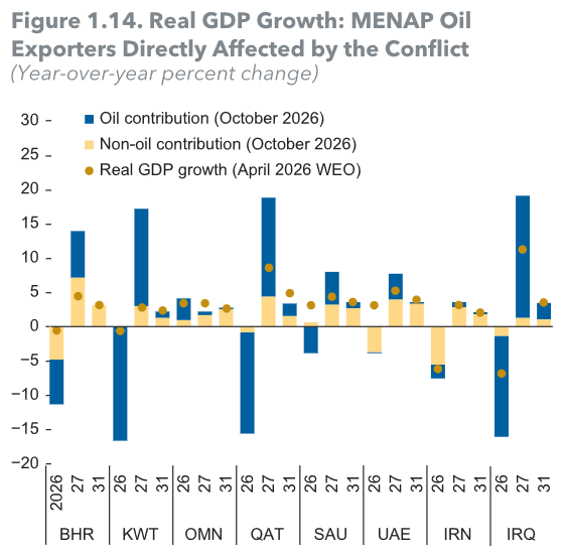
(a) Overall National Economic Performance: As Annex A and Annex B below show, MENA region economies grew by 3.3% in 2025, but are expected to contract by (-)2.0% in 2026, following which growth rates of 7.0% in 2027 and 3.6% in 2031 are projected as of October REO. Economies of all Gulf oil exporters except Oman are expected to contract, with Kuwait (-16.7%), Iraq (-16.0%), Qatar (-15.6%), and Bahrain (-11.3%) recording double-digit degrowth. Thanks to its diversified economy, large population and lower base effect, despite being at war, Iran is to suffer a relatively mild (-)7.6% decline in 2026, followed by growth of +3.6% and +2.0% in 2027 and 2031, respectively. Oman, with major ports outside the Strait of Hormuz, is expected to grow by +4.1%. While the IMF REO predicts a sharp economic turnaround for the region and the individual countries, this presumes an early end to the hostilities and blockades, which is by no means a certainty. Interestingly, the Pakistani economy is expected to grow at an annual rate between 3.2% and 4.5%. In particular, Annex B provides 9 datasets illustrating the performance of the Middle East Region along various macroeconomic indicators.
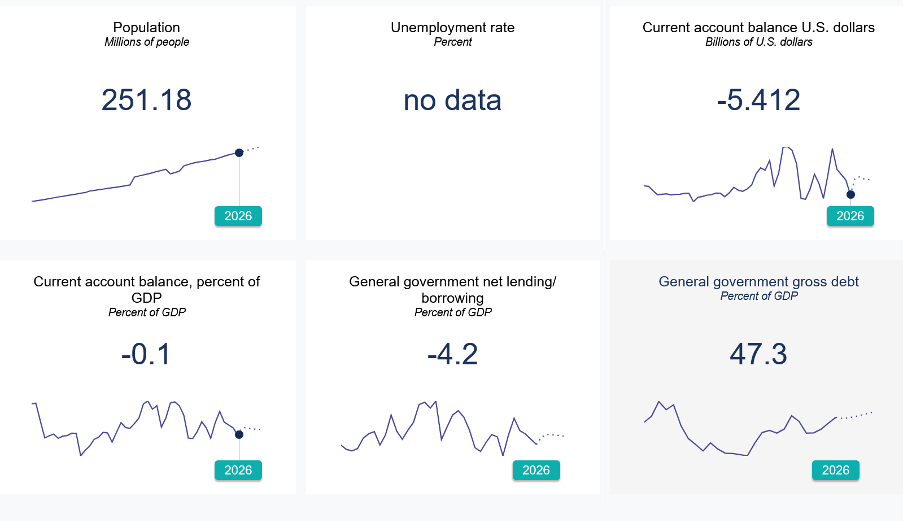
(b) Overall Regional Economic Indicators are provided in Annex C, Annex D1 and Annex D2 below. Having already discussed the GDP growth in the previous paragraph, we note that the region has suffered a sharp deterioration in twin deficits and inflation, and the recovery is likely to be mixed: inflation is likely to remain elevated, and the twin balances would stage an anaemic recovery. Within the MENAP region, the subregional performances also remain subject to geopolitical factors. In particular, the Report’s projections about the GCC economies seem a bit too optimistic in view of the economic attrition currently underway and continuing al-Houthi attacks on Saudi Arabia.
6. Oil Factor:
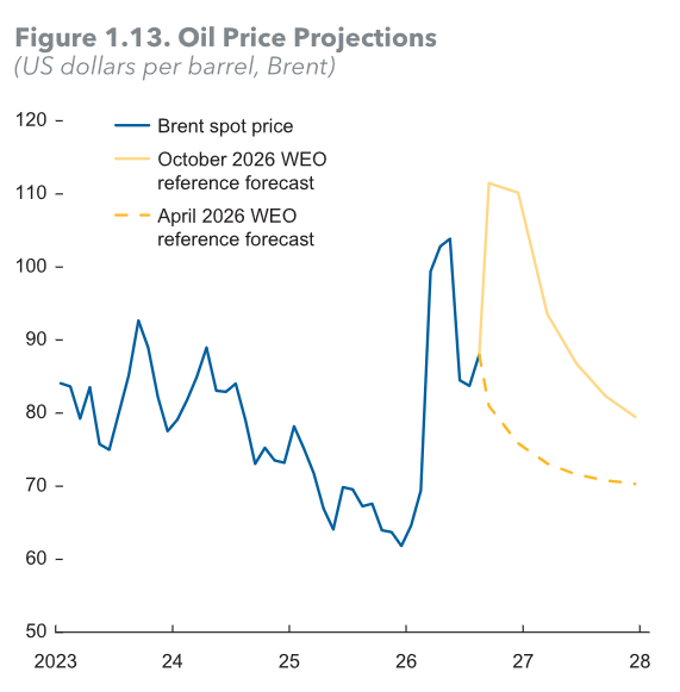
Nearly all the WANA economies currently depend on the hydrocarbon sector, either directly as exporters or indirectly through ODA, remittances, trade, investment and tourism. Over the past three years, conflicts and blockades at the twin choke points of the Strait of Hormuz and Bab al-Mandeb have frequently disrupted this sector. While volumes have suffered, prices have risen, even as insurance and freight costs have increased manyfold. Annexes E to H2 provide some insights into this sector. However, in its latest monthly report[4] released on November 13, 2026, the International Energy Agency said that the world oil market will return to a 1.7 mbpd surplus in the fourth quarter of this year, as Middle East exports recover faster than global oil demand despite continued attacks on shipping. If that projection is realised, the economic wheel would have turned full circle, and the hapless oil and gas consumers could afford a well-deserved sigh of relief – at least till the WANA is on boil all over again!
[1] These land neighbours are: Iraq (longest land border at ~1,599 km, bilateral trade: $10 bn to $12.5 bn), Turkey (~534 km; $7 bn), Azerbaijan (~611 km; $644 mn), Armenia (~44 km; $737 mn), Turkmenistan (~1,148 km; $3 bn), Afghanistan (~921 km; $2.7 bn to $4.0 bn), and Pakistan (~909 km; $2.8 bn). Iran-Russia trade across the Caspian Sea is estimated at $5.8 bn in 2025. Iran has a positive trade balance with most of these countries. The recent US economic measures against Iran are likely to lead to a surge in trade with them. Separately, China, which till the War bought up to 90% of Iran’s crude exports, was Iran’s largest trading partner, with official bilateral trade estimated to range between $10 bn to $13 bn.
[2] At its peak, such informal trade between the UAE and Iran was estimated to be around $18 billion annually.
[3] A caution about regions referenced in the IMF report is advised: The report uses four terms, often in a concentric manner. First is the “Middle East”, which refers roughly to West Asia; Second is Middle East and North Africa (MENA), which largely coincides with WANA in our parlance; Third is Middle East, North Africa, Afghanistan and Pakistan (MENAP); Lastly, sometimes the Caucasus and Central Asia (CCA) has also been added to the data. A point to be noted here is that the IMF does not include Israel in the MENAP region.
[4] For details, please see: https://www.reuters.com/business/energy/world-oil-market-is-returning-surplus-gulf-exports-recover-iea-says-2026-11-13
Annexures
Annex A
Annex B
Annex C
Annex D 1
Annex D 2
Annex E
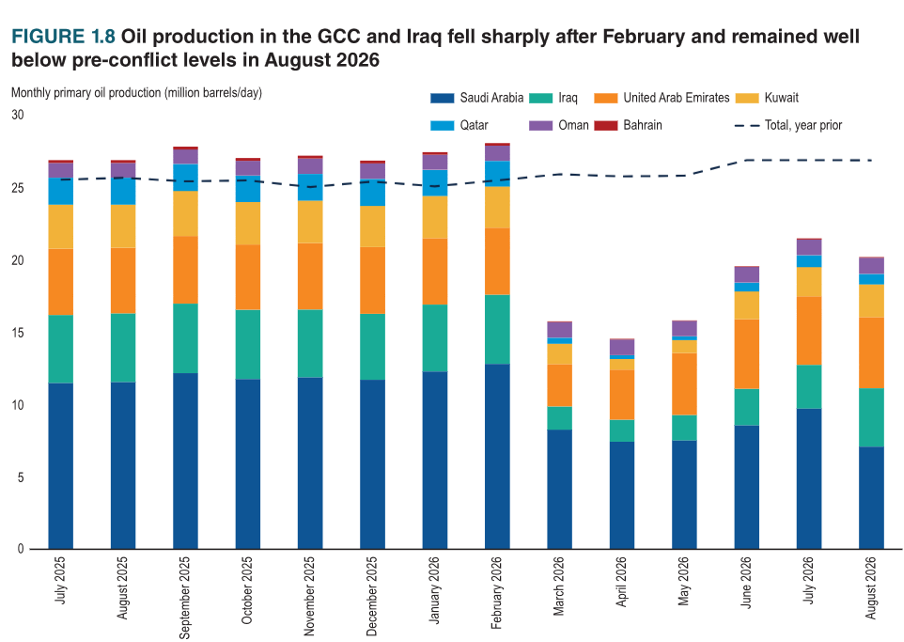
Annex F
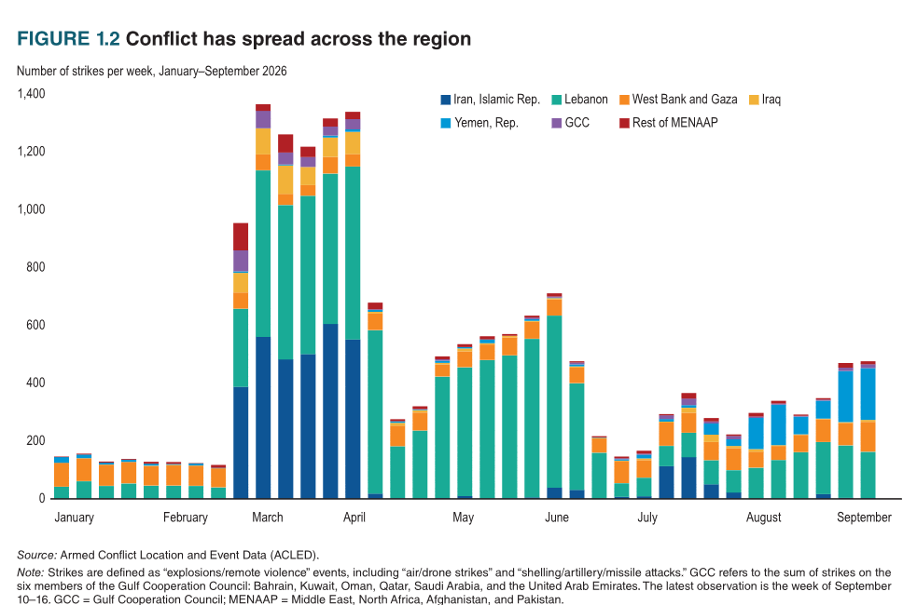
Annex G
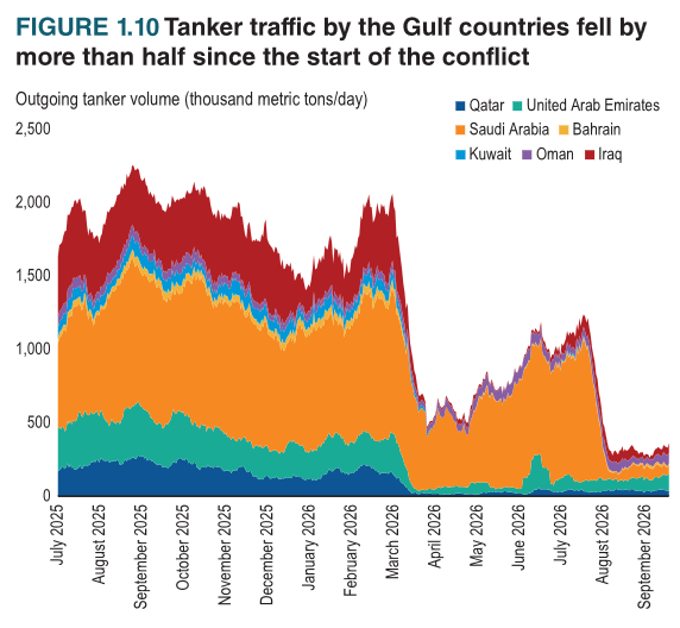
Annex H 1
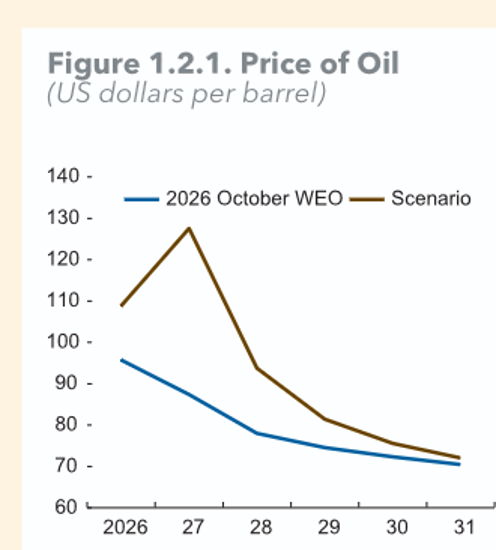
Annex H 2
The previous issue of US Troop Withdrawal: Back to Iraq’s Future? are available here
