
While the recent surge in fighting between the forces of Iran-supported Ansar Allah and the Saudi-backed coalition has its own drivers and motivations, the origin of this conflict can be traced back nearly a century, to 1934, to be precise. In this paper, we try to provide the historical, political and ethno-sectarian background to the evolving situation.
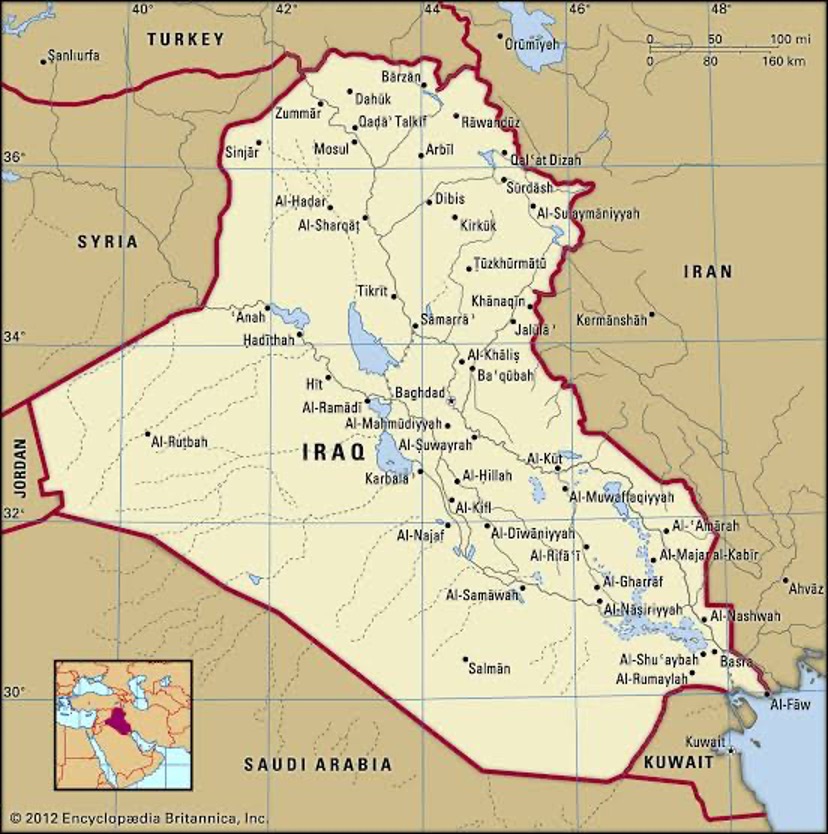
2. Geography
2.1 Basic Information: Iraq is a mid-sized Arab country with an area of 438,317 sq kms (Reference Map above) and a population of 46 million. Its neighbours are Iran, Turkey, Syria, Jordan, Saudi Arabia and Kuwait. It has a 58 km shoreline at the northern end of the Persian Gulf. Over 90% of Iraqis are Muslims, and among them 61% are Shias and most of the rest are Sunnis. About a tenth of Iraqis are non-Muslims belonging to faiths such as Christians, Mandaeans, Yazidis, etc. Ethnically, 75% of Iraqis are Arabs, nearly 20% Kurds, and the rest are of other stock. Kurdistan Regional Government has a high degree of autonomy within Iraq’s federal constitution, under which the President is always a Kurd and the Prime Minister a Shia Muslim.
2.2 The History: Iraq (earlier called Mesopotamia) has nearly seven millennia of history and is regarded as one of the cradles of civilisations centred around the Tigris and Euphrates rivers. In particular, the Babylonian and Abbasid Empires were based in Iraq. It has also been at the crossroads of civilisations and was an integral part of the Silk Route. In the modern era, it was part of the Ottoman Empire, after which an uneasy political arrangement between the Hashemite monarchy and Britain (which controlled oil resources and defence) ruled Iraq till 1958, when a coup overthrew the monarchy, and Iraq became a republic. The Arab Ba’ath Socialist Party came to power in 1968, with Saddam Hussein progressively accumulating power, first as Vice President and later as President (1980-2003). While his iron-fisted rule at home delivered stability and progress at home, his muscular regional misadventures, such as the invasions of Iran and Kuwait in 1980 and 1990, respectively, proved to be his undoing.
2.3 The Economy: Iraq is one of the few Arab countries blessed with both water and oil, although it has not fully leveraged them. It has the Tigris and Euphrates rivers flowing through it, giving it ample irrigation potential. Similarly, Iraq ranks third in the world behind Venezuela and Saudi Arabia in the amount of proved oil reserves, estimated at 143.1 billion barrels, which are mostly in the south near Basra and in the north in Kurdistan. The oil sector was nationalised in 1972, but during the past two decades several production sharing contracts have been signed with foreign oil majors, mostly from the US, China, Russia and France. Iraq currently produces approximately 3.3 mbpd to 3.7 mbpd, with exports of around 2.34 mbpd following severe disruptions caused by the closure of the Strait of Hormuz. Iraqi production level has stagnated since the 1980s, and the country has plans to raise production capacity to 6 mbpd. In fact, the Iraqi economy has suffered since 1980 due to wars, sanctions and domestic instability. Iraqi economy is highly reliant on oil exports. Its Nominal GDP in 2026 is estimated at $265 bn, having grown by 0.5% in 2025; The per capita GDP is $5,677, and the HDI is 0.712. The UNSC sanctions imposed in 1990 crimped the Iraqi economy, making it hobble along till the regime change through the US-led invasion (OIF) in March 2003 unseated him and his party’s rule. Since then, the economy has taken an uneven path, with oil prices, domestic and regional turbulence being the main determinants of its performance.
3. The Context
When taken together, the 8-year-long OIF and the 12-year-long OIR marked over two decades of the US and allied NATO forces’ presence in Iraq. OIF-OIR combination has been the longest-running war ever fought by the US. It resulted in the deaths of over 4,500 American troops, injuries to over 32,000 and expenses estimated at $2.89 trillion. Even though the US did not maintain any record of Iraqi casualties, these were estimated to be many times higher: over 2,00,000 civilian deaths, over a million displaced and massive damage to physical, security, economic and administrative infrastructure. Over a longer-term perspective, the US and allies launched Operation Desert Storm in January 1991 to liberate Kuwait from Iraqi occupation. Subsequently, very strict economic restrictions were imposed on Iraq through the UN Security Council resolutions, which continued till OIF in 2003. Thus, the US has had an adversarial relationship with Iraq for over 35 years, during which Iraq’s nominal per capita income plummeted from $10,261 in 1990 to $5,410 in 2025.
4. The OIF Aims and the Outcome:
4.1 Rationale for OIF: Pitching in for OIF in 2003, the American Neo-Conservatives (Neo-Cons) had argued that such a military overthrow would not only reform the autocratic Iraqi polity but also lead to positive changes in the entire Arab World. While Saddam Hussein’s dictatorship was toppled shortly afterwards, the country is far from a model state, and Iraqi statecraft has not undergone the expected improvement. As the US leaves Iraq now, the political, security and administrative structures it leaves behind are widely perceived as incompetent and corrupt. Notwithstanding the introduction of some semblance of democracy and respect for due process, most Iraqis are still dissatisfied with the current situation. They suffer high youth unemployment and scant trickle-down of the enormous oil revenues. Despite being OPEC’s second-largest oil producer, Iraq has shambolic infrastructure, particularly in the power sector.
4.2 Flawed Execution: Moreover, soon after the takeover, the US transitional authorities abruptly disbanded the long-standing Ba’ath Party administrative apparatus without putting alternative structures in place. This lacuna created a huge institutional void, which has been filled by the Muhasasa (sect-based quota) system that breeds nepotism. The simultaneous dismissal of armed forces, police and security apparatus left a huge number of mostly trained (and often also armed) mostly Sunni military and security personnel jobless and shorn of privileges they enjoyed in Saddam’s era. They became the underbelly of the crime world and various militant movements. This also created sectarian polarisation in traditionally secular Iraqi society. With Shia groups gaining ascendancy in Iraq, neighbouring Iran, with a Shia theocracy, began making deeper inroads in the country. There were two violent Sunni reactions. First, the Sunni extremist outfit al-Qaeda engaged in anti-American and anti-Shia militancy before being put down. Then, Daesh militancy erupted in 2014, proclaiming a new “Caliphate”, and within months was in control of a huge swath of territory spanning Iraq and Syria. It was widely seen as a reaction of disgruntled armed Sunni men to the preponderance of Shias in both countries. By early 2015, Daesh had militarily occupied nearly a third of Iraq and was within a whisker’s reach of Baghdad. The official Iraqi army was no match for Daesh Jihadis, and its cadres simply melted away. This situation alarmed the Baghdad authorities into seeking the US military’s return in 2015 to roll back Daesh. The US deployed experts and air force support. Similar help was sought from Iran and Kurdish militias in Iraq and Syria to provide infantry support. Iraq’s own Shia militias pooled their resources together as the Popular Mobilisation Forces (PMF, or Hashad Al-Shabi). This unlikely and unwieldy military coalition took nearly four years to defeat Daesh, and Iraq was finally able to declare victory over ISIS only in 2019, even as it still acknowledges the existence of some Daesh sleeper cells which continue to engage in sporadic terrorism. It took the US five more years to agree to its military quitting Iraq, and a bilateral agreement for phased withdrawal to be completed by September 30, 2026, was reached only in 2024. Unlike OIF, under which surged US military presence in Iraq to reach a high of 160,000 in 2007, OIR numbers were in the single-digit thousands, mostly confined to air force units.
5. The Reactions
The concerned stakeholders have marked the US troops’ final withdrawal from Erbil air base in Iraqi Kurdistan in various ways. Iraqi government has celebrated it as a 4-day public holiday for the Sovereignty Festival. The US President Trump called it a “Great Day for America”, describing the US military involvement in Iraq as a “very expensive excursion into Hell”, blaming his predecessors for a prolonged “quagmire.” Iranian Islamic Revolutionary Guard Corps issued a lengthy, rhetoric-laced statement congratulating the zealous Iraqi people, the unified Islamic Resistance Front and the revolutionary combatants of the Islamic world on this expulsion of America from Iraq, which was the result of their steadfastness for their independence. IRGC claimed that America left not through negotiation, not through favours, but through the determination of a nation that stood firm, the blood of mujahideen, foremost among whom it counted “martyred” Lieutenant General Qassem Soleimani, head of the IRGC’s Qods Force and Abu Mahdi al-Muhandis, Deputy Head of Hashd al-Shabi, killed in a US drone attack in January 2020. It went on to assert that America’s exit from Iraq is the prelude to its expulsion from all of West Asia and the geography of the Islamic Ummah. The non-official reactions in Iraq are largely along sectarian lines. The Shia armed militias have taken credit for booting out the American troops from the country, while Sunni and Kurdish politicians have expressed anxiety about the resurgence of Daesh, increased insecurity, particularly against drones and missiles and Iran gaining even greater influence in Iraq. Some observers pointed out that Iraqi sovereignty was still incomplete as the Turkish military bases persist in Iraqi Kurdistan. Further, there were reports in the US media about Israel maintaining at least two clandestine military bases in Iraq’s western desert as forward outposts against Iran. Moreover, despite the withdrawal, the US Central Command retained sufficient military capability based in neighbouring Turkey, Jordan and Kuwait for intervening in Iraq.
6. Continuation of the US Influence
Even after troop withdrawal, the United States have several means to pressurise Iraq. These include:
(i) Diplomatic Strong Arm: The US embassy in Baghdad is the world’s largest, with an area of 104 acres (42 ha), nearly as large as Vatican City. While its current strength of around 350 is a fraction of its peak strength of 16,000 in 2012, it still projects enormous power. For instance, earlier this year, following the parliamentary elections, the Shia majority’s Coordination Framework (CF) coalition wanted to appoint ex-PM Nouri al-Maliki as the new Prime Minister, but US President Trump rejected him publicly. The CF complied and instead appointed Ali al-Zaidi, a businessman without any political experience. At 41, he is the youngest Iraqi PM ever.
(ii) Oil revenue Choke: For over two decades, Iraq’s oil revenues have been routed through the Development Fund for Iraq (DFI) maintained by the New York Federal Reserve. This was ostensibly done to appropriate Iraqi oil revenues for reconstruction and development efforts as well as to protect them from lawsuits and claims relating to Saddam Hussein’s rule. Although Iraq now claims to be a sovereign state, this arrangement continues, giving the US a stranglehold on the country’s oil revenues, which constitute nearly 90% of government budgetary receipts.
(iii) Foreign Exchange Veto: In addition to DFI, a complex and opaque system allows the US Treasury to control access of Iraqi commercial banks and other financial institutions to foreign exchange. This instrument has been increasingly used to block Iraqi foreign exchange from being funnelled to Iran, subject to the most severe American economic sanctions. Interestingly, the current Iraqi PM’s own bank was blacklisted by the US Treasury in 2024 over alleged money laundering on behalf of Iran and Iranian-backed Iraqi Shia militias. It was conditionally reinstated in July this year. The limited ability of Iraqi banks to obtain US Dollars through daily auctions by the Central Bank of Iraq has also been stopped under US pressure.
(iv) Projects: During PM Ali al-Zaidi’s Washington visit in July 2026, the two sides finalised 48 commercial agreements and memoranda of understanding valued at over $60 billion. These included mega-projects in upstream and midstream hydrocarbons, power, agriculture and commerce. Separately, several American oil majors, including ExxonMobil, Chevron, Halliburton, HKN Energy, KBR and Baker Hughes, have lucrative contracts in an ambitious Iraqi program to raise output and lay pipelines. These projects, tied to Iraqi oil revenues through DFI, further cement Iraqi dependence on the US.
(v) Defence: Over the past 23 years, Iraqi defence forces have been trained and equipped by the United States. This has fostered a reliance, providing the Pentagon leverage over them. The US has hinted that despite its troop withdrawal, this partnership is likely to continue.
(vi) Demographics: Over 1,55,000 persons of Iraqi descent reside in the United States. Their profile is loaded in favour of Iraqi minorities (such as Chaldean/Assyrian Christians and Kurds) who have been given asylum. Other large segments are those who served as US military contractors or military interpreters during its occupation of the country. Over the past two decades, a large number of kith and kin of Iraqi nomenklatura have either been educated or settled in the US or maintain funds there.
7. Ties with India:
7.1 Although India and Iraq have been traditional friends and economic partners, their mutual domestic and regional preoccupations in recent decades have slowed them down. With the exception of the 2013 India visit by the then Iraqi PM Nouri al-Maliki, the two sides have not had any VVIP visit since 1975 when PM Indira Gandhi visited Iraq. Bilateral contracts at other levels have been ongoing. Bilateral trade was $27.51 billion in 2025-26. It was 9:1 in Iraq’s favour, due to imports of a large amount of Iraqi crude (Indian Exports: $2.96 bn; India’s Imports: $24.55 bn). Indian exports are dominated by rice, cereals, meat products, pharmaceuticals, iron and steel, ceramics and tea. Despite a 14.5% decline in trade over the previous year, Iraq was our 7th largest trading partner. India continues to be Iraq’s second largest market, even as India has no equity oil in Iraq. India’s project exports had acquired a significant share of Iraqi construction activity in the 1975-85 period, but these have dwindled since. The people-to-people ties have been spurred by medical and educational tourism to India and Indian pilgrims to Iraq’s Shia shrines.
7.2 There is an evident need to give higher priority to Iraq in our otherwise robust West Asia policy to deepen our bilateral economic engagement. We could also help Iraq rebuild its institutions. In recent years, VVIP visits to and from Iraq have resulted in mega-deals, particularly focused on upstream hydrocarbons and power with the US, China, France, Italy and the UK. As supplies from Russia look uncertain for several reasons, Iraq, traditionally vying for our top source with Saudi Arabia, is poised to return to our oil market. With global oil prices likely to head south after Strait of Hormuz blockades are eventually lifted, we need to aggressively leveraged our oil demand to expand the bilateral economic engagement with Iraq in hydrocarbons, infrastructure, renewable energy, skilling, education, healthcare as well as institution-building.
8. Analysis and Comments
8.1 Over its long history, Iraq has had more than its fair share of turbulence. This was largely due to geopolitical factors: Iraq was either an empire itself or a battleground between the empires around it. Over the past century, its vast oil wealth also created push-pull forces, from foreign suitors to domestic megalomaniacs masquerading as leaders of a mythical Arab Nation. In the last half a century, in particular, the Iraqis have suffered enormously from near-constant instability and disruption. Iraq-Iran War (1980-88) was followed by the Iraq-Kuwait War (1990-91) and mass impoverishment due to debilitating UNSC economic sanctions. The OIF in 2003 and the US physical occupation for the next 8 years, coupled with insurgencies, kept Iraq on the boil.
8.2 The recent American troops’ departure puts Iraq on uncharted waters, further muddied by political incoherence and inexperience at home, and exceptional regional turmoil caused by a vicious war between the US and Iran. Closure of the Strait of Hormuz due to this war has choked Iraqi oil exports. Both the belligerents wield enormous clout in Iraq and have pressed Baghdad authorities to side with them to the exclusion of the other. So far, Baghdad has managed this piquant situation creditably and avoided being drawn into the conflict. Iraq’s official line on this war has been measured and minimal. Though some of Iraq’s Shia militias have been sporadically active in support of Iran, it could have been far worse.
8.3 After decades of mayhem, Iraq is an exhausted and deeply polarised country. The Iraqis are bewildered by a weak government’s cosmetic claim of nominal returned sovereignty, contrasting with its inability to disarm various militias. They impatiently await signs of incremental improvements in governance with expectations that are quite basic and modest: more stability, better security and law & order, job opportunities, improved living standards and, above all, less of “Hogra” or bureaucratic haughtiness. While Iraqis do not wish to go back to times of brutal dictatorship, many of them pine for stability and order that prevailed then. The challenge for the current set of Iraqi power brokers is how to meet the Iraqi population’s aspirations without taking away the few gains, such as democracy, pluralism and private enterprise, that have accrued to them during the 23-year-long scrape.
With the American troops gone, the ruling Iraqi elite has one less excuse for non-delivery.
The previous issue of The Saudi-Yemeni Conflict: A Backgrounder are available here
