
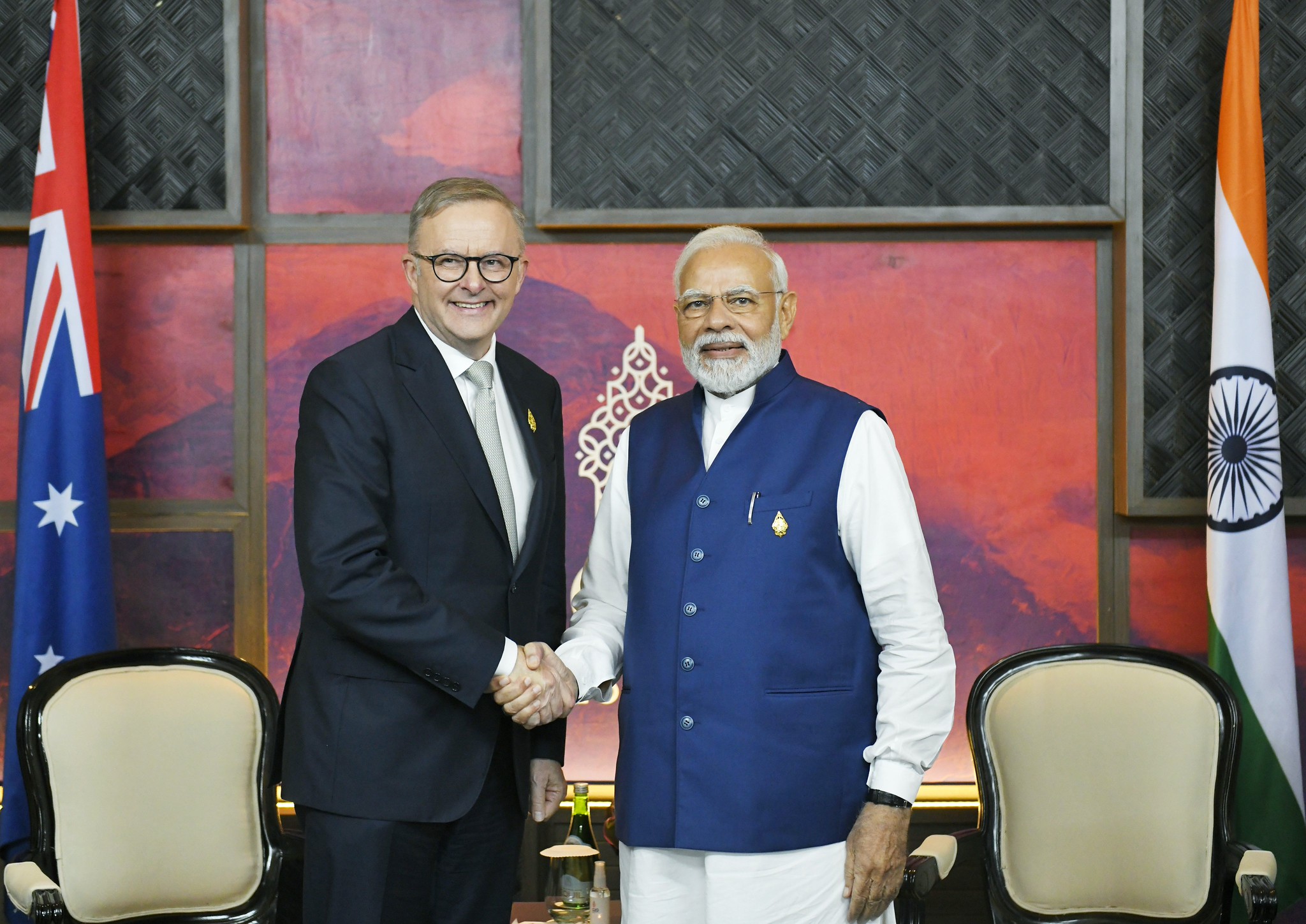
Prime Minister Narendra Modi’s recent visit to Australia for the third India–Australia Summit delivered a raft of announcements across defence, energy, trade and technology. Yet the real story lies not in the number of agreements signed, but in what they reveal about the trajectory of the relationship. For years, India and Australia have spoken of shared interests and strategic convergence. This Summit suggests the partnership is finally entering a new phase, one defined less by intent and increasingly by implementation.
This article examines the key outcomes from the visit, why they matter, and what they indicate about the next phase of the India–Australia partnership.
Clean energy partnership: one of the biggest wins
The India–Australia energy relationship has moved through three phases: traditional cooperation on coal and LNG; a transition focused on renewables, hydrogen and joint research; and now a strategic energy partnership centred on critical minerals, resilient supply chains and industrial collaboration. An evolution that also reflects increasing overlap between climate, economic security and geopolitics.
The most significant outcome of the visit is the finalisation of administrative arrangements under the India–Australia Civil Nuclear Agreement, unlocking the commercial supply of Australian uranium to India.
With the world’s largest uranium reserves, Australia’s entry into India’s fuel mix strengthens New Delhi’s energy security and dovetails with the SHANTI Act’s opening of the nuclear sector to private investment. For a programme targeting an expansion from around 8 GW today to 100 GW by 2047, the deal signals fuel certainty that can channel private capital and underwrite long-lead projects.
The nuclear file between the two countries has been open since 2014, but it has taken more than a decade to move from legal possibility to operational reality. The 2015 Australia–India Nuclear Cooperation Agreement, backed by an NSG waiver for India, made uranium trade permissible under IAEA safeguards. Yet regular commercial shipments never materialised beyond a small test consignment in 2017.
After Prime Minister John Howard’s 2006 visit signalled willingness to sell uranium to India, the subsequent Rudd government reversed that decision. The tide turned again under Julia Gillard in 2011, when the Australian Labor Party backed exports to India as economically beneficial. The 2014 agreement, operational from November 2015, created the legal basis but left key questions unresolved: how to account for Australian uranium in India’s mixed safeguarded/unsafeguarded fuel cycle; how to handle reprocessing and enrichment; and whether India’s non-NPT status posed proliferation risks.
Commercial logic also lagged. Uranium exporters need operating reactors, not just MoUs. India’s nuclear share in generation remained modest, and projects faced delays stemming from land acquisition, financing, liability and construction challenges.
By 2026, however, the picture has changed considerably, installed capacity has roughly doubled since 2014 to 8.78 GW, with 24 reactors in operation and a standardised fleet of 700 MW PHWRs. The 2026 Administrative Arrangement changes the game by putting in place the procedural safeguards and accounting mechanisms that Australian policymakers had long sought. In effect, it transforms the 2015 treaty from a framework into a working channel for uranium trade.
The timing is also strategic. Nuclear offers consistent, low-carbon baseload power that complements variable renewables and reduces reliance on coal at critical hours. Australian uranium adds a stable, trusted source to a supply chain that has leaned heavily on Kazakhstan and Canada.
The domestic policy environment is also more conducive. The 2025–26 Budget announced a ₹20,000 crore Nuclear Energy Mission for Viksit Bharat, targeting R&D on small modular reactors (SMRs), with at least five indigenous SMRs envisioned by 2033. The SHANTI Act (2025) permits private participation across the nuclear value chain, opening the door for new investment and technology partnerships.
For Canberra, the deal is equally strategic. Australia does not operate civilian nuclear power plants and India represents one of the fastest-growing clean-energy markets, offering a long-term demand anchor beyond traditional buyers. The arrangement also harmonizes with broader cooperation on critical minerals, green hydrogen and clean-tech supply chains, reinforcing Australia’s positioning as a reliable supplier in a fragmenting global economy.
Still feeling the effects of the Gulf crisis, both sides reaffirmed commitments to steady energy flows, LNG to India and liquid fuels and downstream products to Australia. Renewable collaboration also gained momentum as Australia prepares to host COP 31, with agreement to operationalise a rooftop solar training academy to skill 2,000 women and youth as technicians, installers and helpers, directly feeding into India’s Surya Ghar Yojana and helping build a shared clean-energy workforce pipeline.
The next few months will be judged by concrete milestones: the first commercial uranium cargo; power purchase agreements and financing tied to new nuclear capacity; progress on SMR pilots; and the scaling of joint projects in critical minerals and green hydrogen. This will convert strategic convergence to hard infrastructure, investment and supply-chain integration.
Fresh momentum for a security partnership
The Summit gave fresh momentum to the defence partnership. Both sides welcomed a new Joint Declaration on Defence and Security Cooperation aimed at promoting a joint defence industrial ecosystem, co-development of military hardware, enhanced information sharing and interoperability, and more complex defence exercises under the Mutual Logistics Support Arrangement, including reciprocal aircraft deployments.
Institutionally, the establishment of an Annual Defence Ministers’ Dialogue is also significant. It gives the relationship a regular, high-level mechanism for accountability.
The leaders also signed a Maritime Security Collaboration Roadmap to enhance domain awareness, joint operational coordination, capability development and capacity building, with a focus on shipbuilding, ship repair and maintenance. This moves the relationship beyond periodic exercises towards more sustained maritime cooperation.
Personal and institutional exchanges were strengthened through an MoU between the Indian Coast Guard and Australia’s Maritime Border Command to enhance cooperation on civil maritime security. Knowledge exchange was further deepened with the addition of Indian military instructors at the Australian Defence College for 2028–29, embedding professional military education ties at a senior level.
The two sides also signed the Australia–India Partnership on Cyber, Critical Technologies and Supply Chains (PACTS), structured around five pillars (TABLE 1). It is designed to align standards, secure supply chains and accelerate joint work on emerging technologies that have direct defence and security applications. An MoU on the Provision of Defence Articles and Defence Services is also under development to streamline co-production, maintenance, repair and overhaul of bilateral and potentially third-country projects.
The defence partnership now has both structure and momentum, underpinned by an annual ministerial dialogue, a maritime roadmap, embedded instructor exchanges and a cyber and critical technologies framework. The challenge now is to demonstrate that these new mechanisms can deliver. Early indicators will include co-development projects, expanded logistics support under the Mutual Logistics Support Arrangement, concrete MRO arrangements and the operationalisation of PACTS workstreams.
| Pillar | What does it include? | Nodal Offices |
|---|---|---|
| Supply Chain Resilience |
|
National Security Council Secretariat (NSCS) and The Office of the Ambassador for Cyber Affairs and Critical Technology |
| Critical Technology |
|
NSCS and The Office of the Ambassador for Cyber Affairs and Critical Technology |
| Cybersecurity |
|
Cyber Diplomacy Division, MEA and The Office of the Ambassador for Cyber Affairs and Critical Technology |
| Digital resilience |
|
Oceania Division, MEA and The Office of the Ambassador for Cyber Affairs and Critical Technology |
| Defence research and collaboration |
|
Defence Ministeries |
From ECTA to CECA: locking in a US$45–50 billion trajectory
The visit reinforced momentum under the Economic Cooperation and Trade Agreement (ECTA) while bringing the Comprehensive Economic Cooperation Agreement (CECA) a step closer to conclusion. More than a conventional tariff-liberalisation pact, CECA is expected to deepen services access, professional mobility, standards alignment and supply-chain cooperation. Bilateral trade is projected to reach US$45–50 billion by 2035, up from around US$27 billion in 2021–22, as both sides seek to translate preferential market access into durable commercial partnerships and export opportunities.
This trade agenda is being underwritten by capital. AustralianSuper, Australia’s largest pension fund, announced an additional AUD 500 million investment in India’s National Investment and Infrastructure Fund (NIIF), taking its total India exposure to AUD 3.3 billion across infrastructure, equities and private markets. With about AUD 410 billion AUM , the fund’s move signals confidence in India’s investment ecosystem and aligns Canberra’s resource base with Delhi’s scale.
The trade pillar is complemented by efforts to increase energy security, secure supply chains and deepen defence cooperation. The real test for CECA will be how quickly it translates ambition into execution.
Education, Skills, Culture and Sports
Education, science, culture and sport remain one of the strongest foundations of the India–Australia relationship. With each summit, outcomes in this area have become more tangible.
Australia announced AUD 10 million in Maitri grants through the Centre for Australia–India Relations for projects that strengthen business, education and community ties.
Education cooperation is moving from student mobility to institutional presence. The University Grants Commission issued a Letter of Intent to Flinders University to establish a campus in Bengaluru, while Victoria University received a Letter of Approval to operationalise its campus in Gurugram. These embed Australian universities in India’s higher-education ecosystem, enabling joint degrees, research collaboration and faculty exchanges on Indian soil.
On the skills side, Western Australia and the Government of India agreed to establish a National Centre of Excellence for Skilling in Mining at the National Skill Training Institute in Bhubaneswar, focusing on mining safety, operations and processing. Complementing this, the National Council for Vocational Education and Training (NCVET) and the Australian Skills Quality Authority (ASQA) signed a Letter of Intent to strengthen quality assurance in technical and vocational education, align occupational standards in priority sectors, and enable staff exchanges and joint workshops.
Scientific collaboration gained new instruments. The Geological Survey of India and Geoscience Australia signed an MoU on advanced exploration methodologies and capacity building, directly relevant to critical minerals mapping. India’s Traditional Knowledge Digital Library (TKDL) will now be accessible to IP Australia, enabling more informed patent examination and helping prevent misappropriation of documented traditional heritage.
On cultural restitution, both sides welcomed the voluntary return of three Tamil Nadu artefacts to India, signalling respect for heritage and indigenous rights.
Sport is increasingly being viewed as a strategic people-to-people and economic partnership, not just a shared passion. The India–Australia Sports Collaboration Roadmap focuses on five priorities: capacity building; sports science and technology research; cooperation on major sporting events, including the 2032 Brisbane Olympics and the proposed 2030 Ahmedabad Commonwealth Games; industry and investment partnerships; and advancing women’s leadership and participation in sport.
The roadmap also welcomes the first Big Bash League match in India, to be held in Chennai in December 2026, and supports discussions on making BBL matches an annual fixture in the country.
For all the emphasis on campuses and skills, concrete progress on student and professional mobility was limited. The joint outcomes did not announce new visa arrangements, expanded post-study work rights, or sector-specific mobility corridors for nurses, engineers, IT professionals or other categories where both sides have clear demand. The Migration and Mobility Agreement, announced earlier, set the direction but left numbers, quotas and fast-track mechanisms largely unspecified. This remains the most visible/unfinished part of the agenda.
ACITI: a trilateral corridor for emerging technologies
The Summit advanced the technology agenda through the Australia–Canada–India Technology and Innovation (ACITI) Partnership. Leaders welcomed a new MoU to deepen trilateral cooperation in emerging technologies, with AI as a key focus. The partnership will promote joint research, talent exchanges, standards cooperation and innovation linkages across the three countries.
More importantly, ACITI reflects a wider shift in India’s external partnerships, towards agile trilateral arrangements that are lighter on protocol, but richer in strategic utility than a purely bilateral format.
On space, Australia confirmed ongoing tracking support for India’s Gaganyaan human spaceflight programme by commissioning a temporary space tracking terminal on the Cocos (Keeling) Islands. This infrastructure will provide telemetry, tracking and command support during critical phases of Gaganyaan missions, adding another reliable node to India’s overseas tracking network.
Conclusion
From being in the crosshairs almost three decades ago, when Australia suspended defence cooperation with India after Pokhran II (1998), the relationship has come a long way. The operationalisation of Australian uranium sales to India is a testimony to how the relationship has shifted, and the promise it holds.
India and Australia complement each other almost by design. The challenge is no longer identifying convergence but delivering outcomes: the first commercial uranium cargo, CECA conclusion and early trade gains, visible co-development or MRO projects in defence, funded ACITI workstreams in AI and critical tech, and measurable mobility and skills outcomes.
PM Modi’s Australia visit should also be placed within the larger context of his summer of diplomacy. A three-nation tour to Indonesia, Australia and New Zealand, coming soon after Japanese Prime Minister Sanae Takaichi’s state visit to India which followed the PM’s five nation tour of UAE, the Netherlands, Sweden, Norway and Italy. Some will call it too little, too late. But the rush for stable anchors usually spikes when turbulence rises. India’s push across the Asia-Pacific is calibrated for exactly this moment, a region nervous about China’s assertiveness and wary of Washington’s unpredictability under a second Trump term.
Partnerships built on trust, complementary strengths and sustained delivery will matter more than ever. India and Australia are increasingly positioning themselves as two such anchors.