As nations vie for supremacy in critical and emerging technologies, geopolitics and high-tech innovations intersect to shape global dynamics. Technological advances, from artificial intelligence (AI) to space exploration, not only revolutionise industries but also redefine global power and strategic alliances. This edition explores the new high-tech bilateral cooperation roadmap signed by India and Japan, how IPOs may be the next step for India’s private space companies, how trailing edge process nodes may be the smarter play for India’s semiconductor ambition, the physical cyber security threat that manifested as the BAT-BMS saga, and the state of space debris mitigation.
What's Cooking on India Japan High-tech Cooperation
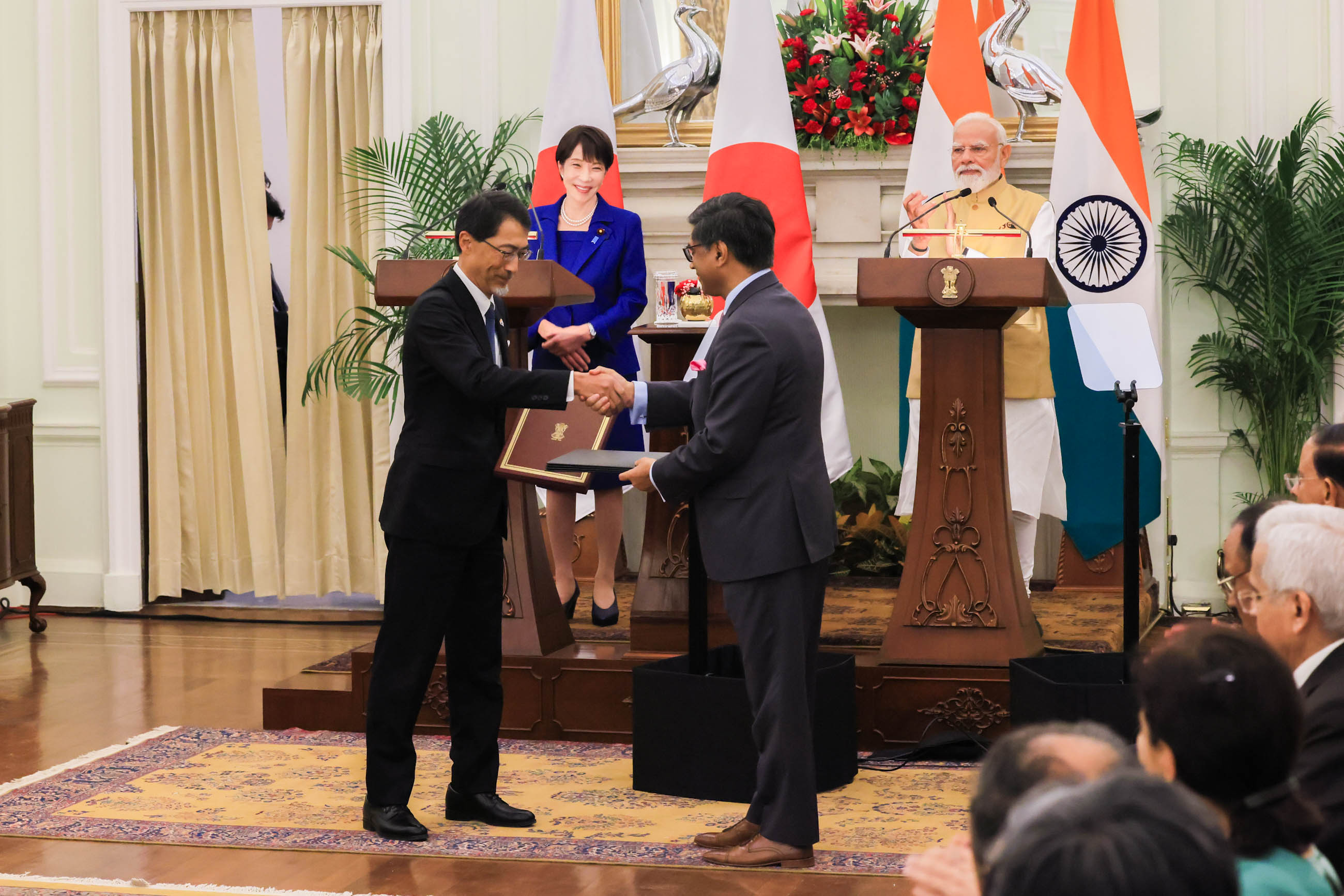
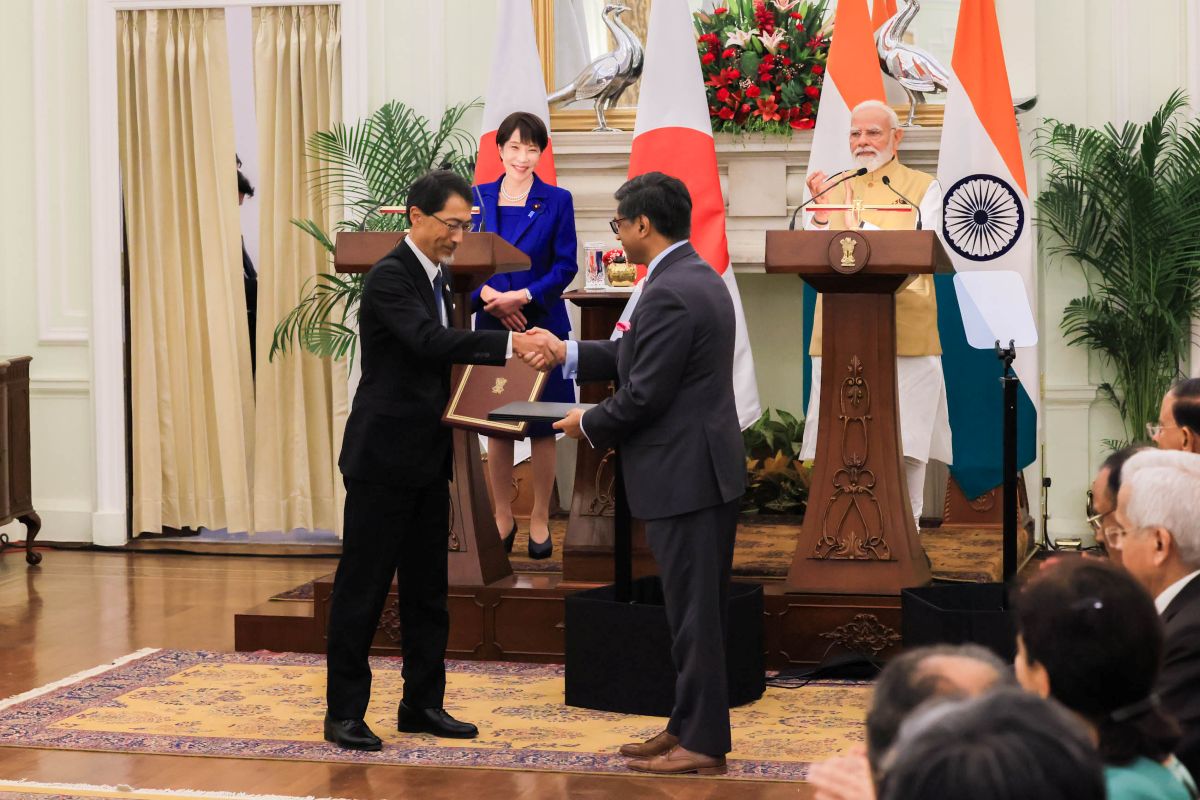
The 16th India Japan Annual Summit, held in New Delhi on 2 July 2026, produced one of the most technology heavy outcome documents the two countries have signed in recent years. According to a press release from India’s Press Information Bureau (PIB), the visiting Japanese Prime Minister and the Indian Prime Minister finalised sixteen separate outcomes spanning economic security, Artificial Intelligence (AI), energy, pharmaceuticals, critical minerals, mobility and financial technology, effectively converting a decade of incremental bilateral engagement into a single coordinated roadmap.
At the centre of this roadmap sits the India Japan Joint Declaration on Economic Security. Rather than a symbolic gesture, the declaration commits both governments to project-based collaboration aimed at building joint resilience across semiconductors, critical minerals, information and communication technology including AI, clean energy and pharmaceuticals. This framing matters because it treats these sectors not as isolated industrial policy goals but as a single resilience architecture, one where a disruption in mineral supply or chip availability is understood to have knock-on effects across the AI and pharmaceutical value chains. The accompanying India Japan Fact Sheet 2.0, referenced in the same text, is intended to track the growing volume of government-to-government and business-to-business engagement underpinning this architecture.
The AI component of the summit is where the shift from declaratory intent to structural commitment becomes most visible. The India Japan Joint Statement on Cooperation in the Field of AI elevates what had been a research partnership into what the release describes as a strategic research and development relationship, building on the existing India Japan AI Initiative. It lays out a roadmap for cooperation across the entire AI technology stack, from compute and data to model development and deployment, in pursuit of a shared vision of safe, secure, trusted, inclusive and human-centric AI.
This is reinforced institutionally by a Memorandum of Cooperation between the IndiaAI Mission and Japan’s Ministry of Economy, Trade and Industry, which links IndiaAI directly with Japan’s GENIAC initiative through business-to-business matchmaking, joint webinars on AI policy challenges, and mutual access to computing resources for joint projects. For a country still building out its sovereign compute base, this compute sharing dimension is arguably as significant as any funding announcement, since access to trusted, external capacity has become a genuine bottleneck for Indian AI developers.
Model development itself features prominently in the agreement set. A Memorandum of Understanding (MoU) between IIT Bombay, the BharatGen Technology Foundation and Japan’s National Institute of Informatics is aimed specifically at advancing large language models with an emphasis on scientific reasoning structured around joint research exchanges rather than one-off technology transfer. Separately, India’s SarvamAI has signed a MoU with Japan’s Preferred Networks covering cooperation across the full AI technology stack including foundation models. Sarvam has already built a name for itself domestically through its open sourced 30B and 105B parameter models trained on IndiaAI Mission compute, so a tie-up with a Japanese frontier lab known for its own foundation model work suggests both sides see value in pooling research talent rather than competing for it, particularly given that neither country currently commands the scale of compute available to the US or China.
Beyond AI, the summit addressed the physical infrastructure that any serious technology partnership eventually depends on. A Memorandum of Cooperation (MoC) in the field of batteries aims to expand business opportunities while building what the release terms a trusted, resilient and sustainable battery supply chain, an area where Japan’s materials expertise complements India’s manufacturing ambitions. A parallel memorandum on geology and mineral exploration focuses on upstream critical minerals, addressing the raw material chokepoint that sits upstream of both battery and semiconductor manufacturing. On pharmaceuticals, the two sides agreed to strengthen supply chains for active pharmaceutical ingredients and key starting materials through bilateral investment, technical collaboration, and industry academia linkages – an area of particular sensitivity given how concentrated global API production has become in a small number of countries.
The mobility component, formalised through a MoC on the Next Generation Mobility Partnership, builds on an initiative first announced at the 15th Annual Summit in August 2025. It is designed to accelerate private sector-led investment across rail, automotive and road infrastructure, aviation, shipbuilding, ports, logistics, and urban development, with an explicit goal of positioning India as a manufacturing hub for third-country exports under the ‘Make in India for the World’ banner. Financial technology cooperation was addressed through an exchange of letters between India’s International Financial Services Centres Authority and Japan’s Financial Services Agency, establishing a framework for regulatory cooperation and information exchange specifically in fintech and regtech.
Internet governance and digital infrastructure cooperation, though less headline grabbing, round out the picture. A MoU between the National Internet Exchange of India and Japan’s Network Information Center covers IPv6 adoption, internet security improvements, and capacity building, positioning both countries to coordinate more closely at regional and global internet governance forums.
Taken together, the sixteen outcomes read less like a checklist and more like an attempt to build reliable facets into a bilateral relationship that both governments increasingly view through the lens of strategic resilience.
Moving From VC to IPOs: Lessons for India's Space Startups
After years of speculation, the largest privately owned space company in the world, the US’s SpaceX finally offered equity via an Initial Public Offering (IPO). According to a release published on SpaceX’s own investor relations page, the company issued an aggregate of 638,888,888 shares of Class A common stock, including the full exercise of an overallotment option by underwriters for an additional 83,333,333 shares, taking gross proceeds from the offering to approximately US $85.7 billion.
Shares began trading on the Nasdaq Global Select Market under the ticker SPCX on 12 June, with book running managers including Goldman Sachs, Morgan Stanley, BofA Securities, Citigroup and JPMorgan. For a company that spent two decades as one of the most closely watched private entities in the world, the shift to public markets instantly unlocked a scale of capital access that even the most generous venture rounds could never have matched.
That scale is the real story for founders and investors watching from India. Venture capital, by design, operates within fund cycles and return timelines that cap how much capital any single company can absorb before dilution or governance constraints start to bite. Public markets remove much of that ceiling, particularly for businesses whose growth depends on genuinely capital intensive infrastructure rather than incremental iteration.
India’s nascent private space sector offers perhaps the closest domestic analogue to the SpaceX story, both in terms of capital intensity and in terms of the state dependent regulatory environment such companies must navigate. Skyroot Aerospace became India’s first spacetech unicorn in 2026 at a valuation of roughly US $1 billion, and its emergence has pulled venture attention toward adjacent players such as Agnikul Cosmos, which is developing flexible small satellite launch vehicles and even launched its Vikram-1 on 18 July 2026 marking the first ever Indian private space launch, and Astrobase Space which is building a high-thrust rocket engine using full-flow staged combustion out of a 46,000 square foot Bengaluru facility. These companies are explicitly positioning themselves to address a bottleneck created by the Indian Space Research Organisation’s (ISRO) limited production rate for launch vehicles and satellites.
Companies operating at this end of deep tech typically need capital commitments that stretch far beyond what a Series C or D round can responsibly provide, since rocket engine testing, launch infrastructure and regulatory certification all carry costs and timelines that venture funds structured around seven- to ten-year exits are poorly suited to underwrite. A public listing, even a modestly sized one relative to SpaceX, would give Indian New Space companies the kind of patient, large-scale capital base that space hardware development actually requires.
India's Trailing Edge Scale Strategy in Semiconductors
India’s semiconductor and AI ecosystem, instead of racing toward the sub 10 nanometre chips that anchor most cutting edge advanced applications, actually points toward mature process nodes, assembly, and packaging capacity.
A closer look at how this posture has developed suggests it is not a fallback position but a deliberate scale strategy, one built around the recognition that leading-edge capability is a moving target controlled by others while trailing edge capacity is something India can actually own.
The clearest evidence of this comes from the India Semiconductor Mission itself which has prioritised assembly, testing, marking, and packaging facilities well ahead of any commitment to leading edge fabrication. India’s Union Cabinet approved Semicon 2.0 on 15 July 2026 with a fiscal outlay of INR 1,27,500 crore to accelerate the development of a robust and resilient semiconductor ecosystem by building on the first phase, Semicon 1.0, for which the government had made an outlay of INR 76,000 crore for the development of the semiconductor and display manufacturing ecosystem in the country. Of that original outlay, INR 64,000 crore were allocated for chip fabs, INR 10,000 crore for the semiconductor lab, and INR 1,000 crore for the Design-Linked Incentive (DLI) scheme, with virtually all of it having already been committed to projects by mid-2026.
Under Semicon 2.0, the funding model itself is changing; rather than one-time grants, the government is shifting to milestone-linked funding and equity investments to help semiconductor startups scale beyond chip design into commercialisation and manufacturing. Under this equity approach, startups that secure private venture capital funding would receive matching investment from the government without seeking board representation or management control, and the Centre plans to exit these investments as the companies mature, recycling the proceeds into other semiconductor firms. This reflects a broader shift in posture: the government is positioning itself less as a one-time incentive provider and more as a long-term ecosystem creator.
The scope of Semicon 2.0 is also wider than the original mission. The new phase broadens incentives beyond fabrication to include semiconductor equipment, materials, research, innovation, startup funding, and ecosystem development. On the technology roadmap, officials have said that by 2029, India is expected to achieve the capability to design and manufacture chips required for nearly 70–75% of domestic applications, and that the next phase will focus on advanced manufacturing with a clearly defined roadmap to achieve 3-nanometre and 2-nanometre technology nodes, with India aiming to be among the top semiconductor nations globally by 2035. Separately, the budget for financial year 2026–2027 allocated INR 1,000 crore for Semicon 2.0 with a strong emphasis on industry-led research and training centres, and raised the outlay for the Electronics Components Manufacturing Scheme (ECMS) to INR 40,000 crore, reflecting investor interest in a broader components ecosystem beneath semiconductors.
This trailing-edge posture also functions as insurance against a geopolitical risk that Indian policymakers now openly acknowledge. The legal authority that cut China off from advanced chip-making equipment and inputs beginning in 2022 sits with the same US Commerce Department that could, in a different political moment, extend similar restrictions to India. China’s own response offers a useful comparison; the Semiconductor Manufacturing International Corporation’s (SMIC) continued reliance on a 7-nanometre process, rather than more advanced nodes used elsewhere, shows how sanctions can push a country toward maximising output at an older node instead of chasing the leading edge outright, a lesson not lost on Indian planners betting on trailing-edge chips for automotive, industrial, and power electronics applications rather than flagship compute.
The BAT-BMS App and the Case for Cross-border Quality Control
India’s Ministry of Electronics and Information Technology (MEITy) has reportedly directed Google and Apple to remove the BAT-BMS application along with two similarly functioning apps called Lossigy and Epoch Li-ion, from their respective app stores in India after videos circulating on social media appeared to show strangers using the app to remotely disable the battery systems of moving e-rickshaws. The episode has been described as the country’s first widely visible cyber-physical security incident in the electric mobility space, and it illustrates why quality control for connected hardware can no longer be treated as a domestic labelling exercise once the software and firmware inside that hardware routinely cross borders before the product itself does.
BAT-BMS was developed by Shenzhen Grenergy Technology as a companion application for Bluetooth enabled lithium ion battery packs, allowing owners to monitor voltage, current, temperature, charging cycles and battery health, while also offering a discharge control feature intended for maintenance purposes. That maintenance feature became the vulnerability. Many of the e-rickshaws and electric two wheelers using these battery management systems in India ship with no password protection at all, or continue to run on factory default credentials that were never changed during import, distribution or sale. Within a Bluetooth range of roughly ten to twenty metres, anyone with the app installed could pair with a nearby vehicle’s battery system without the owner’s knowledge and, in some documented cases switch off the power while the vehicle was in motion. Vehicles running on branded proprietary or encrypted battery management software were unaffected. The failure, in other words, was not conceptual. It was a basic authentication gap that any reasonably resourced import certification process should have caught before the hardware reached Indian roads.
That is precisely where the cross-border quality control argument becomes unavoidable. India currently has no mandatory pre market cyber security certification requirement specifically for connected battery management systems entering the country, whether embedded in imported vehicles, retrofitted battery packs, or standalone components sold to local assemblers. Contrast this with the regulatory direction other jurisdictions have already taken for connected consumer hardware more broadly where baseline requirements such as unique, non-default credentials and mandatory encrypted communications have become conditions of market access rather than best practice recommendations left to individual manufacturers. A comparable authentication gap in a residential solar storage system, or in a commercial backup installation supporting critical infrastructure, would carry consequences considerably more severe than a stalled rickshaw in traffic.
A durable solution would require the kind of cross-border quality control regime that treats connected battery hardware the way pharmaceuticals or telecom equipment are already treated, with mandatory security baselines verified before market entry.
Managing Space Debris and Sustaining Heavy Low-Earth Orbit Deployment
For most of the space age, debris mitigation was framed as a long horizon environmental problem, one where the priority was limiting catastrophic collisions at altitudes where atmospheric drag is too weak to pull fragments back down within a human lifetime. The arrival of mega constellations at very low altitudes has not eliminated that long-term risk, but it has forced a second, more immediate concern onto the same agenda; namely, short-term collision avoidance and space traffic management for a population of active satellites now large enough to represent a meaningful share of everything humans have ever put into orbit.
When orbital debris first became a recognised problem in the late 1970s and early 1980s, operational spacecraft made up only a modest fraction of all cataloged objects larger than about ten centimetres. Mitigation guidelines, standards and national regulations developed gradually over the following decades. However, that progress was undone within two years by two largely avoidable events, China’s intentional destruction of its Fengyun 1C satellite in an anti-satellite weapons test in 2007, and the accidental 2009 collision between the operational Iridium 33 satellite and the defunct Cosmos 2251, both of which generated enormous fragment clouds that erased more than a decade of mitigation gains almost overnight. After those two events, the catalogued object population in low-Earth orbit stabilised for roughly a decade, settling close to what simple extrapolation from 1980s era space activity would have predicted even in the complete absence of any mitigation effort at all.
That stabilisation ended around 2020, coinciding with the rapid deployment of mega constellations. Three structural differences separate this new era from the first sixty years of the space age: the sheer number of operational spacecraft now involved; the unusually high proportion of active satellites relative to catalogued debris objects; and the very low altitudes at which most of these constellation satellites operate. That third factor turns out to be double edged. Very low orbits are self-cleaning in a way higher orbits are not since atmospheric drag pulls defunct objects back into the atmosphere within years rather than centuries, which is precisely why most mega constellation operators chose those altitudes in the first place. But the same low-altitude environment now hosts thousands of active, manoeuvring spacecraft operating in close proximity, which is what has shifted the operational priority from long-term fragment accumulation toward the immediate, day-to-day challenge of avoiding collisions between functioning satellites and everything else sharing that orbital shell.
Current efforts to manage this shifted risk profile fall into some broad categories, each addressing a different part of the problem. Space situational awareness and tracking networks, largely built on ground based radar and optical systems supplemented by a small but growing number of dedicated tracking satellites, form the foundation since neither collision avoidance nor active debris removal is possible without first knowing where objects actually are with enough precision to act on that information. Collision avoidance itself has become largely automated for the largest constellations with operators running frequent conjunction assessments against catalogue data and executing propulsive manoeuvres whenever the probability of a close approach crosses a defined threshold, a workload that scales directly with the number of active satellites in a given orbital shell and that has grown substantially as constellation size has increased. Active debris removal, the most technically demanding of measures, remains largely at the demonstration stage internationally, with a small number of missions having tested rendezvous, capture and controlled deorbit of a single defunct object, though none has yet operated at anything approaching the scale that would be required to meaningfully reduce the existing debris population rather than simply managing its growth rate.
Check these out
- Vrinda Goel, 'Why critical minerals are becoming central to India's bilateral deals', Business Standard, 6 July 2026.
- Luciano Anselmo and Carmen Pardin, 'Orbital Debris in Low Earth Orbit: How the Situation Changed since the Advent of Mega Constellations', 5th European Conference on Space Debris. https://conference.sdo.esoc.esa.int/proceedings/sdc9/paper/103/SDC9-paper103.pdf
- Lee Wha Gwon, Isabel Wen Badon, Youngjeon Lee, Ho-Joong Kim & Seung Hwan Lee, 'Advances in large-scale DNA engineering with the CRISPR system', Exp Mol Med 57, 1902–1912 (2025)
- Human's Relationship with Technology in Nick Land's Accelerationism - Jurnal Filsafat
- DST, 'Breakthrough in super-alloy bi-metallic structures through additive manufacturing can reduce import of super-alloys', Government of India, Department of Science and Technology
- Daniel Morton, 'Breakthroughs in materials science are helping to improve tomorrows energy storage', 15 August 2025, Renewable and Sustainable Energy Institute, University of Colorado Boulder
- Daniel Morton, 'Watching Carbon Capture in Action', 13 March 2026, Renewable and Sustainable Energy Institute, University of Colorado Boulder