
Abstract
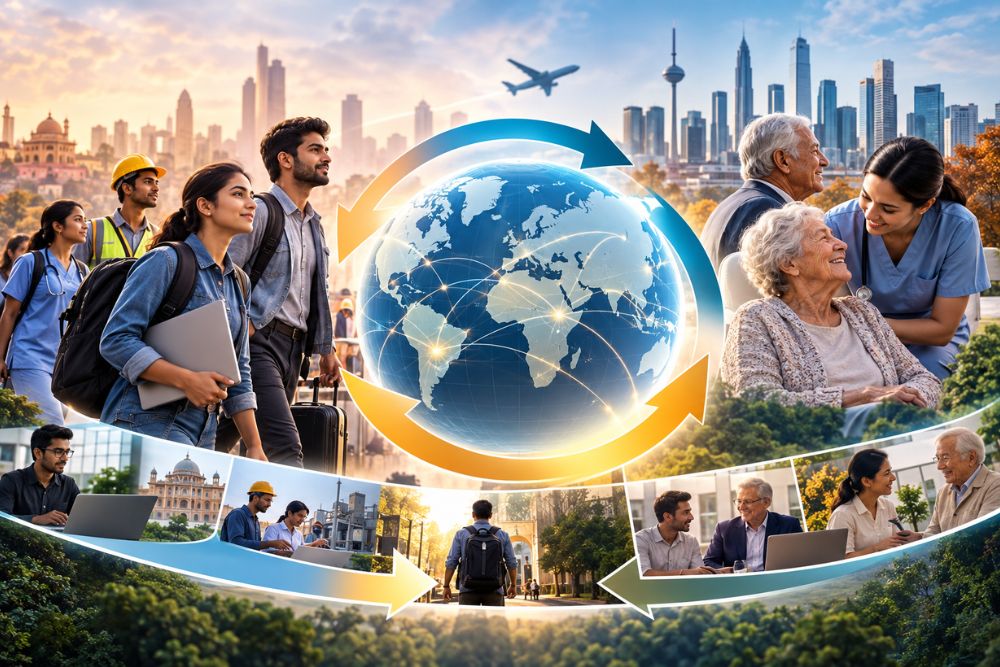
Demographic shifts are asserting new pressures on several labour markets worldwide. In many advanced economies, steep fall in fertility rates coupled with improved life expectancy are leading to a shrinking share of workers vis-a-vis the elderly. This is creating new demands for labour, either due to severe shortages or because of an increased demand for specific labour-intensive services. On the other hand, many emerging economies continue to have large enough youth populations who, with the right training and support, can cater to the demands of labour markets both domestically and globally. This new demographic reality presents an opportunity for the world to rethink labour mobility and migration, challenging the traditional thinking that sees migration as a uni-directional linear movement. The current moment demands a new paradigm of thinking around the movement of workers in a world that will increasingly become older. This article argues in favour of circular labour mobility as a deliberate design choice, repositioning skilled labour outflow as “brain circulation” rather than brain drain. The notion of circularity rests on mutual gains produced at both ends of a corridor rather than a zero-sum unidirectional flow of labour from origin to destination.
Disclaimer: The examples of Singapore, Hong Kong and the GCC are not presented as universally applicable templates, nor as arguments for tightly controlled or temporary migration as an end in itself. These countries have adapted their approaches to foreign labour in very different ways, reflecting their particular economic, demographic and political circumstances. Their experiences are useful less as models to be copied than as illustrations of how countries can seek to balance the economic benefits of foreign talent with questions of national identity, social cohesion and integration. The appropriate balance will necessarily differ across countries. The level and nature of integration will depend on the social and political salience of migration in each context, alongside the economic reality of whether, and to what extent; a country depends on foreign labour. The challenge is therefore not to identify a single model of mobility, but to understand how different societies can build systems that meet their labour-market needs while remaining responsive to their own social and political realities.
Introduction
For most of modern history, human migration – whether internal or international – has largely been driven by two forces – development and disruption. Development-driven migration followed industrialisation wherein workers moved from agrarian peripheries to industrial cores because that is where wages, infrastructure, and opportunities were concentrated. It is the reason why people continue to move, often in search of better economic pathways and opportunities for themselves or their families. Disruption and distress-driven migration, on the other hand, follow shocks like war, famine, disasters and conflicts, pushing people out (often in large numbers) in search of refuge, and often without a clear blueprint for a return. Despite their contrary motivations, both forms of migration share one feature: the migration is largely linear and uni-directional. A worker or family moves from one point to another, and the expectation of institutions – statistical, legal, and social – is that the movement terminates in settlement.
Demographics: The new force reshaping labour markets around the world
A new driver of migration is now emerging around the world: demography. The world is ageing, a shift that will have profound implications for all aspects of the economy and society. The average global citizen was 20.3 years old in 1970, data from United Nation’s World Population Prospects 2024 (2024) shows. By the turn of the millennium, they were 25.1 years old. As of 2026, the global median age is estimated to be 31.1 years and this is projected to rise further to 35 years by 2045. In short, the world is getting older on average.
This overall ageing is being accompanied by another significant transformation — a sharp drop in fertility rates around the world accompanied by the increase in life expectancy will mean a future with a shrinking working-age population and an expanding cohort of the elderly. By utilizing the Potential Support Ratio (PSR) – the proportion of the working-age population relative to the elderly, a higher value being better – as a diagnostic lens, it becomes possible to identify economies that are likely to be facing economic and fiscal pressures.
As of 2026, 73 nations are estimated to have a PSR below four, with nearly half of these having this ratio below three. (This is calculated using the age-wise population estimates from the UN’s Population Division (World Population Prospects, 2024, medium fertility variant). This demographic gap is projected to widen significantly with 97 countries expected to fall below this critical PSR threshold of four by 2035, and the number of countries in this category set to cross 100 by 2040. As the PSR further declines, societies will have more elderly than people who can provide care for them. Recognising the criticality of this issue, in its Ageing Report – Economic & Budgetary Projections for the EU Member States (2022-2070) published in 2024, the European Commission stated that despite growing labour force participation in the period 2022-2070 among older people driven through pension reforms, the gains will remain vastly insufficient to offset the shrinkage of the working age population (EC, 2024). As a result, the workforce in EU member states is expected to lose 25 million people (12% decline) from its current strength, by 2070. Furthermore, the total cost of aging, which would include pensions, healthcare, and long-term care, for the region is also projected to rise to 25.6% of GDP by 2070, from 24.4% in 2022 (Ibid.).
While the world will have two groups of countries – one with a higher proportion of the elderly and those with relatively younger populations (including India), this surplus and deficit won’t simply even out. Despite differential national trends, the world is moving towards getting older in general. This means a simple linear model of young people moving out from labour-surplus economies to labour-deficit ones will not be possible. While technological solutions and fiscal reforms will have a role to play, a circular model of mobility – where people can easily move between destinations and return to their homes after a few years in a different labour market – will increasingly become a strategic imperative.
Linear vs non-linear: Why the current moment demands a new paradigm of thinking
Relying on the traditional one-way, permanent migration route to fix labour deficits in one economy simply shifts human scarcity from one aging nation to another (EBRD, 2025). But designing intentional corridors where workers can share skills, build financial capital, and return with upgraded expertise, allows us to move away from a zero-sum depletion of human talent.
Historically, international organisations like the United Nations Department of Economic and Social Affairs (UN DESA) have defined international migration strictly by duration of stay, creating a hard distinction between transient and long-term movement. Under its 1998 definition, an individual residing in a host country for 3 to 12 months was classified as a short-term migrant, whereas anyone staying 12 months or longer was categorised as a long-term migrant (UN Statistic Division, 1998; IOM, n.d). These definitions could not distinguish between a rotational nurse on a two-year, return-bound contract from a family that had emigrated permanently. These definitions codified movement as unidirectional. While international statistical guidelines have since evolved to formally track circularity, repeated movements, and contract-bound labour flows, many national databases tend to default to the 12-month rule. As a result, a foreign worker on a multi-year, rotational contract with a guaranteed return date and zero intention of permanent settlement, is aggregated into the same statistical bucket as a permanent immigrant. This conceptual flaw treats all long-term mobility as a zero-sum, permanent demographic shift.
Circular mobility, on the other hand, is a non-linear institutional design where workers move, acquire capital and skill, and return, converting what would otherwise be a one-way loss or brain drain into “brain circulation,” a term Saxenian (2002) used to describe how skilled outflow, properly designed, recirculates capital, know-how, and professional networks back into the origin economy rather than stripping them away permanently. Circular mobility must be skill-matched and sector-specific and not broad or undifferentiated, because sectoral labour shortages generate costs that cascade well beyond the sector itself – a shortage of truck drivers raises costs across an entire economy’s supply chain, just as a shortage of nurses cascades into a healthcare crisis. Circular and skilled-mobility pathways are designed around certified skill pathways, quotas tied to demonstrated and specific shortages, and structured re-integration in host economies. Further, circular mobility requires “mobility readiness” which includes language proficiency and culture adaptability training in addition to sector specific skilling which has been a rarity in the world of linear migration.
Such mobility has the potential to transform cross-border movements from a game of shifting shortages into dynamic human-centered partnerships that honour the dignity of workers while renewing economic resilience at both ends of the corridor. Such a system draws labour at specific moments and in specific sectors where scarcity is evident, while also allowing the labour to recirculate rather than be permanently lost or permanently retained. This is a fundamentally different problem from the ones that drove migration in the twentieth century, and it cannot be solved by linear thinking and tools.
The case of German-Philippine Triple Win Framework within the healthcare sector exemplifies this argument. Germany’s healthcare sector faces severe labour shortage due to an ageing population, making it necessary for the country to turn to nations with demographic surplus like the Philippines. Operated jointly by the German Federal Employment Agency (BA) and the Deutsche Gesellschaft fur Internationale Zusammernarbeit (GIZ), alongside partner government agencies like the Philippine Department of Migrant Workers, the Triple Win Framework established targeted, skill-matched corridors (GIZ & BA, 2021). The candidates go through standardised pre-departure language training, professional certification verifications, and training for structured integration. This model is built on the WHO Global Code of Practice (2010) to prevent talent drain from vulnerable health systems, facilitating circular flows, bilateral knowledge transfer, and ethical recruitments. The Philippines Government, in return, supports returning workers through entrepreneurship funding, local skills recognition, and structured re-entry pathways that facilitate both local economic reintegration and seamless future reemployment.
The three-node network: Designing pathways that are sustainable
The design and durability of any mobility pathway does not solely depend on economic logic. It is shaped and nurtured by the broader systems it is embedded in and interacts with, namely socio-cultural, political and economic. These forces jointly determine the success of a pathway, not only in terms of number of beneficiaries, but also whether the pathway has sustained over time. These three nodes also explain how well-designed mobility pathways are able to survive shifting political climates, socio-cultural dynamics, and public attitudes.
The socio-cultural node addresses affinity, worker dignity, and social cohesion. A circular worker requires sufficient familiarity with the host context to function effectively, adapt to its expectations, and be empowered to sustain safely in the new environment. However, this node extends beyond worker adaptation, and also encompasses the host society’s capacity for mutual accommodation and social integration. Through pre-departure assistance, language and cultural training, and access to proper support mechanisms, the country of origin as well as the host country can encourage smooth assimilation, lower the identity isolation among workers, and promote fluid mobility.
The political node is perhaps one of the most volatile factors. Anxieties related to demographic changes within the host society tend to impact the lived realities of the workers at a granular level and shape national standpoints and policy interventions at a macro level. In fact, several researchers, including Craig & Richeson (2014), Dennison (2022), and Ford & Melon (2020), have argued that perceived shifts in society’s demographic composition tend to influence political attitudes independent of any competition for jobs. Simply put, the fear and anxieties are not driven by foreign workers occupying jobs as much as the concerns over what a shifting demographic may indicate. Therefore, it becomes important for host countries to have transparent systems in place with respect to foreign workers, their rights, and social protection.
The economic node is the most familiar of the three, driven by factors like wage differences, low remittance, and labour market dynamics. Embedded in the theory of Economics of Labour Migration (Stark & Bloom, 1985), this node reflects the host countries’ structural dependencies on foreign labour to fill essential jobs while providing origin families with capital for risk diversification and asset accumulation. However, treating the economic tenets in isolation may produce ill-equipped policies that are incompatible with socio-cultural and political realities.
To understand how mobility architecture operates in practice, policy design must be examined across jurisdictions that have explicitly institutionalised non-settlement labour corridors. Hong Kong, Singapore, and the Gulf Countries provide compelling, comparative case studies. While all three regions face structural dependencies on foreign human capital, their governance models demonstrate distinct approaches to balancing the Three-Node Network, contrasting state-governed corridors against pure market drift.
Singapore exemplifies a mobility architecture which is designed to prevent job losses for the domestic labour market due to international labour hiring, thereby creating a balance between both. Recognising the political necessity of preserving a “Singaporean Core”, the Ministry of Manpower adopts a multi-tiered work pass framework that tightly matches skill levels to economic privileges, notably through the Complementarity Assessment Framework (COMPASS) for Employment Passes and foreign worker levies for Work Permits. Through the COMPASS framework, applicants are evaluated not just on individual salary and qualifications, but also on whether their hiring improves company diversity and supports local employment. For mid- and low-skilled workers, the state uses dynamic Foreign Worker Levies (taxes on employers) and Dependency Ratio Ceilings (caps on the percentage of foreign staff a firm can hire). Economically, these levers fill crucial labour shortages in tech, construction, and finance. Politically, they show citizens that foreign hiring is tightly controlled. Culturally, they manage population density to preserve social harmony. By adjusting these administrative levers continuously, Singapore stays economically open without triggering political instability (Ministry of Manpower, Singapore, n.d.).
Hong Kong’s foreign domestic worker corridor offers a contrasting model centred on targeted sectoral demand and statutory contractual protection illustrating how aligning economic utility with legal rights stabilises a non-settlement pathway. Governed by a Standard Employment Contract (SEC), workers receive statutory protections, including a Minimum Allowable Wage (MAW) and guaranteed health coverage, while two-year contract cycles maintain explicit circularity. Governed by SEC mandated by the Immigration Department, several foreign domestic helpers, primarily from the Philippines and Indonesia, are integrated into Hong Kong’s household economy. Economically, this corridor addresses a critical caregiving gap, enabling high female labour force participation and generating vital remittance flows for origin states. Politically, the framework maintains clear boundaries of non-permanence, as workers operate on renewable two-year contracts and are explicitly excluded from acquiring permanent residency, insulating the programme from broader domestic anxieties regarding permanent demographic shift. However, what prevents this non-settlement status from degrading into structural exploitation is the reinforcement of the socio-cultural node. Under SEC, workers are entitled to statutory protections, including MAW, mandatory employer-provided housing, free medical care, and designated weekly rest days. By anchoring the corridor in enforceable legal protections, Hong Kong mitigates the severe social isolation and human rights vulnerabilities that frequently destabilise temporary labour programmes elsewhere. (Hong Kong Labour Department, 2025).
The major economies of the Gulf Cooperation Council (GCC), particularly Saudi Arabia and Qatar, also show what happens when a system relies almost entirely on the economic node, and why states must shift toward a balanced model. Historically, the region relied on the traditional Kafala (sponsorship) system, which bound a worker’s legal status directly to a single employer. While this system built massive infrastructure quickly and cheaply, it ignored worker rights and dignity – the socio-cultural node. This imbalance created severe international reputational damage, diplomatic tension with origin countries, and distorted local job markets. Recognising that pure economic extraction was unsustainable, these states began building state-governed circular corridors. Through Saudi Arabia’s Labour Reform Initiative (LRI) and updated laws in Qatar, governments dismantled key parts of the Kafala system. Using digital platforms like Qiwa and Absher, workers can now switch jobs when their contracts end without needing their employer’s permission. Exit permit requirements have been largely dropped, and electronic Wage Protection Systems (WPS) track salary payments in real time. These reforms prove that no labour corridor can survive on economic utility alone, and that long-term viability requires state oversight and baseline worker protections.
Ultimately, what Singapore, Hong Kong, and the GCC show us is that the three-node network is not just a theoretical model, but a practical blueprint for building migration policies that actually work over time. Economic demand might create the initial need for foreign labour but it can never carry the load alone. Without political oversight to address public fears about demographic shifts, labour programmes trigger severe social backlash. And, without cultural protections that respect worker dignity, those same programmes quickly slip into exploitation and bring about human rights failures and diplomatic fallout. Lasting circular mobility depends on treating all three nodes as connected parts of the same structure. By balancing economic needs with political trust and anchoring both in basic human dignity, state-designed corridors can turn cross-border labour from a flashpoint for social tension into a stable, lasting system.
The critical foundation - social security that moves with the worker
While designed pathways, skill alignment, and political governance provide the structural skeleton of circular mobility, the entire model risks collapse without an essential welfare mechanism – portable social security. Under traditional migration paradigms, social protection systems have been strictly territorial, wherein workers may contribute to pension funds and healthcare schemes in host or destination countries, but are unable to carry these funds across borders due to portability issues, especially for blue and grey collared workers.
The International Labour Organization’s (ILO) current strategy for extending social protection to migrant workers addresses this gap directly, centring on the negotiation of bilateral and multilateral social security agreements that allow benefits, covering old age, disability, and health, to move with the worker rather than being forfeited at the border (ILO, 2024). Progress on this front has been significant but uneven with cross-border portability research indicating that roughly 660 bilateral social security agreements existed worldwide by 2020, a marked increase from approximately 100 in 1980, though coverage remains concentrated in old-age and survivor benefits, with considerably weaker provision for health and unemployment protection (Holzmann & Wels, 2020).
What such portability requires in practice is illustrated by how two major sending countries have constructed origin-side protection along different timelines and through different institutional models. The Philippines’ Overseas Workers Welfare Administration, established in 1977, operates as a mandatory, membership-funded institution that accompanies workers across the entire migration cycle – pre-departure orientation, resource centres, and legal assistance at overseas postings, and reintegration support that includes livelihood and job-matching assistance upon return. Programmes like Balik Pilipinas, Balik Hanapbuhay, and the Overseas Filipino Worker (OFW) Enterprise Development and Loan Program (EDLP), provide grants and low-interest loans to help returning workers start businesses.
Another such example comes from Vietnam where the interventions are fairly recent. The Law on Vietnamese Workers Working Abroad under Contract, which came into force in 2022, requires labour export enterprises to embed insurance and healthcare provisions within worker contracts, while reintegration support is delivered through One-Stop Service Offices operated jointly with the Women’s Union and international partners, reflecting a model that relies on partnership-based delivery rather than a single centralised fund.
These two cases exemplify the centrality of social security and safety nets for workers. The ability of workers to preserve and transfer their earned social protections through pension funds and healthcare insurance across countries is vital to worker welfare and the pathways to be successful. Traditional social security systems need to be reformed to include portability mechanisms in order to make workers resilient to economic and social shocks and protect them from long-term vulnerability.
Remittances as the visible signal of a closed loop
If circularity is a design claim, remittances are its most measurable proof point, not because remittances are unique to circular systems, but because a functioning loop should show a pattern distinct from one-way extraction – sustained, recurring flows tied to active corridors rather than a one-time transfer followed by disengagement. According to the 2023 World Development Report, globally remittance flows to low- and middle-income countries reached a record US$ 647 billion in 2022 (World Bank, 2023). The World Bank further states how many low-skilled workers alone migrate and remit a large proportion of their incomes to support their families back home. Citing examples from India, the report states that Indian migrants in GCC Countries send an average of 70% of their earnings to their families – a figure that signals active, ongoing economic relations with the host country rather than a severed tie. Remittances alone do not prove circularity as a permanently settled diaspora also remits, but combined with structured return, credential recognition, and reintegration financing (as in the Philippines’ Balik Hanapbuhay and OFW Enterprise Development and Loan Program), they become one leg of a system in which financial capital, technical skill, and professional networks all cycle back, making the home country more competitive in a global marketplace. This is the operational difference between a remittance economy built on permanent absence and one built on managed, repeated circulation.
Conclusion
Read together, the demographic data and the institutional case studies point to the same conclusion – a world where labour scarcity will increasingly be simultaneous and structural on both ends of corridors will need to reimagine worker movement afresh. What is required is an intentionally designed non-linear pathway for workers to move between labour markets, one that is skill-matched rather than undifferentiated, and is protected by portable social security and stabilised by attention to political and cultural conditions. With an ambitious and driven young population running into millions India holds a demographic asset at precisely the moment global demand for structured, return-oriented labour corridors is becoming non-optional rather than aspirational. In the new uncertain world of AI, shifting genomics, and ageing demographics, architecting the framework for circular labour mobility and building the capacity to execute could be India’s ultimate gift to the world.
*******Bibliography
Craig, M. A., & Richeson, J. A. (2014). On the Precipice of a “Majority-Minority” America: Perceived Status Threat from the Racial Demographic Shift Affects White Americans’ Political Ideology. Psychological Science, 25(6), 1189–1197. https://doi.org/10.1177/0956797614527113.
Dennison, J. (2022). A Review of Experimental Evidence of How Communication Affects Attitudes to Immigration. Comparative Migration Studies, 10, 35. https://doi.org/10.1186/s40878-022-00310-3
Deutsche Gesellschaft für Internationale Zusammenarbeit & Bundesagentur für Arbeit (GIZ & BA). (2021). Triple Win Programme: Recruiting nurses from abroad sustainably. GIZ Factsheet. https://www.giz.de/en/downloads/Factsheet_TripleWin_2021_en_.pdf
European Bank for Reconstruction and Development. (2025). Transition Report 2025–26. EBRD. https://www.ebrd.com/home/news-and-events/publications/economics/transition-reports/transition-report-2025-26.html
European Commission. (2024). The 2024 Ageing Report: Economic and Budgetary Projections for the EU Member States (2022-2070). https://economy-finance.ec.europa.eu/document/download/971dd209-41c2-425d-94f8-e3c3c3459af9_en?filename=ip279_en.pdf. Accessed September 15, 2026.
Ford, R., & Mellon, J. (2020). The skills premium and the ethnic premium: a cross-national experiment on European attitudes to immigrants. Journal of Ethnic and Migration Studies, 46(3), 512–532. https://doi.org/10.1080/1369183X.2018.1550148. https://research.manchester.ac.uk/en/publications/the-skills-premium-and-the-ethnic-premium-a-cross-national-experi/. Accessed September 15, 2026.
Holzmann, R., & Wels, J. (2020). The cross-border portability of social security benefits: Status and progress? International Social Security Review, 73(1), 65–97. https://doi.org/10.1111/issr.12228
Hong Kong Labour Department. (2025). Employers’ corner: Things Employers Should Know When Employing Foreign Domestic Helpers. Government of the Hong Kong Special Administrative Region. https://www.fdh.labour.gov.hk/en/employer_corner.html. Accessed Sep 28, 2026.
International Labour Organization. (2024). ILO Strategy on extending social protection to migrant workers, refugees and their families. https://www.ilo.org/publications/ilo-strategy-extending-social-protection-migrant-workers-refugees-and-their
International Organization for Migration. (n.d.). Fundamentals of migration. Retrieved August 17, 2026, from https://www.iom.int/fundamentals-migration
Ministry of Manpower Singapore. (n.d.). Complementarity Assessment Framework (COMPASS). Government of Singapore. https://www.mom.gov.sg/faq/compass. Accessed September 15, 2026.
Saxenian, A. (2002). Brain Circulation: How High-Skill Immigration Makes Everyone Better Off. Brookings Commentary. https://www.brookings.edu/articles/brain-circulation-how-high-skill-immigration-makes-everyone-better-off/
Stark, O., & Bloom, D. E. (1985). The New Economics of Labor Migration. The American Economic Review, 75(2), 173–178. https://www.jstor.org/stable/1805591
United Nations Statistic Division. (1998). Recommendations on Statistics of International Migration, Revision 1 (Statistical Papers, Series M, No. 58/Rev. 1). United Nations. https://unstats.un.org/unsd/publication/seriesm/seriesm_58rev1e.pdf
United Nations. (2024). World Population Prospects 2024: Summary of Results (UN DESA/POP/2024/TR/NO. 9). United Nations Department of Economic and Social Affairs, Population Division. https://population.un.org/wpp/assets/Files/WPP2024_Summary-of-Results.pdf
World Bank. (2023, June 13). Migration and Development Brief 38: Remittances Remain Resilient but Likely to Slow. World Bank Group & KNOMAD [Press release]. https://www.worldbank.org/en/news/press-release/2023/06/13/remittances-remain-resilient-likely-to-slow
World Health Organization. (2010). WHO Global Code of Practice on the International Recruitment of Health Personnel. World Health Assembly Resolution WHA63.16. https://apps.who.int/gb/ebwha/pdf_files/WHA63/A63_R16-en.pdf
Additional Readings
Clemens, M. A., & Gough, K. (2018). A Tool to Implement the Global Compact for Migration: Ten Key Steps For Building Global Skill Partnerships. Center for Global Development. https://www.cgdev.org/sites/default/files/tool-implement-global-compact-migration-ten-key-steps-building-global-skill-partnerships.pdf
Constable, N. (2017). Maid to order in Hong Kong: Stories of migrant workers (2nd edn). Cornell University Press.
Dennison, J., & Geddes, A. (2021). Thinking Globally about Attitudes to Immigration: Concerns about Social Conflict, Economic Competition and Cultural Threat. The Political Quarterly, 92(3), 541–551. https://doi.org/10.1111/1467-923X.13013
Guzmán, P.G., Coelli, F. & Nilsson, E. (2025). The scale and limits of migration in offsetting population ageing. Centre for Economic Policy Research. https://cepr.org/voxeu/columns/scale-and-limits-migration-offsetting-population-ageing
Kalush, R., & Saraswathi, V. (2024). Reforms without rights: The GCC states’ blinkered view of labour reforms. Gulf Research Center. https://gulfmigration.grc.net/wp-content/uploads/2024/09/Kalush-Saraswathi-Reforms-without-Rights-Published-2024-09-09.pdf
Newland, K. (2009). Circular migration and human development (Human Development Research Paper 2009/42). United Nations Development Programme. https://hdr.undp.org/content/circular-migration-and-human-development
Organisation for Economic Co-operation and Development. (2025). OECD employment outlook 2025: From job shortage to labour shortage—the new challenge of population ageing. https://doi.org/10.1787/194a947b-en
Statistics Korea (KOSTAT). (2023). Population Projection for Korea: 2022–2072. Ministry of Economy and Finance, Republic of Korea. https://mods.go.kr/synap/skin/doc.html?fn=3026fabdd869a95b50f01570fbb871f26b48482ef67ca6843f9667c8da31f845&rs=/synap/preview/board/11748/
United Nations Economic Commission for Europe. (2016). Defining and measuring circular migration (ECE/CES/STAT/2016/5). United Nations. https://unece.org/fileadmin/DAM/stats/publications/2016/ECECESSTAT20165_E.pdf
United Nations Statistical Commission. (2021). Report on the fifty-second session (2-5 March 2021) (Official Records of the Economic and Social Council, Supplement No. 10./2021/24-E/CN.3/2021/30). United Nations. https://unstats.un.org/unsd/statcom/52nd-session/documents/2021-30-FinalReport-E.pdf
World Bank. (2023). World Development Report 2023: Migrants, refugees, and societies. https://www.worldbank.org/en/publication/wdr2023. Accessed September 15, 2026.