
As geopolitical tensions mount, ongoing conflicts globally have cradled battlefield innovation. Ananta’s Command Chain reviews the security and defence-centric developments that are shaping warfare’s evolution. In this edition we analyse India’s new Kusha air defence missile being a complement and not a replacement for S-400, the state of India’s AWACs programme, Ukraine’s new military leadership, and the Houthis’s entry into the Iran war.
Kusha and the S-400: Building a Layered Grid
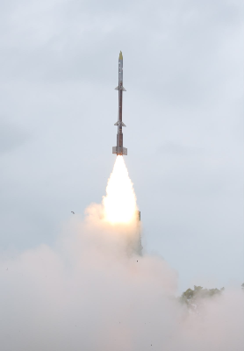
Kusha maiden flight test
On 23 July 2026, India’s Defence Research and Development Organisation (DRDO) carried out the first flight-test of the Kusha long-range surface-to-air missile from the A.P.J. Abdul Kalam Island off the Odisha coast. The missile was fired at an electronic target simulating a fast, high-altitude aerial threat and intercepted it successfully. Every element of the system – the missile itself, the radars, and the command and control node – was developed by DRDO laboratories working with Indian industry partners. Defence Minister Rajnath Singh called the test a milestone, noting that only a small number of countries possess the ability to build long-range air defence of this class, and that Kusha would reduce India’s reliance on imported systems.
The instinctive comparison that follows any Kusha announcement is with the S-400 Triumf, the Russian system India began inducting in 2021 under a five-regiment contract worth roughly US$ 5.50 billion dollars. That comparison is understandable but misplaced. Kusha was never conceived as a replacement for the S-400; it was conceived to sit inside the same air defence grid, occupying a layer that India’s existing inventory does not fully cover on its own terms of cost, production timeline, and strategic autonomy.
Modern integrated air defence does not function through a single exquisite system standing alone. It functions through overlapping rings each tuned to a different altitude band, engagement range, and threat profile, cued by a shared sensor and command network. The S-400 anchors the outer ring with its reported engagement range extending beyond 380 kilometres against select target sets, backed by search radars that can track large numbers of objects simultaneously. Below that sits the indigenous Akash and its upgraded variants for medium-range coverage, and further down the Akashteer and shorter-range gun and missile systems handle close-in point defence. Kusha, once operational, is intended to fill the space between the S-400’s outer envelope and the Akash family’s medium-range coverage.
There is a strategic logic to filling that tier domestically that has little to do with raw range figures. The S-400 was procured under a government-to-government arrangement with Russia, a relationship that has grown more complicated since 2022 as Moscow’s own production lines are stretched by the war in Ukraine and as India navigates sanctions-related friction over payments and logistics. Relying on a foreign supplier for the outermost and most consequential layer of the air defence grid creates a dependency that a country with India’s threat environment, spanning both the Pakistan and China fronts, cannot comfortably sustain indefinitely. Kusha offers a sovereign fallback and, over time, a scalable production base that does not hinge on the health of a foreign partner’s supply chain, alignment, priorities, or geopolitical standing.
The economics reinforces the same point – imported long-range air defence batteries are expensive to acquire and even more expensive to sustain since spares, maintenance cycles, and technology upgrades all route back through the original supplier. A domestically produced system, once it clears operational trials, can be manufactured and maintained in India’s own industrial base, with costs falling in successive production batches in the way indigenous programmes like the Akash have already demonstrated. For a military that needs to defend a vast and varied geography, from the high Himalayas to the western desert to the Bay of Bengal, the ability to produce interceptors at scale and at a predictable cost matters as much as any single performance metric.
Will AWACS Have Their Day? Netra Mk II and India's Battle Space Management Gap
The Indian Air Force (IAF) reached a quiet but significant milestone on 25 June 2026, when DRDO handed over the Final Operational Clearance (FOC) certificate for the indigenous Netra Airborne Early Warning and Control system. The Initial Operational Clearance (IOC) was granted back in 2017. The ceremony in Bengaluru, presided over by Deputy Chief of Air Staff Air Marshal Awadhesh Kumar Bharti, closed the loop on a programme that has taken close to a decade from IOC to FOC, underlining just how long the road from prototype to fielded battle space management asset has been for India’s indigenous Airborne Warning and Control System (AWACS) effort.
Netra in its original form is a modest platform by global standards: three Embraer ERJ145 jets fitted with an Active Antenna Array Unit that provides roughly 240 degrees of radar coverage rather than the full 360 degree picture that a dome-mounted rotodome antenna delivers. It has nonetheless served as a proof of concept for indigenous airborne radar, mission computing, and data linking – technologies that were far from guaranteed to work when the programme began in the early 2000s under DRDO and the Centre for Airborne Systems (CAS).
The larger ambition that sits with the programme now is generally referred to as Netra Mk II, which the Cabinet Committee on Security (CCS) approved in July 2025 at a cost of roughly INR 19,000 crore. In this programme, used Airbus A321 aircraft acquired from Air India, will be sent to the Airbus Defence and Space facilities in Spain for structural modification to match military standards before returning to India for DRDO and Indian industry to fit an indigenous AESA radar mounted on a dorsal fin antenna, a configuration expected to deliver coverage in the region of 300-360 degrees. Six aircraft are planned for this programme, a fleet size that would roughly double India’s current organic airborne early warning capacity once complete, and the project is expected to take about three years from the 2025 start date, though defence programmes of this complexity routinely slip against such timelines.
A two-and-a-half front problem spanning Pakistan and China, combined with a long coastline and expanding naval ambitions in the Indian Ocean, means the IAF cannot rely on ground-based radars alone to build a usable and reliable air picture, since terrain masking, the curvature of the earth, and the sheer geographic spread of potential contingencies all limit what fixed installations can see. An airborne platform pushes the radar horizon outward by hundreds of kilometres and, critically, lets commanders manage the battle space in real time, cueing fighters onto targets, coordinating strike packages, and providing early warning against both manned aircraft and the drone swarms that have become a defining feature of recent conflicts from Ukraine to West Asia.
India’s neighbours have not stood still on this front. Pakistan operates a mixed fleet of Swedish built Saab 2000 Erieye aircraft and Chinese ZDK03 platforms giving it a numerically comparable if technologically uneven AWACS capability, while China has invested heavily in its KJ series of airborne early warning aircraft, including newer variants with reliable 360 degree coverage. Against this backdrop, India’s current organic fleet of three Netra Mk1A jets, however capable, leaves a gap in both numbers and coverage geometry. Netra Mk II is explicitly designed to close this gap alongside three larger Israeli-built Phalcon systems mounted on Russian Ilyushin IL76 airframes that form the other leg of India’s existing AWACS inventory.
The Indian Navy’s requirements sit somewhat apart from that of the Air Force but rhyme with the same underlying logic. Carrier- and fleet-based airborne early warning, whether through helicopter-mounted radar systems or fixed-wing platforms suited to operations from India’s carriers, remains an area where the Navy has historically depended on a mix of indigenous and imported solutions. And, the broader push toward indigenisation that Netra Mk II represents is likely to shape how the Navy approaches its own battle space management requirements over the coming decade, particularly as it expands its footprint across the Indian Ocean region.
From Zaluzhnyi to Drapatiy: Reading Ukraine's Revolving Command against Russia
Ukraine’s military leadership has changed hands with a frequency that would be unusual for any army, let alone one fighting for national survival. In the space of a single week in July 2026, President Volodymyr Zelenskyy dismissed General Oleksandr Syrskiy as commander-in-chief of the armed forces and replaced him with Major General Mykhaylo Drapatiy; then a day later removed Lieutenant General Andriy Hnatov as chief of General Staff in favour of Major General Ihor Skybyuk. The reshuffle followed the ouster of Defence Minister Mykhaylo Fedorov roughly a week earlier, a move that triggered public protests in Kyiv and exposed a rift between the ministry’s reform-minded civilian leadership and the military’s more conservative old guard.
The pattern stretches back to the earliest days of the full-scale invasion. Valeriy Zaluzhnyi, the General credited with the defence of Kyiv in 2022 and the string of counteroffensive successes that followed, was replaced as commander-in-chief by Syrskiy in February 2024 after months of visible tension with Zelenskyy over mobilisation policy and the pace of the war. Zaluzhnyi was sent to London as ambassador, a prestigious post that nonetheless removed a popular general from any position of domestic political leverage. Syrskiy, who had built his reputation by stabilising the front around Kyiv and later around Bakhmut, himself lasted roughly two-and-a-half years in the top job before being removed, defending his record in a statement that framed his job simply as the conduct of war and his removal as a change of position rather than a verdict on his performance.
What this churn reflects is less a crisis of individual competence than a structural tension that has run through Ukraine’s war effort from the start, the pull between a civilian leadership under Zelenskyy trying to accelerate reform, procurement, and the integration of new technology, and a military hierarchy shaped by Soviet-era command traditions that resists rapid change. Fedorov’s brief six-month tenure as defence minister captures that tension well. A 35-year-old associated with Ukraine’s rapid embrace of drone warfare and digital mobilisation tools, he clashed openly with Syrskiy over defence procurement contracts before his removal, and his popularity with the wider public was visible in the scale of protests that followed his dismissal.
Set against this is Russia’s own senior command which has been comparatively static in its public face even as the war has ground on for more than four years. Valery Gerasimov has held the post of chief of the General Staff since 2012 and has retained overall command of the war effort despite periodic reports of friction with the defence ministry and with Wagner’s leadership before its 2023 mutiny. Sergei Shoigu was moved from defence minister to secretary of the Security Council in 2024, replaced by economist Andrei Belousov, a change driven more by Moscow’s need to manage a wartime economy than by any battlefield failure. Where Kyiv’s changes have often followed visible setbacks, public pressure, or personal rivalries played out openly, Moscow’s have tended to happen quietly and with far less domestic political consequence reflecting a system where senior officers answer upward to a single centre of authority. The only exception was the former head of Russian Aerospace Forces Sergie Surovikin who, during the June 2023 mutiny led by the late Wagner Group head Yvgeny Pragozhin, disappeared from his command and reemerged in a largely distant and irrelevant military representative leadership role in a Commonwealth of Independent States (CIS) structure.
This contrast cuts in more than one direction, Ukraine’s willingness to remove commanders who lose public confidence, however disruptive in the short term, has also meant that officers seen as more adaptive and technologically literate, like Drapatiy, have had an upward path that a more rigid hierarchy might have blocked. Russia’s stability at the top has avoided the kind of visible institutional churn Ukraine has experienced, but it has also insulated commanders from meaningful accountability for the enormous personnel losses documented along static and slow-moving front lines such as around Kostyantynivka.
The immediate risk for Ukraine is coordination; a new commander-in-chief and a new chief of General Staff taking office within days of each other, in addition to a change of defence minister only weeks earlier, means the top strata of the military hierarchy will need time to establish working relationships even as the war continues without pause.
What the past four years have shown is that Ukraine’s command structure has proven its ability to renew itself under pressure in a way that keeps pace, however imperfectly, with the demands of a technologically evolving war, from the shift toward long-range drone strikes on Russian refineries to the contested reforms Fedorov pushed before his removal. Whether Drapatiy and Skybyuk can convert that capacity for renewal into a more stable command culture, rather than simply the next entry in a long list of changes, will shape how Ukraine manages a war that both sides now appear to be settling in for over the long term.
The Houthis's Widening War
For the Iran war that began with US and Israeli strikes on targets on 28 February 2026, Yemen’s Houthi movement kept itself deliberately on the sidelines. This restraint, given the group’s history of rapid, high-profile intervention on behalf of Iran and its allied Axis in the region, seemed out of place. That restraint had already broken down once in late March 2026 when the Houthis launched their first missiles at Israel since the Gaza ceasefire, framing the move as solidarity with Tehran and vowing to continue strikes on what they called sensitive military targets until the wider campaign against the so called “Axis of Resistance” stopped. Yet even after that initial salvo, the group’s involvement remained sporadic rather than sustained, with reporting through the spring describing Houthi leaders as reluctant to commit fully, wary of the risk of assassinations in their command structure, internal factional strain within Yemen, and uncertainty over resupply of weapons from Iran.
This calculus shifted by late July as the Houthis declared a blockade against Saudi Arabia on 20 July, a move with the potential to widen the Iran war considerably beyond its existing missile exchanges and to put a second major maritime chokepoint, in addition to the already disrupted Strait of Hormuz, at risk. Rallies in Sanaa in support of the declaration featured placards invoking hostility toward the US and Israel, underlining how the group continues to frame its actions in the language of the broader anti-American, anti-Israeli axis it has aligned itself with since the escalation began.
The strategic logic behind targeting Saudi Arabia specifically, rather than simply continuing strikes on Israel reflects the Houthis’ specific geography and history. Riyadh had maintained a fragile, long-negotiated ceasefire arrangement with the Houthis prior to this war, one that had allowed both sides to step back from the brutal Yemen civil war that dominated the previous decade. A blockade targeting Saudi shipping marks a departure from this arrangement and indicates that the Houthis are prepared to use their most potent asymmetric tool: control over the maritime approaches to the Bab al Mandab Strait. By extending this strategy beyond Israeli-linked shipping, they effectively broaden the conflict to include the Gulf states that are perceived as being aligned with the US and Israel in the war.
Check these out
- Bruce Ridel, 'Who are the Houthis, and why are we at war with them?' Brookings, December 18, 2017
- Center for Climate and Security, International Military Council on Climate and Security, The Resilience Brief Episode 6: In Hot Water: Climate Challenges for Naval Forces. The Resilience Brief Podcast, November 28, 2025
- Merle L. Pribbenow II, The -Ology War: Technology and Ideology in the Vietnamese Defense of Hanoi, 1967. The Journal of Military History 67, No. 1 (January 2003): 175–200.
- Jon Bateman and Sophia Besch, How Europe Fights Russia Without the U.S. Carnegie Endowment for International Peace, July 10, 2026
- Jon Bateman and Charles Hooper, How a U.S.-China War Would Unfold. Carnegie Endowment for International Peace, June 12, 2026
- Jo Borrás, Europe's next-generation submarines are getting a lithium-ion battery upgrade. electrek, July 25, 2026
- Torpedo performance Markov model – Expert Systems with Applications
