
Introduction
Despite a saturated media coverage on Israel’s current security overdrive and its muscular foreign policy, not enough attention has been paid to their fountainhead, viz., the domestic political ecosystem. The decision-making elite in Israel influences the regional dynamic, and in turn, is influenced by external, mainly American, persuasions. Instead of episodic media coverage of these two phenomena, there is an evident need to understand this dynamic at the root of Israeli polity and anticipate their likely course as they have the capacity to create and/or influence the regional hotspots.
The Context
For a democratic country of only 9 million, Israeli domestic politics is quite complex and perpetually evolving. Its intricacy and progression manifest a multifaceted society based on migrants from nearly a hundred countries trying to assimilate into a nation. The government structure is based on the Westminster model with a titular President and an executive Prime Minister enjoying a majority in the Knesset, the country’s unicameral parliament. The political flux is currently on steroids for two reasons: the state of war since the Oct 7, 2023, Hamas attack, and the approaching next parliamentary elections to be held before the end of October 2026. The forthcoming 26th elections to the Knesset are perhaps the most consequential in Israel’s 78-year history in deciding its domestic and regional orientation at this critical juncture. Many of Israel’s 7 million voters feel an unprecedented angst about the ongoing regional developments and uncertainty about the United States’ evolving posture towards Iran, making the Knesset elections even more unpredictable than normal.
The Structure
Israel has no written constitution; instead, it has several Basic Laws adopted at various times after the state was formed in 1948. Israel’s Supreme Court subsequently elevated the Basic Laws to the status of constitutional law. Elections are governed primarily by “Basic Law: The Knesset”, which was first adopted in 1958. Accordingly, the Knesset has 120 seats with a four-year term. The Knesset elections are held on a proportional representation basis with the entire country as a single constituency. The various political parties contest the election based on their manifestos and candidates’ lists. If the party exceeds the cut-off limit (currently 3.25% of the votes), it is offered seats in the Knesset proportionate to its share of the votes.
A Historical Perspective
Following the formation of the State of Israel in 1948, the Ashkenazim-dominated Labour party ruled the country, either singly or in a left-of-centre coalition till 1977. In the 1977 election, a political “earthquake” occurred: for the first time, the Labour Party won fewer seats (32) than the Likud Party, which got 43. The change was caused by a decrease in the relative population of Ashkenazim and setbacks suffered by Israel in the Yom Kippur War in 1973 under the Labour government. For the next two decades, the Knesset elections became more competitive with Labour and Likud duelling for the top two spots and many smaller parties, mostly on the centre-right, joining the fray. During this period, Labour-led governments tried and failed to negotiate a settlement to the Israel-Palestine dispute. Heavy Israeli losses due to the Intifada and war with Hezbollah also led to erosion of Labour’s popularity, and the Israeli public opinion shifted rightwards. In 2006 and 2009, Kadima, a centre-right party, won the largest number of seats, but the Likud leader Benjamin Netanyahu was able to put together a majority coalition and became Prime Minister in 2009. He has been Israeli PM for a combined total of 18 years, the longest in Israel.
As a former Israeli PM, Golda Mayer famously quipped, every Israeli believed himself to be a Prime Minister material. Indeed, deep political divisions, multi-ethnic vote banks[i] and the lure of proportionate representation stimulate Israeli politicians’ ambitions, resulting in many political parties which mutate, merge or disappear with time. No single political party has won a majority in the Knesset during the last five decades, and the need to cobble a majority coalition gives disproportionate clout to smaller parties, provided they get over the 3.25% threshold.
The electoral performance of the main political parties since 1999 is listed in Table 1 below:
Table 1: Performance of the Main Political Parties in Knesset Elections since 1999
| Party | Coalition | 2022 | 2021 | 2020 | 2019 (Sep) | 2019 (Apr) | 2015 | 2013 | 2009 | 2006 | 2003 | 1999 |
|---|---|---|---|---|---|---|---|---|---|---|---|---|
| Knesset No. → | 25 | 24 | 23 | 22 | 21 | 20 | 19 | 18 | 17 | 16 | 15 | |
| Likud | Co | 32 | 30 | 36 | 32 | 35 | 30 | 31 | 27 | 12 | 38 | 19 |
| Yesh Atid | 24 | 17 | 11 | 19 | ||||||||
| Religious Zionist Party | Co | 14 | 6 | |||||||||
| Blue and White | 12 | 8 | 33 | 33 | 35 | |||||||
| Shas | Co | 11 | 9 | 9 | 9 | 8 | 7 | 11 | 11 | 12 | 11 | 17 |
| Torah Judaism | Co | 7 | 7 | 7 | 7 | 8 | 6 | 7 | 5 | 6 | 5 | 5 |
| Otzama Yehudit | Co | 6 | ||||||||||
| Israel Beytenu | 6 | 7 | 7 | 8 | 5 | 6 | 15 | 11 | 4 | |||
| Democratic Front for Peace | 5 | 6 | 4 | 4 | 3 | 3 | 3 | |||||
| United Arab List (Raam) | 5 | 4 | 4 | 13 | 4 | 4 | 4 | 2 | 5 | |||
| Labor | 4 | 7 | 7 | 6 | 6 | 24 | 15 | 13 | 19 | 19 | 26 | |
| Am Ehad | 0 | 3 | 2 | |||||||||
| Center Party | 0 | 6 | ||||||||||
| Gil - Gimla'ey Yisrael | 0 | 7 | ||||||||||
| Habayit HaYehudi | 0 | 5 | 5 | 8 | 12 | 3 | ||||||
| Hatnua | 0 | 6 | ||||||||||
| Joint List | 0 | 6 | 15 | 13 | ||||||||
| Kadima | 0 | 2 | 28 | 29 | ||||||||
| Kulanu | 0 | 4 | 10 | |||||||||
| Meretz | 0 | 6 | 4 | 5 | 6 | 3 | 5 | 6 | 10 | |||
| National Demo. Alliance (Balad) | 0 | 3 | 3 | 3 | 3 | 2 | ||||||
| National Union | 0 | 4 | 7 | 4 | ||||||||
| National Union - Mafdal | 0 | 9 | ||||||||||
| New Hope | Co | 0 | 6 | |||||||||
| Shinui | 0 | 15 | 6 | |||||||||
| Yemina | 0 | 7 | 6 | 7 | ||||||||
| Yisrael B'Aliya | 0 | 2 | 6 | |||||||||
N.B.: (i) Parties currently in the Ruling Coalition are indicated by ‘Co’ in Col 2;
(ii) The blanks in the table indicate non-representation in the Knesset.
The Current Picture[ii]
For the sake of understanding the complex political spectrum, it can be broadly divided into four clusters based on their political proclivities: Left, Right (including religious parties), Centre and “Arab.” The details of various political parties in these clusters are as follows:
Right-Wing and Religious Parties
Likud: Led by Benjamin Netanyahu, it is the largest right-wing party, focusing on free-market economics, a strong defence policy, and conservative values.
Shas: An ultra-Orthodox, Sephardic religious party that combines traditional Judaism with social welfare programs for its working-class base.
Religious Zionist Party (RZP): An ultra-nationalist, religious faction advocating for the expansion of settlements and a strong Jewish identity in the state.
Otzma Yehudit: A far-right, ultranationalist party led by Itamar Ben-Gvir that emphasises national security and tough counter-terrorism measures.
United Torah Judaism (UTJ): An alliance representing Ashkenazi ultra-Orthodox Jews, focused on maintaining traditional religious law, exempting religious seminary students from military service, and securing community funding.
A recently formed Yashar (“Straight” or “Honest” in Hebrew), a right-wing political party led by former IDF chief of staff Gadi Eisenkot, an outlier in Israeli politics, has emerged as a dark horse. Two Israeli opinion polls published on June 25 gave the neophyte party the second-highest number of seats, next only to Likud, with its leader outperforming PM Netanyahu in popularity. The party gained from its hawkish stand on security, an untainted leader (who lost his son in the Gaza conflict) and a strong anti-incumbency wave[iii].
Centrist and Liberal Parties
Yesh Atid: A secular, centrist party led by Yair Lapid that emphasises socioeconomic reform, the separation of religion and state, and liberal democratic values.
National Unity: A centre-right alliance led by Benny Gantz focusing on state security, national resilience, and broad societal unity.
Yisrael Beiteinu: Led by Avigdor Lieberman, this secular, right-wing party draws heavy support from Russian-speaking immigrants and advocates for aggressive security stances alongside secular governance.
Left-Wing Parties
Labour (Avoda): The historic centre-left party that historically championed Zionism, workers’ rights, and a two-state solution with the Palestinians. It has fallen out of favour with the voters, with a dwindling tally.
Meretz: A left-wing, secular, and socially progressive party focusing on human rights, peace negotiations, and environmental issues.
Arab-Majority Parties[iv]:
Ra’am (United Arab List): An Islamist, conservative Arab party that focuses on civil rights, socioeconomic improvement for Arab-Israelis, and pragmatism in national coalitions.
Hadash-Ta’al: A left-wing alliance of secular and Arab nationalist factions (including communists) that prioritises Arab-Israeli rights and the end of the Israeli occupation of Palestinian territories.
The political parties’ strength in the 2022 elections is given in Table 2 below:
Table 2: The Performance of Political Parties in the 2022 Elections
|
Party or alliance |
Leader |
Knesset |
Status | |||
|
Likud |
Benjamin Netanyahu |
36 / 120 |
Government | |||
|
Yesh Atid |
Yair Lapid |
24 / 120 |
Opposition | |||
|
Shas |
Aryeh Deri |
11 / 120 |
Government | |||
|
Blue & White |
Benny Gantz |
8 / 120 |
Opposition | |||
|
Religious Zionist Party |
Bezalel Smotrich |
7 / 120 |
Government | |||
|
United |
Agudat Yisrael |
Moshe Gafni |
7 / 120 |
Government | ||
|
Degel HaTorah | ||||||
|
Otzma Yehudit |
Itamar Ben-Gvir |
6 / 120 |
Government | |||
|
Yisrael Beiteinu |
Avigdor Lieberman |
6 / 120 |
Opposition | |||
|
United Arab List |
Mansour Abbas |
5 / 120 |
Opposition | |||
|
Hadash– |
Ayman Odeh |
5 / 120 |
Opposition | |||
|
The Democrats |
Yair Golan |
4 / 120 |
Opposition | |||
|
Noam |
Avi Maoz |
1 / 120 |
Government | |||
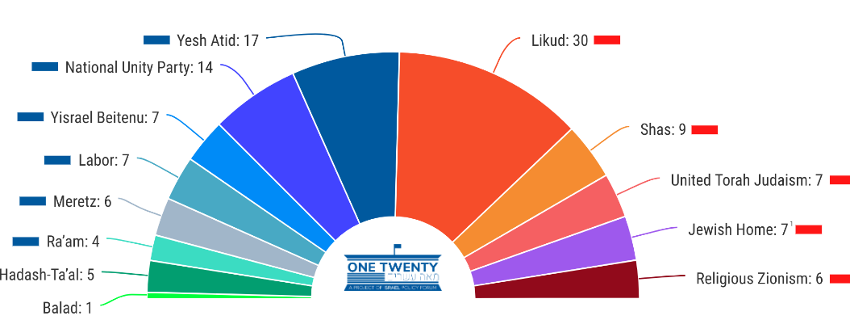
The Graphic 1 below depicts the current seat position:
Graphic 1: Current Knesset Party-Wise Set Up
Current Context: The composition of the current 24-member Cabinet is given in Table 3 below:
Table 3: Composition of Current Israeli Cabinet
| Government Position of the Minister | Name | Party |
|---|---|---|
| 1. Prime Minister | Benjamin Netanyahu | Likud |
| 2. Minister of Defense | Yisrael Katz | Likud |
| 3. Minister of Finance & Minister in the Ministry of Defense | Bezalel Smotrich | Religious Zionist Party |
| 4. Minister of Foreign Affairs | Gideon Sa'ar | New Hope |
| 5. Minister of Justice, Interior, Labor, Religious Services and Jerusalem Affairs | Yariv Levin | Likud |
| 6. Minister of Transportation | Miri Regev | Likud |
| 7. Minister of National Security | Itamar Ben Gvir | Otzma Yehudit |
| 8. Minister of Education | Yoav Kish | Likud |
| 9. Minister of Economy | Nir Barkat | Likud |
| 10. Minister of Culture & Sport | Miki Zohar | Likud |
| 11. Minister of Communications | Shlomo Karhi | Likud |
| 12. Minister of Energy | Eli Cohen | Likud |
| 13. Minister of Environmental Protection | Idit Silman | Likud |
| 14. Minister of Agriculture | Avi Dichter | Likud |
| 15. Minister of Tourism, Housing, Health & Social Affairs | Haim Katz | Likud |
| 16. Minister of Immigration & Absorption | Ofir Sofer | Religious Zionist Party |
| 17. Minister of Science & Technology | Gila Gamliel | Likud |
| 18. Minister of Heritage | Amihai Eliyahu | Otzma Yehudit |
| 19. Minister of Diaspora | Amichai Chikli | Likud |
| 20. Minister of National Projects | Orit Strook | Religious Zionist Party |
| 21. Minister of Social Equality & Women's Advancement | May Golan | Likud |
| 22. Minister of Negev & the Galilee | Yitzhak Wasserlauf | Otzma Yehudit |
| 23. Minister in the Ministry of Justice & Minister of Regional Cooperation | David Amsalem | Likud |
| 24. Minister in the Ministry of Finance | Ze'ev Elkin | New Hope |
It would be seen that Likud has 16 of the 24 cabinet members. Of the rest most important portfolios have gone to the two ultra-religious parties (Religious Zionist Party and Otzama Yahudit) led by firebrand leaders, viz. Bezalel Smotrich and Itamar Ben Gvir, respectively, who have personally been given responsibility for important portfolios such as Finance, Defence (junior minister’s charge) and National Security.[v]
The current 4-year term of the Knesset can be described as Israel’s most turbulent. After the last election in October 2022, Likud party leader Benjamin Netanyahu formed the most right-wing cabinet in Israel’s history by co-opting two ultra-religious parties long regarded as untouchable for their extreme right-wing views. The ruling coalition has a wafer-thin majority against a divided opposition. Against all odds, the Netanyahu government is likely to complete its 4-year term, which would be a remarkable feat as the country faced five elections during the preceding three years (2019-22). This accomplishment is a testament to Netanyahu’s political acumen[vi] as well as desperation in keeping his divided flock together by pandering to their respective micro-agendas.
Netanyahu Factor
Mr Netanyahu, the longest-serving PM in Israel, is a consummate politician who has been the most influential, though highly polarising, force in the country’s politics for over thirty years. Over this period, he has increasingly pursued hard[vii], non-conventional policies, often in disregard of prevalent legal norms and public opinion. These policies have made him a highly polarising figure in Israeli politics and a bete noire internationally. He stands for uncompromised security for Israelis[viii], expansion of Israeli settlements in the occupied territories and preference for muscular military solutions[ix] instead of diplomatic negotiations with the regional adversaries and their proxies. Domestically, his current term has been conspicuous by an “ends-justifying-the-means” approach to curb judicial oversight, seemingly indiscriminate dismissals of officials, outlawing some Arab political parties/personalities, nod-and-wink for the Jewish seminaries and settlers in the Occupied Palestinian Territories (OPT), ignoring the allegations of widespread abuses by the IDF in Gaza, OPT, etc. Most observers believe that while Mr Netanyahu’s personal popularity may be waning, the past three years of hostilities have pushed the popular narrative towards Netanyahuism – a phenomenon he or his successors would find it difficult to live down.
The current 4-year term of the Knesset can be described as Israel’s most turbulent. After the last election in October 2022, Likud party leader Benjamin Netanyahu formed the most right-wing cabinet in Israel’s history by co-opting two ultra-religious parties long regarded as untouchable for their extreme right-wing views. The ruling coalition has a wafer-thin majority against a divided opposition. Against all odds, the Netanyahu government is likely to complete its 4-year term, which would be a remarkable feat as the country faced five elections during the preceding three years (2019-22). This accomplishment is a testament to Netanyahu’s political acumen[vi] as well as desperation in keeping his divided flock together by pandering to their respective micro-agendas.
Emerging Trends
Israel’s nearly 7 million voters have been on an emotional roller coaster since the last elections to the Knesset in 2022. The four-year stint began with large protests and demonstrations against what was seen as a cynical government attempting to hijack the national agenda on issues such as judicial supremacy, exemptions for ultra-orthodox Jews, delay in PM’s corruption trial, rampant settlement activity in OPT, etc. But, then, October 7, 2023, horror happened, rudely disrupting the public narrative and turning it towards accountability for Israel’s largest and most serious security lapse, rescuing the hostages and wreaking vengeance on Gaza’s Hamas militia. While these issues became the national causes, their pursuance left the public opinion largely dissatisfied: the politico-military accountability was piecemeal, far too many hostages died, and their release had to be negotiated with Hamas, which is still around.
Similarly, although the war against Hezbollah has greatly enfeebled it, the Lebanese militia still retains the capacity to threaten citizens living in northern Israel. Two intensive wars against Iran, widely regarded as an existential enemy, had the Israelis under threat from Iranian missiles and drones for months – much longer than any war in their history. As if all this mass-trauma was not enough, serious and public differences recently emerged between the Trump Presidency and Israeli leadership about peace with Iran and cessation of hostilities with Hezbollah. Three years of near constant wars have also meant economic hardships, social dislocation and alienation with much of the world.
These gritty experiences have left most Israelis both dazed and hardened. Long-held absolute faith in their security, intelligence systems and IDF have shown to have limits, and many durable shibboleths lie broken. In a recent poll, 92% of Israelis believe Iran emerged as the winner after the war and deal with the US[x]. Moreover, 72.5% did not believe PM Netanyahu’s assertion that Israel achieved significant gains and removed an existential threat, and 56.4% rating his management of the war as “failed” or “poor.” Just 26.5% considered the premier’s management of the offensive “good” or “excellent,” and 17.1% considered it “fair.” Although there is a growing realisation of the inevitability of political solutions to these conflicts, the popular constituency needed to pursue such a strategy is almost absent.
As Israeli society ruminates over the recent turbulence, a profound churn seems to be underway. While right-wing nationalism is still the default popular position, the electorate has not yet indicated its party preferences. The war-toughened Israeli public currently accords priority to issues such as trust in leadership, national security (nearly 61% favour continued operations against Hezbollah despite the US Pressure), and socio-political equity. There is evidence of anti-incumbency with large sections dissatisfied about the perceived mismanagement of major politico-military crises over the past three years. Some seek new blood at the top to move away from past excessive reliance on muscular solutions, particularly now as Washington’s defence umbrella and diplomatic cover can no longer be taken as a given. While PM Netanyahu’s approval rating has shrivelled to 35%, he is a political Houdini who is still the man to beat at the next Knesset election. He is formidably adept at the shenanigans accompanying the Knesset elections, which have as much to do with public mandate as with horse-trading to somehow cobble a majority. But then, four months to the elections is a very long time in personality-driven Israeli politics as it heads into uncharted territories. A lot would depend on the evolution of the ground situation and how the politicians on public notice scurry.
***
[i] The Israeli population can be classified into the following social groups based on their origin:
(a) Ashkenazim: Those who migrated from the West, mainly Europeans, following the Holocaust and anti-Jewish pogroms; (b) Mizrahim and Sephardim: those with Middle Eastern and Spanish ancestry; (c) Others: such as Ethiopian Jews (Falasha), Heradi (ultra-orthodox seminary students). Incidentally, there are approximately 85,000 Jews of Indian origin living in Israel, comprising of nearly 1% of the population. They primarily consist of the Bene Israel (Maharashtra), Cochin Jews (Kerala), Baghdadi Jews (Kolkata/Mumbai), and Bnei Menashe (Manipur/Mizoram).
[ii] Constant flux in Israeli polity makes the numbers inherently imprecise.
[iii] For details, please see: “Polls show support for Bennett-Lapid alliance slipping as Eisenkot’s party climbs”, Times of Israel, June 25 2026; https://www.timesofisrael.com/polls-show-support-for-bennett-lapid-alliance-slipping-as-eisenkots-party-climbs
[iv] The Israeli Arabs are nearly a tenth of the Israeli population. Their political parties currently face contrarian forces: if united in one bloc, they could have up to a tenth of Knesset seats, making them a kingmaker in a hung house. However, in the current national mood, no political coalition is likely to include them. At the same time, PM Netanyahu has hinted at a move to bar a few Arab politicians from the election.
[v] These two ministers have conducted themselves provocatively on contentious issues such as the al-Aqsa mosque, Jewish settlements in the Occupied Palestinian Territories (OPT), and abusing the detained foreign volunteers of the “Samud” flotilla trying to bring humanitarian assistance to Gaza.
[vi] Since 1996, Netanyahu has been Israel’s PM three times under six different cabinets. If taken cumulatively, he is already longest serving Prime Minister of the country.
[vii] During the tenure of the current 25th Knesset, the Netanyahu government has seen the passage of several hardline laws, including the following: Reasonableness Standard Amendment (2023), Teacher Dismissal and Anti-Sympathy Laws (2024), Deportation of Family Members of Attackers Law (2024), UNRWA Activities Ban (2025-2026), and Death Penalty for Terrorists Law (2026). In July 2024, the Knesset passed a resolution that overwhelmingly rejected the establishment of a Palestinian state.
[viii] Although the October 7 attack exposed Netanyahu’s claim of providing security to Israelis, he has not admitted to any lapse on his part.
[ix] Top brass of the Israel Defence Force (IDF) has often differed with him in the conduct of war operations. More seriously, he has lately fallen out with President Trump on persevering with his campaign against the Hezbollah militia of Lebanon, as Iran wanted the ceasefire to envelope Lebanon front. This has seriously eroded his claim to have a special relationship with President Trump, whom he earlier described as “the best friend Israel has had in the White House.”
[x] For details see: “Poll:92% of Israelis believe Iran emerged as winner after war and deal with US”, Times of Israel, June 21 2026; https://www.timesofisrael.com/poll-92-of-israelis-believe-iran-emerged-as-winner-after-war-and-deal-with-us
The previous issue of A Geopolitical History of Persian Gulf are available here
