
While the recent surge in fighting between the forces of Iran-supported Ansar Allah and the Saudi-backed coalition has its own drivers and motivations, the origin of this conflict can be traced back nearly a century, to 1934, to be precise. In this paper, we try to provide the historical, political and ethno-sectarian background to the evolving situation.
2. Geography
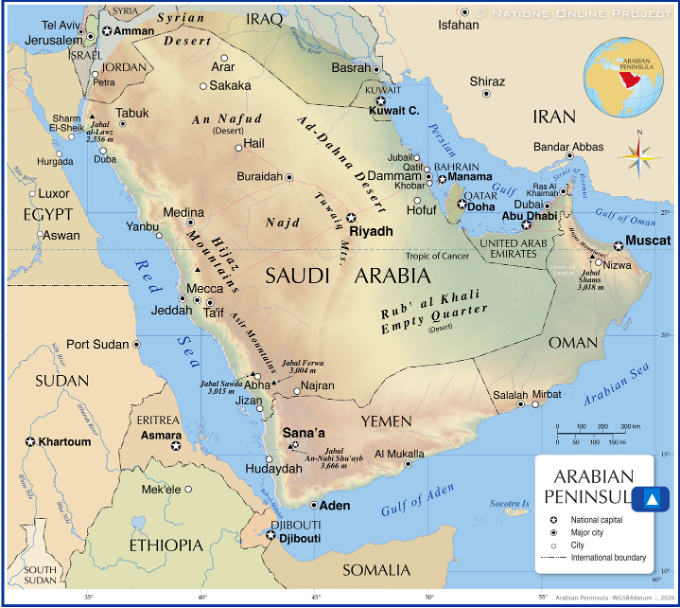
2.1 Yemen is in the southwestern corner of the Arabian Peninsula (Map 1). The entire Arabian Peninsula was desert except for its southwestern corner facing the Red Sea, which the Romans called Arabia Felix (Happy Arabia). This region had the Asir mountain range running parallel to the Red Sea from Taif to the Bab al-Mandeb strait. Relatively ample rains in the shadow of the Asir mountain range and fertile lands sustained agriculture and fixed habitations in contrast to the rest of the peninsula being populated by nomadic tribes. Apart from agriculture, the Yemenis thrived on trade mediation between India and Europe by sea and land as well as religious tourism to Makkah and Madina in the nearby Hijaz region. The country has an area of approximately 4,55,000 sq kms. It has a land border with Saudi Arabia in the north and Oman in the east. It has a coastline of nearly 2000 kms along the Arabian Sea to the east, the Gulf of Aden to the south, and the Red Sea to the west. It also shares maritime borders with Djibouti, Eritrea, and Somalia across the Horn of Africa. At the southwestern corner of Yemen lies the 32 kms wide Bab al-Mandeb Strait connecting the Red Sea with the Gulf of Aden. It has become a vital maritime choke point through which nearly 12% of global trade passes. Among the strategically important islands belonging to Yemen is Perim/Mayun Island dividing the strait into two separate channels—a wider western channel used by large ships and a smaller eastern channel. Socotra Island in the northern Arabian Sea also belongs to Yemen. Asir mountain range runs parallel along the Red Sea shore, ending at the Kahboub Mountains near the Bab al-Mandeb. Most of the country east of the Asir Mountains is desert. Among the mineral deposits are hydrocarbons near the Marib region in the centre of the country, although these deposits are relatively small by Gulf standards.
2.2 Yemen’s current population is estimated at around 43 million. Nearly 70% of Yemenis live in the area in the north and west of the country controlled by Ansar Allah (al-Houthis). Main population centres are: Sana’a (Capital), Aden (Main port on the Gulf of Aden), Hudaydah (port on the Red Sea), Taiz, Marib and Mukalla.
3. Religious and Ethnic Divide
3.1 While nearly 99% of the Yemeni population is Muslim, 65% of them are Sunnis and 35% are Zaydi Shias. Ethnicity-wise, divisions are thought to be 92.8% Arab; 3.7% Somali; 1.1% Afro-Arab; 1.0% Indo-Pakistani; and 1.4% others.
3.2 Without dwelling deeply into theology, Islam spread in the Arabian Peninsula from 622 AD onwards and Prophet Mohammed was later succeeded by four enlightened Caliphs; viz. Abu Bakr (r. 632–634), Umar (r. 634–644), Uthman (r. 644–656), and Ali (r. 656–661). These four Caliphs exercised both religious and state powers, as Islam spread through proselytisation and military conquests. Until that juncture, Islam was only the mainstream or Sunni sect, but theological differences began surfacing. Among these were Zaydism, which was founded by Zayd ibn Ali (695-740 AD), a religious scholar and great-grandson of Ali bin Abi Talib, the son-in-law and cousin of the Prophet Muhammad. Zaydism emerged as a distinct branch of Shia Islam after Zayd ibn Ali led a major, but ultimately unsuccessful, rebellion in Kufa against the Umayyad Caliphate in 740 CE. He was killed during the uprising. Initially, Zaydism was established in northern Iran, but it later found a base in the Sa’ada region of the hilly areas of northern Yemen. Today’s al-Houthi group comprises tribes professing Zaydism.
3.3 Although Zaydism is part of Shiism, it is theologically regarded as closer to Sunni Islam. It regards five leaders – the four Enlightened Caliphs and Zayed bin Ali – while Iranian Shi’ism recognises twelve leaders. The two branches of Shi’ism also differ primarily in their definition of the Imamate, political activism, and core theological doctrines regarding infallibility and the occultation of leaders.
4. History
4.1 Ancient and Medieval Era: Yemen was an ancient civilisation thought to date back to the times of the Queen Sheeba (around the 10th century BC), and Yemen was called the Sabaean federation/kingdom in her memory. In the first century BC, Romans unsuccessfully tried to take over the Sabaean Kingdom. Yemenis were early converts to Islam in the 620s AD and played an important role in the early Islamic state’s military expansion. After adoption of the Zaydi sect of Shia Islam in northern Yemen of today, Muhammad ibn Abdullah ibn Ziyad founded the Zaydi dynasty in Tihamah region around 818. The state stretched from Haly (in south of Makkah in present-day Saudi Arabia) to Aden. They nominally recognised the Abbasid Caliphate but ruled independently. Around the same time, a Himyarite clan called the Yufiri established their rule over the highlands from Saada to Taiz, while Hadhramaut was an Ibadi stronghold and rejected all allegiance to the Abbasids in Baghdad. The first Zaidi imam, Yahya ibn al-Husayn, founded the Zaidi imamate in 897 with influence in Saada and Najran. By 1063, the Sulayhi dynasty had subjugated Greater Yemen and extended its rule to the Hejaz and occupied Makkah. Queen Arwa (1067-1138) was the most important and longest-reigning ruler in this dynasty. She sent Ismaili missionaries to India, where a significant Ismaili community was formed that exists to this day. After her death, the Yemeni state fragmented and eventually came under the tutelage of the Ottomans. By the early 16th century, the Portuguese arrived along the Yemeni coast, occupied Socotra Island, and began threatening Aden. Over the next few decades, Yemen remained a battleground between the Ottomans, Portuguese and the local rulers. Zaydi Imamate in the Yemeni highlands remained largely independent and was the sole coffee producer in the world until the first half of the 18th century, when the Europeans broke Yemen’s monopoly by smuggling coffee trees and cultivating them in their own colonies in the East Indies, East Africa, the West Indies, and Latin America. During the mid-19th century, the British acquired possession of the ports of Mocha and Aden first as coal storage depots for their steamers to and from India, and later to protect their sea route via the Suez Canal, which opened in 1869. In competition, the Ottomans occupied the Yemeni highlands in 1873 and held on till 1911, when they recognised the Zaydi Imamate.
4.2 Modern Post-Independence Era: Zaydi Imam Yahya Muhammad Hamid ed-Din (1911-1948), fought a war with Ibn Saud of Riyadh in 1934 for control of Asir, but had to concede the three provinces of Najran, Asir, and Jazan for 20 years under the Treaty of Taif. He also signed a treaty with Britain recognising British sovereignty over the Aden Protectorate for 40 years. The death of his son Ahmed bin Yahya in 1962 triggered a 6-year civil war pitting the Royalists, supported by Saudi Arabia, Jordan and Israel, against military officers with Egypt’s backing. The external involvement mirrored acute polarisation in the Arab world, pitting Nasser’s Arab Socialist Bloc against Islamic Nationalists led by Saudi Arabia. The civil war ended in 1968 following the June 1967 war in which Israel decimated the armies of Egypt, Jordan and Syria. The territory of northern Yemen was declared as the Yemen Arab Republic (YAR) with a military-led government. Around the same time, the Aden Protectorate was given independence by the British, eventually forming the People’s Democratic Republic of Yemen (PDRY) as a socialist state with close ties with the Soviet Union and China. The ties between the two Yemenis oscillated between negotiations for unification and military skirmishes. Moreover, ties between the two Yemens and Saudi Arabia alternated between hostility and financial support. YAR did not regard its border with the Kingdom as demarcated and maintained its claim to the three provinces temporarily ceded under the Treaty of Taif in 1934. Saudis, who had no diplomatic ties with the USSR and China, had deep suspicion of PDRY’s symbiotic links with the communist bloc. A civil war broke out between two factions of the ruling party in PDRY in 1986 that caused thousands of deaths.
4.3 Yemeni Unification: The dismemberment of the Soviet Union and its east European satellites in 1989 removed the political and economic plank under the PDRY. Moreover, the discovery of hydrocarbon reserves in the Marib region straddling the border between the two Yemens also motivated their unification, which was announced in 1990 as the Republic of Yemen with Sana’a as its capital. YAR President Ali Abdullah Saleh became its first President, and PDRY President Ali Abdullah al-Beidh became the Vice President. However, the merger led to frictions, and the southern part tried unsuccessfully to secede in 1994. The unified country led a somewhat tentative existence, with Al-Qaeda in the Arabian Peninsula (AQAP) being sporadically active in terrorist acts. In 1990, Saudi anger against Yemen over Sanaa’s perceived neutrality on the Iraqi invasion of Kuwait resulted in the expulsion of nearly 800,000 Yemenis from the Kingdom to Yemen. A demarcation agreement on 1500 km long land and maritime border between Yemen and Saudi Arabia was signed in June 2000.
4.4 Impact of the Arab Spring: Yemen was rocked by anti-government protests from early 2011 onwards, which eventually saw President Ali Abdullah Saleh handing over to Vice President Abdrabbuh Mansur Hadi in November 2011. The new government’s weakness prompted al-Houthi forces led by Abdul-Malik al-Houthi to oust it in 2014 and occupy Sana’a. Hadi fled to Aden in early 2015 and claimed to be the country’s legitimate president. He eventually fled from Aden to Riyadh. In March 2015, Saudi Arabia announced that it would lead a coalition against al-Houthis. The coalition included the United Arab Emirates, Kuwait, Qatar, Bahrain, Jordan, Morocco, Sudan, and Egypt. In retaliation, al-Houthis launched increasingly audacious missile and drone attacks against Saudi Arabia and the UAE. These included attacks on the Abqaiq oil processing facility in Saudi Arabia in 2019 as well as Abu Dhabi in 2022. After suffering significant casualties in ground fighting in Yemen, the UAE decided to withdraw its ground troops, who had done heavy fighting against al-Houthis. This, and other withdrawals, reduced the fighting capabilities of the coalition forces and their actions were reduced to implementing an air and sea blockade on the Houthi-controlled areas and bombing by the Saudi Air Force. In February 2018, Aden was seized by the UAE-backed separatist Southern Transitional Council (STC). The UAE also acquired a significant military presence on Socotra island and continued to pursue AQAP militants, particularly in Hadramout Province. Growing instances of famine and displacement led to a UN-sponsored ceasefire between the Houthis and the Coalition Forces in 2022 that held for nearly 4 years. Al-Houthis also waded into Israel’s wars in October 2023 against Hamas in Gaza and Hezbollah in Lebanon. Apart from firing missiles and drones at Israel, they also blocked the Bab al-Mandeb strait through which nearly 12% of global trade passes, causing major maritime disruption. They were subjected to a bombing campaign by the US, UK and Israel, but their blockade continued until 2025.
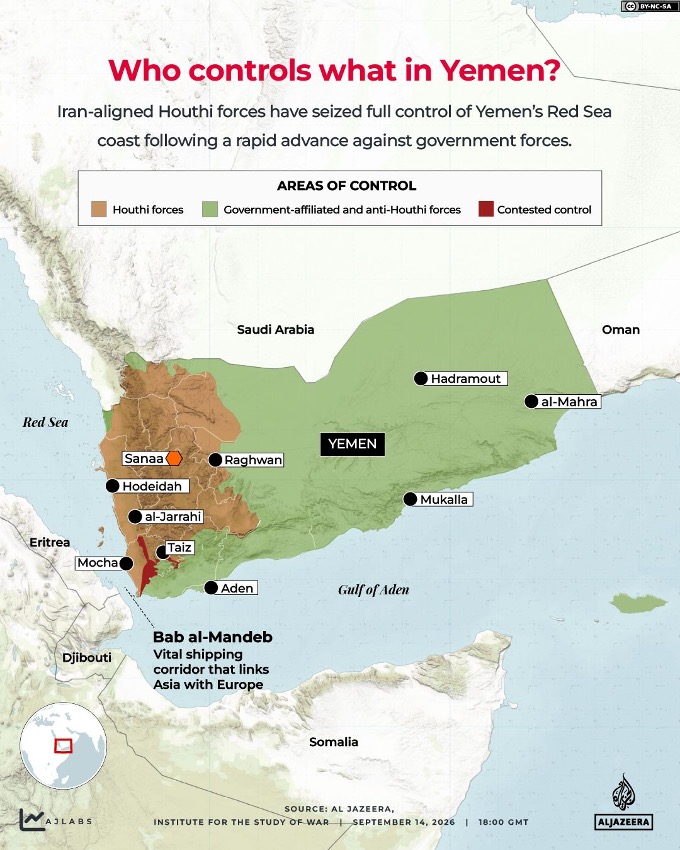
4.5 Recent Developments: On July 13, 2026, the Saudi Air Force bombed Sanaa airport to prevent an Iranian airliner from landing there, unleashing a fierce reaction by al-Houthis. These escalations led to the collapse of the four-year-old ceasefire. In retaliation, al-Houthis resumed targeting Saudi Arabia with missiles and drones, initially hitting bordering cities and military installations, but later expanded to targets such as Yanbu and Riyadh. While Saudis alleged to have brought down a projectile aimed at holy Makkah, al-Houthis denied having targeted it. In retaliation for a decade-old Saudi air and maritime blockade of al-Houthi-controlled areas, the latter announced a blockade of shipping to and from Saudi ports on the Red Sea. This move forced Saudi oil supplies to the Asian markets to travel around Africa instead of passing through the Bab al-Mandeb strait. In addition, the fighting on the ground also escalated, with al-Houthi forces making a lightning advance along the Red Sea coast towards Bab al-Mandeb and the strategic Perim/Mayun island. After controlling almost the entire Red Sea coast, they have been trying to occupy the strategic highlands running parallel to the coastline, meeting stiff resistance from the coalition forces and Saudi air raids. Marib region in central Yemen has also witnessed heavy fighting. Alarmed by al-Houthi forces’ successes, Saudi Arabia has sought foreign help without major response so far. In this regard, Saudi Crown Prince Mohammed bin Salman phoned President Trump to urge air raids on al-Houthis, without eliciting a positive response. He also travelled to Cairo to meet Egyptian President el-Sisi. Saudis have also invoked the Makkah Agreement, and the three Chiefs of Staff of Saudi Arabia, Pakistan and Turkey met in Riyadh on September 25. While no concrete outcome has been publicised, some reports suggest that Pakistani intelligence analysts have lately been helping Saudi targeting of al-Houthi forces.
5. Current Political and Military Stakeholders
5.1 As already mentioned, Yemen has been in a civil war for the past 12 years between the “Internationally Recognised Government” based in Riyadh and Ansar Allah (al-Houthis) rebels based in Sana’a. The current control of the two belligerent forces on the ground is shown in Map 2.
5.2 Some basic background information on the various political stakeholders involved in the Yemeni civil war is as follows:
(a) Al-Houthis:
The Houthis, also known as Ansar Allah (supporters of God), are an armed group in control of mainly northwestern Yemen and several areas close to Saudi Arabia. They are led by Abdel-Malik al-Houthi who acts as Supreme religious and political leader and directs the overall military, strategic, and governance path of the movement. His cousin Mohammed Ali al-Houthi is a prominent political figure and head of the Supreme Revolutionary Committee, which oversees regional supervisors. Mahdi al-Mashat serves as the President of the Supreme Political Council, acting as the civilian head of state in Houthi-controlled territories. The political and military hierarchy of the movement is largely clan-based.
Al-Houthi decision-making structure comprises of:
- The Jihad Council: The secretive supreme military command council, which coordinates battlefield operations and military strategy.
- Supreme Political Council: Acts as the administrative and executive governing body handling day-to-day governance in areas under Houthi control.
- Network of Supervisors: A parallel system of local and regional ideological enforcers (mashrifin) who bypass traditional bureaucratic structures to implement leadership directives across governorates.
The Houthis, from Yemen’s Zaidi Shia minority, emerged in the northern mountainous region of Saada in the 1990s, demanding a greater share of power. They capitalised on the widespread public anger against the weak transitional government that came to power after longtime President Ali Abdullah Saleh was forced to step down following the 2011 Arab Spring protests.
The Houthis initially allied with military units loyal to former President Saleh as they captured the Red Sea port of Hodeidah in October 2014. In January 2015, they seized the presidential palace in Sanaa, forcing President Abd-Rabbu Mansour Hadi to flee to the southern port city of Aden. Hadi later moved to Saudi Arabia, from where he ran his government-in-exile until his resignation in 2022. The Houthi group then spent years, with Iran’s backing, fighting a military coalition led by Saudi Arabia.
Often perceived as part of a regional alliance known as the “axis of resistance” and backed by Iran, the Houthi group nevertheless has its own base, its own interests, and its own ambitions.
The group has gained international prominence for its attacks on Israel and shipping in the Red Sea since the start of Israel’s battle against Hamas in Gaza in October 2023.
Since September 10, they have tightened control over the country’s Red Sea coast, a vital shipping lane.
(b) Presidential Leadership Council
The Riyadh-based PLC was established in 2022 when former President Hadi formally transferred his powers to the new eight-member body. It represents the internationally recognised government of Yemen, with a mandate to manage the country’s political, security and military affairs, and to steer negotiations towards a permanent ceasefire. It is chaired by Rashad al-Alimi, an adviser to Hadi and former interior minister with the government of the late President Saleh. Initially, its eight members included three from the UAE-backed Southern Transitional Council (STC). In January 2026 following UAE-Saudi clash in Mukalla, two of those members were replaced. It currently has three Vice Presidents (A nephew of Late President Ali Abdullah Salem and two members of Islamist Party called Al-Islah) and four other members (including one member of the UAE-backed Giants Brigade, an ex-defence minister, a lawmaker from the Houthi area and the Governor of Hadramaut province).
Its membership is drawn from a mix of northern and southern politicians and military-linked leaders in a bid to unite major anti-Houthi forces under one roof.
The PLC is backed by Saudi Arabia and the alliance that Riyadh leads. Since taking over complete control of southern Yemen after the dissolution of the STC, the PLC aims to unite Yemen, including the areas controlled by the Houthis.
(c) Islah party
The Yemeni Congregation for Reform, better known as Islah, is a Sunni Islamist movement with historical ties to the Muslim Brotherhood. It is a faction within the recognised PLC-led government but has long had an independent identity. Its major stronghold has long been Marib, the country’s sole gas-producing region with one of its largest oilfields.
(d) National Resistance Forces
The National Resistance Forces is a government-aligned military faction led by Tareq Saleh, nephew of the late former President Saleh. It inherited many of Yemeni armed forces units and armaments.
It aims for a unified Yemen, positioning itself as a counterweight to both the Houthis and southern secessionists. The force has maintained ties to Saudi Arabia and, like the Islah party, is part of the PLC. Yet, it is often regarded as a wild card as its leadership retains the ambition of ruling Yemen again.
6. Short Analysis and Comment
The following remarks are in order:
(i) The current tumult in Yemen and between Yemen and Saudi Arabia has complex and multi-layered drivers rooted in shared history and geography as well as ethnic differences.
(ii) In the current regional context, Iranian theocrats and al-Houthis share a strong bond of Shia ethnicity. They are also part of the so-called “Axis of Resistance” pitted against Israel. Iran’s technical and financial assistance, as well as moral support, has been a tremendous enabler for al-Houthis to emerge over the last two decades from an obscure rag-tag outfit to a feared non-state actor capable of taking on mighty Saudi Arabia, threatening Israel, defying British, American and Israeli bombing and causing serious maritime disruption at the Bab al-Mandeb chokepoint. While they continue to be a serious disruptor, their precise domestic and regional endgame remains unclear at this stage. How far are they likely to go to help Iran and vice versa can only be speculated, noting that they did not do much during the two wars Iran faced during the past 18 months.
(iii) Moreover, non-kinetic aspects of the Ansar Allah Group have not been articulated beyond condemnation of Israel and the US. What are they fighting for in Yemen and in the region? What kind of ties do they eventually want with Saudi Arabia? What is their political and welfare agenda? These questions have not been credibly addressed. In that void, there is little to base a long-term prognosis of the Yemeni situation. Till these inputs are available, al-Houthi, though among the most powerful non-state actors in the world, may remain a symptom of regional ferment without making a worthwhile contribution to its resolution.
(iv) Saudi motivations about Yemen have always been somewhat nebulous. Riyadh always wanted neighbouring Yemen to be weak and divided, but not a social burden on the Kingdom through mass migration, terrorism, etc. Before 1990, a Yemeni national did not require either a visa or a work permit in Saudi Arabia. This exception was revoked to punish Yemen, then a non-permanent member of the UN Security Council, for failing to condemn Saddam Hussein’s invasion and occupation of Kuwait. Still, a significant number of Saudis belong to Yemeni tribes. The most egregious example of such persons was al-Qaeda supremo Osama bin Laden, who, though a family member of a mammoth Saudi construction group, was of Hadhrami extraction. Many of the AQAP members, who posed a very serious terrorist threat to Saudi Arabia, were also of Yemeni extraction. Kingdom has avoided conscription as it was unsure of the patriotism of such ethnicities. These and other factors enabled the North Yemenis to impose an effective asymmetric balance of power vis-à-vis Saudi Arabia even before the current conflict. When push came to shove in the past, the Saudi options seemed limited to either buying peace, carpet-bombing Yemen or relying on foreign defenders. In the new context of the Saudi-Yemeni conflict being linked to extraneous considerations (such as the Iran-US war) and spilling over the Bab al-Mandeb blockade – in tandem with a Yemeni civil war- we are on uncharted and very choppy seas.
***
The previous issue of Islamabad MOU and Pakistan: An Analysis are available here: LINK
(The views expressed are personal)
