
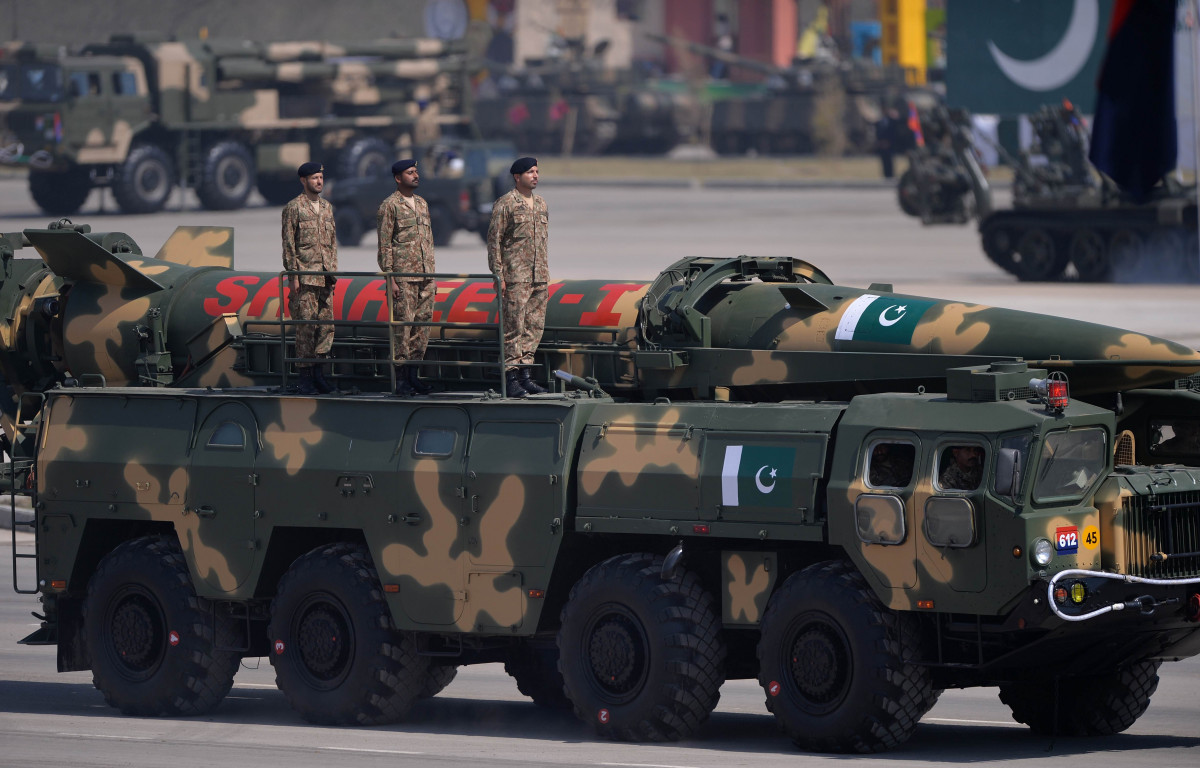
Pakistan’s military parade showcasing its nuclear-capable missiles
Source: https://pxhere.com/en/photo/535401
Nuclear Sabre-rattling
Lt Gen (Retd.) Khalid Ahmed Kidwai (KAK), Adviser to Pakistan’s National Command Authority, delivered the keynote address at the Islamabad Non-Proliferation Conference 2026, organized by the Strategic Vision Institute, on October 20. A long-time presence in Pakistan’s nuclear policy making, KAK’s views can be presumed to reflect those of the Pakistani establishment.
KAK said that Pakistan’s credible minimum nuclear deterrent had established strategic stability in South Asia by shaping strategic behaviour on both sides. He added that the policy of Full-Spectrum Deterrence that came into being in 2011 with the flight test of the short-range Nasr (Hatf-IX) ballistic missile occupies a central place in Pakistan’s security calculus. Full Spectrum Deterrence, while remaining within the broader philosophy of credible minimum deterrent, encompasses tactical, operational and strategic nuclear weapons, providing full coverage of India and its outlying territories. Pakistan has enough weapons of varied range and yield to deter India’s policy of massive retaliation. Pakistan’s nuclear deterrent today is based on an operationally balanced triad of land, air and sea based strategic forces, which deter a major Indian aggression comprehensively.
According to KAK, the South Asian experience illustrates the enduring relevance of nuclear deterrence for preserving strategic stability in a complex environment. He invoked the crises situations since 1986 -viz. Operation Brasstacks, Operation Parakram, the aftermath of the Mumbai terror attack in 2008, the challenge of India’s Cold Start Doctrine responded to with Nasr, the post Uri terror attack strikes by India in 2016, the post Pulwama attack crisis in 2019 and the May 2025 conflict- and claimed that Pakistan’s nuclear deterrent forced India to adjust its actions by way of curtailment of its politico-military objectives, the time and space of action and the scale of war etc. He added that from the high point of the objective of cutting Pakistan into two during Operation Brasstacks, India had come down to the low point of limited strategic strikes with standoff weapons.
KAK said that Pakistan’s strategic weapons create two effects. First, in limiting the scale, scope and character of India’s military options. India’s desire to seek space for limited war despite a nuclear overhang remains shrunk. Second, each time there is a crisis, alarm bells start ringing far off, especially in Washington DC, other western countries and in the Middle East, bringing diplomatic interventions to cool the emerging crisis. He expected this impact to become more pronounced in future due to the Makkah Defence Agreement. Referring to the May 2025 crisis, he said that Vice President J D Vance, who only a day or two earlier had said that the conflict was none of US’S business, intervened subsequently to defuse the situation.
Claims regarding the Operation Sindoor Aftermath
Speaking of the post Operation Sindoor situation, KAK said that the new normals are now defined by Pakistan and ensure deterrence stability through a robust combination of Pakistan’s conventional and nuclear forces. Air superiority in South Asia has changed hands. The war was won by Pakistan in the very first hours of 7th May as the PAF emerged as the dominant air power in South Asia. The gap will grow with greater technology induction in PAF in the near future. He claimed that the Indian Air Force is low on meaningful numbers, technology and doctrines and severely lags behind.
KAK added that it was time for a changed strategy. The next time India takes military action against Pakistan, a retaliatory policy of quid pro quo plus should be adopted with enhanced strength, geographical reach and imposition of unacceptable costs in sensitive targets.
Pakistan’s Concerns
After the foregoing saber-rattling and claiming that Pakistan shoulders the responsibility of maintaining strategic balance in the conventional and nuclear equation in South Asia, KAK referred to the following two developments that could threaten this balance.
First, induction of emerging technologies, such as AI, hypersonic weapons, cyber technologies, space technologies, robotics and technologies in the electro-magnetic spectrum by India that could upset the balance. Pakistan will have to ensure that this does not happen (presumably by keeping up with India’s induction of such technologies).
Second, according to the SIPRI Yearbook 2026, India has overtaken Pakistan’s nuclear weapons inventory by twenty odd weapons: 190:170. KAK said that Pakistan, however, knows the number and quality of its weapons. The above Yearbook further states that India has operationally deployed around 12 nuclear weapons on a nuclear submarine for occasional deterrence patrols. KAK added that it implies that India has now mated some of its nuclear warheads with SLBMs. This, he claimed, casts doubts on India’s declared policy of ‘no first use’. However, it is irrelevant whether the weapons are for first or second strike, as it gives India the option of first strike at zero notice. Pakistan, therefore, reserves the right to take all appropriate measures to preserve the strategic balance in the face of this development (presumably by reviewing its weapon deployment options). KAK complained that the absence of pre-notification of Indian SLBM tests increases the risk of miscalculation and nuclear escalation.
Analysis of Khalid Ahmed Kidwai’s pronouncements
Pakistan has not announced an official doctrine for the use of nuclear weapons and has sought to maintain deterrence through ambiguity and an evolving stance. It has not committed itself to no first use of these weapons. Pakistan claims to maintain credible minimum deterrence, though its dependence on nuclear weapons has grown with the widening military gap with India. In September 2013, Pakistan’s National Command Authority announced that Pakistan would continue adherence to the policy of credible minimum deterrence, but in view of the “evolving security dynamics in South Asia”, it would maintain a full spectrum deterrence capability to deter all forms of aggression. Pakistan has continued to tout its missiles inventory with a range of 60 to 2750 kilometers. Its nuclear policy makers have often spoken of working towards a nuclear triad. Speaking at the Carnegie International Nuclear Policy Conference in 2015, KAK said that a limited and modern second-strike capability would be helpful for Pakistan. On being asked if this would involve a sea-based capability, he answered in the affirmative, adding that it was work in progress.
Much of what KAK has said now is a reiteration of the aforementioned earlier pronouncements. However, there are a few points of note. First, he has now stated that Pakistan’s nuclear deterrent is based on an operationally balanced triad of land, air and sea based strategic forces. Does this include a credible sea-based capability? This aspect bears careful scrutiny. In 2017 and 2018, Pakistan announced successful flight tests of the sea-based cruise missile, Babur 3, with a range of 450 kilometers. Subsequent reports suggested that Pakistan might initially deploy nuclear tipped Babur 3 missiles on the French Agosta 90 submarines already in its inventory and subsequently on the eight Hangor class diesel-electric submarines being acquired from China. However, there has been no further publicly confirmed test of Babur 3, nor any confirmation of deployment of this missile on Pakistan’s naval platforms. According to some reports that surfaced earlier this year, Pakistan requested China for help in acquiring a nuclear second-strike capability, but China declined the request citing its non-proliferation obligations. Further, Pakistan has nothing to match the reported deployment of SLBMs by India on a nuclear-powered submarine. Therefore, KAK’s aforementioned claim regarding a sea-based capability is suspect. Second,since its 1998 nuclear tests, Pakistan has maintained that there can be no war under a nuclear overhang. However, starting with the Kargil war to the May 2025 conflict, India has progressively expanded the space for military action against Pakistan under the nuclear overhang. Therefore, KAK’s aforementioned assertion that Pakistan’s nuclear weapons “deter a major Indian aggression” (emphasis added) is closer to reality. In any case, India has stated that regardless of the type of weapon used, a nuclear attack by Pakistan would invite a massive retaliatory strike. India’s sea-based second-strike capability has to be seen in this context. Further, the above dynamics also explain KAK’s reference to a retaliatory policy of quid pro quo plus in the conventional domain in the event of a future military action by India. Third,KAK has explicitly confirmed what has been evident all along that Pakistan sees its nuclear weapons as an instrument of blackmail to, inter alia, arouse anxieties in the international community, thereby inviting third party intervention in the event of an India-Pak conflict.
In spite of the heavy element of bravado and nuclear brinkmanship in KAK’s address, it also betrays Pakistan’s continued sense of insecurity. KAK has referred, in particular, to future induction of emerging technologies by India and the reported deployment of SLBMs on an Indian nuclear-powered submarine. He promises necessary steps to respond to these challenges, presumably by keeping/catching up with India in these domains. However, besides being time consuming, especially the acquisition of a credible sea-based capability, such steps would also involve a large financial outlay, placing additional burden on Pakistan’s already overstretched treasury. KAK’s promise of keeping/catching up with India is of a piece with the Pak army’s policy of splurging Pakistan’s scant financial resources in its obsessive competition with India.
Further, KAK’s description of Pakistan as the self-styled maintainer of strategic balance in the conventional and nuclear equation in South Asia is disingenuous. It is in fact the army led Pakistani establishment that has been vitiating regional stability through its short-sighted policies.
Post Operation Sindoor Scenario
The conclusions drawn by Pakistan from the May 2025 conflict are the exact opposite of those drawn by India. Pakistan seems to have drawn a gratuitous conclusion of dominance and victory based on its having shot down an unspecified number of Indian air force aircraft in the very initial hours of the conflict. Even if one discounts the element of grandstanding and brinkmanship, KAK’s pronouncements concerning Operation Sindoor reflect the above misreading. The Pakistani establishment is also emboldened by its being in the good books of President Trump and signing of the Makkah Defence Agreement. It continues to foist the blame for its own failure to check internal terrorism and violence on India. On the other hand, in the Indian reckoning, Operation Sindoor has established yet again that conventional military action against Pakistan under the nuclear overhang is possible and the space for it has expanded with this operation. In any future conflict(s), India may be tempted to expand it further. Since India’s larger Pakistan problem remains intact, India seems to see the May 2025 action as a task partly done. Both sides have expressed the resolve to hit harder and deeper in future. They are plugging the gap in their military capabilities identified in May 2025. The bilateral relationship remains completely frozen and in the absence of diplomacy, coercion, overt and convert, remains the currency of the relationship. Consequently, the current no war-no peace situation between the two countries is anything but stable.
The Pakistan army has formalized and tightened its de-facto control over the country’s nuclear arsenal through the creation of the National Strategic Command headed by a four-star general. The hitherto separate strategic forces commands in the army, navy and air force, responsible for the respective services’ strategic delivery systems, have now been placed under the National Strategic Command.
India and Pakistan have concluded five agreements concerning nuclear CBMs: 1. The 1988 Agreement on Prohibition of Attack Against Nuclear Installations and Facilities. It continues to function through annual exchange of the co-ordinates of the relevant installations and facilities. 2. The February 1999 Lahore Memorandum of Understanding, which, inter alia, provided for the two countries engaging in consultations on security concepts and nuclear doctrines, with a view to developing measures for confidence building in the nuclear and conventional fields. 3. The 2004 decision to establish a dedicated and secure hotline between the Foreign Secretaries of the two countries to prevent misunderstandings and reduce risks relevant to nuclear issues. 4. The Agreement on Pre-Notification of Flight Testing of Ballistic Missiles-2005, and 5. The 2007 Agreement on Reducing the Risk from Accidents Relating to Nuclear Weapons. Singed for an initial period of 5 years, it was extended for a similar period in 2012 and 2017. However, there is no information in the public domain regarding any further extension.
No new nuclear CBMs have been concluded post 2007, both because of the frequent disruption and discontinuation of bilateral dialogue; and Pakistan’s attempts to tie India down to bilateral arrangements, which India is not in a position to accept because of its larger security environment going beyond Pakistan.
In the light of the foregoing, particularly an overconfident Pakistani establishment, India needs to remain vigilant against any misadventure by Pakistan. At the same time, there is need to look for opportunities to resume bilateral diplomacy, alongside deterrence and coercion, to ensure better management of this difficult relationship, thereby reducing the risk of conflict.
The previous issue of the Makkah Joint Defence Agreement are available here