Introduction
For more than three decades following the sudden collapse of the Soviet Union in 1991, the five republics of Central Asia—Kazakhstan, Kyrgyzstan, Tajikistan, Turkmenistan, and Uzbekistan—were frequently viewed through the prism of external rivalries. Framed by outside observers as a passive chessboard for a modern “Great Game” among Russia, China, and the West, using the same terminology for the contestation between the Russian Empire and the British in the 19th century, the region spent its early post-independence years grappling with fragile state institutions, economic dislocation, contested borders, and deep infrastructural dependence on Moscow.
Thirty-five years after independence, that characterization is obsolete. By 2026, Central Asia has emerged not as a geopolitical buffer zone, but as an assertive, increasingly cohesive, and indispensable pivot of Eurasian diplomacy, trade, and resource security. Driven by generational leadership shifts, hard-won internal peace, robust economic expansion, and an astute “multi-vector” foreign policy, the five states have begun speaking with a unified regional voice—transforming their landlocked geography from a historical liability into a premier strategic asset.
A New Era of Regional Cohesion and "C5" Diplomacy
Perhaps the most profound transformation in Central Asia over the past decade is the region’s ability to overcome internal fragmentation and present a collective diplomatic front. In the 1990s and 2000s, intra-regional cooperation was routinely paralyzed by personal rivalries between leaders, disputes over upstream and downstream water rights, energy blockades, and heavily mined borders.
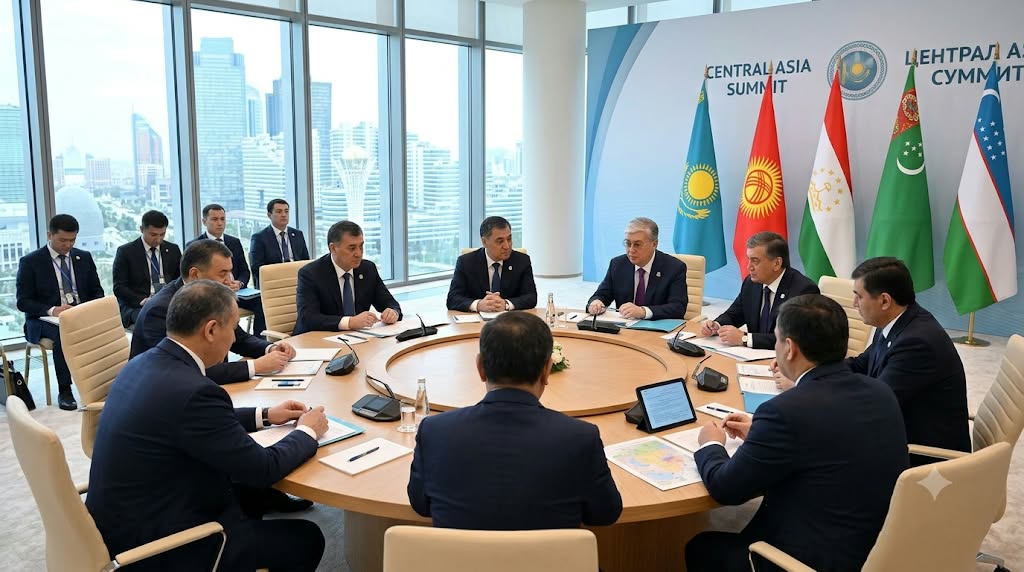
That era began to recede following political transitions in Tashkent and Astana, culminating in the institutionalization of the Consultative Meetings of the Heads of State of Central Asia. Rather than waiting for external powers to mediate their affairs, the five presidents began meeting regularly on their own initiative to coordinate trade, water management, industrial policy, and security.
This internal solidarity gave birth to the “C5+1” diplomatic architecture, a mechanism that has fundamentally altered how major powers engage the region. Instead of negotiating bilaterally from positions of relative weakness, Kazakhstan, Kyrgyzstan, Tajikistan, Turkmenistan, and Uzbekistan now engage global powers collectively. Over recent years, the C5+1 format has been elevated to presidential and ministerial summits with the United States, the European Union, China, Russia, India, Japan, South Korea, and the Gulf Cooperation Council. Whether at the Samarkand C5+1 ministerial meetings with Washington or high-level summits in Tokyo and Brussels, Central Asian leaders increasingly set the agenda—insisting on technology transfer, local value addition, and infrastructure investment rather than raw resource extraction.
Resolving Borders and Consolidating Security, Law, and Order
Confidence on the world stage is impossible without stability at home, and Central Asia’s recent progress in settling Soviet-era territorial anomalies stands as a diplomatic triumph. For thirty years, the Fergana Valley—where the borders of Uzbekistan, Kyrgyzstan, and Tajikistan interlock in a labyrinth of enclaves and exclaves—was a flashpoint for deadly skirmishes over pastureland, water canals, and transit roads.
Through sustained political will, those flashpoints have been systematically extinguished. Following the landmark delimitation of the Uzbek-Kyrgyz frontier, Kyrgyzstan and Tajikistan achieved a historic breakthrough in March 2025 with the signing of their bilateral border agreement, followed swiftly by the trilateral Treaty of Khujand alongside Uzbekistan. By demilitarizing frontier zones, exchanging territories equitably, compensating affected residents, and completing physical border demarcation and fencing by late 2026, the three nations closed the book on Central Asia’s most dangerous interstate disputes.
Alongside border peace, domestic governance, law, and order have steadily strengthened. Across the region, governments have pursued sweeping administrative, judicial, and anti-corruption reforms aimed at modernizing state capacity and improving the rule of law for both citizens and foreign investors. Digitalization of public services—exemplified by Kazakhstan’s advanced e-government ecosystem and Uzbekistan’s rapid fintech and banking modernization—has curtailed petty bureaucratic corruption and brought vast segments of the informal economy into the formal tax base.
EU Reporter
On the security front, the region has demonstrated remarkable resilience despite the volatile neighborhood surrounding Afghanistan and West Asia. Regional intelligence agencies and border forces cooperate closely to counter transnational narcotics trafficking, cybercrime, and violent extremism. Crucially, rather than relying solely on Russian-led security umbrellas like the Collective Security Treaty Organization (CSTO), Central Asian militaries have diversified their defense partnerships, modernized domestic forces, and adopted pragmatic, coordinated engagement with Kabul to ensure border stability and advance trans-Afghan transit projects.
Economic Momentum and Structural Modernization
Economic vitality underpins Central Asia’s newfound self-assurance. While much of the global economy has contended with sluggish expansion, Central Asia has consistently outpaced global growth averages. Projections from international financial institutions—including the World Bank, the International Monetary Fund, and the Eurasian Development Bank—highlight sustained annual GDP expansion across the region, led by vigorous growth in Uzbekistan, Tajikistan, and Kyrgyzstan alongside steady diversification in Kazakhstan.
With a combined population now surpassing 80 million—and a median age under 30—Central Asia possesses a demographic dividend that stands in stark contrast to the aging workforces of Europe, Russia, and East Asia. Governments are actively harnessing this youthful energy by shifting away from pure commodity dependence toward manufacturing, green energy, logistics, and digital technology.
- Kazakhstan has positioned itself as Eurasia’s premier financial, tech, and logistics hub, attracting billions in foreign direct investment while expanding its renewable energy capacity and sovereign wealth reserves.
- Uzbekistan, following years of currency liberalization, privatization, and WTO accession reforms, has become a magnet for industrial manufacturing, textiles, chemical processing, and agricultural exports.
- Kyrgyzstan and Tajikistan are capitalizing on their immense mountainous water reserves to develop major hydropower projects—such as the Rogun and Kambar-Ata-1 dams—that promise to transform them into clean electricity exporters for the entire region.
- Turkmenistan, leveraging some of the world’s largest natural gas reserves, has steadily expanded energy exports eastward while opening new transit links toward the Caspian Sea and Europe.
The Geopolitical Magnet: Why the World is Courting Central Asia
Central Asia’s multi-vector foreign policy—the art of maintaining constructive, balanced ties with all major global centers without submitting to any single bloc—has proved tailor-made for a multipolar world. As geopolitical friction disrupted traditional East-West supply chains following the Russia-Ukraine war and maritime instability in the Red Sea and Strait of Hormuz, global powers rushed to deepen ties with the region.
- China–Central Asia (C5+China) Summits
China has rapidly institutionalized its collective engagement with Central Asia at the presidential level. The format began with a virtual summit in January 2022 to commemorate the 30th anniversary of diplomatic relations, where President Xi Jinping pledged deeper trade, security, and Belt and Road cooperation. This was elevated to the first in-person China–Central Asia Summit in Xi’an in May 2023, symbolically staged at the eastern terminus of the ancient Silk Road. There, Beijing unveiled sweeping infrastructure, energy, and development financing plans while establishing a permanent secretariat for the mechanism. Momentum continued at the second in-person summit in Astana in June 2025, where the six leaders signed a treaty on “eternal good-neighbourliness and friendly cooperation,” agreeing to accelerate rail connectivity, green energy, and industrial modernization ahead of the third summit scheduled for China in 2027.
- Russia–Central Asia (C5+Russia) Summits
Recognizing the growing diplomatic competition from other major powers, Moscow established a dedicated six-party leaders’ format alongside traditional post-Soviet institutions like the CIS and CSTO. The inaugural Russia–Central Asia Summit was held in Astana in October 2022, where President Vladimir Putin and the five Central Asian leaders focused on safeguarding shared security—particularly regarding spill over risks from Afghanistan—and preserving trade, transit, and food supply chains amid Western sanctions on Russia. At the second Russia–Central Asia Summit in Dushanbe in October 2025, the leaders adopted a Joint Action Plan to reinforce industrial cooperation, energy ties, and migration frameworks. Even within this format, Central Asian presidents have increasingly asserted sovereign equality, insisting on mutual respect and balanced economic partnerships rather than passive deference to Moscow’s geopolitical priorities.
- The United States and Europe:
Washington and Brussels view Central Asia as vital to Eurasian strategic autonomy and supply chain resilience. Through the C5+1 framework and the EU’s Global Gateway initiative, Western capitals have poured diplomatic capital and financing into green transitions, educational exchanges, digital connectivity, and alternative trade routes that bypass Russia.
- India–Central Asia Summit (27 January 2022)
Prime Minister Narendra Modi hosted the first Central Asia plus India virtual Summit on 27th January, 2022 to mark 30 years of diplomatic relations. The inaugural Summit adopted the comprehensive Delhi Declaration, establishing a structured institutional architecture for engagement. Key decisions included:
- Institutionalization: Agreeing to hold the leaders’ summit biennially (every two years) and establishing an India–Central Asia Centre in New Delhi to serve as a dedicated secretariat.
- Multi-Tiered Mechanisms: Institutionalizing regular ministerial meetings across Foreign Affairs, Trade, and Culture, alongside annual National Security Advisor (NSA) dialogues on regional security and Afghanistan.
- Working Groups & Forums: Creating senior-official Joint Working Groups (JWGs) on Afghanistan and the Chabahar Port, launching an India–Central Asia Parliamentary Forum, and establishing an India–Central Asia Investment Club under the existing Business Council.
- Cultural & People-to-People Ties: Commissioning a Dictionary of Common Words, organizing traveling Buddhist exhibitions, expanding ITEC and ICCR scholarships, and hosting a 100-member Central Asian youth delegation annually.
Despite strong goodwill and institutional blueprints, India’s engagement lags behind major peers in summit-level execution and commercial scale. While China, Russia, the United States, the European Union, and Japan have all convened high-profile in-person summits with Central Asian leaders—frequently backed by multi-billion-dollar investment pledges—India has yet to hold its second (and first in-person) C5+India Leaders’ Summit, leaving the 2022 biennial pledge unfulfilled.
- Türkiye: Bound by deep linguistic, cultural, and historical kinship, Ankara has rapidly expanded its influence through the Organization of Turkic States (OTS). Türkiye serves not only as a major investor and defense supplier, but as Central Asia’s indispensable western gateway to European markets.
- Iran: Seeking to break out of international isolation and leverage its geography, Tehran has positioned itself as Central Asia’s shortest maritime bridge to the Persian Gulf and Indian Ocean. Through rail links connecting Kazakhstan and Turkmenistan to Iranian ports—including Bandar Abbas and Chabahar—Iran offers landlocked Central Asian exporters vital access to South Asian and Middle Eastern markets.
Critical Minerals and the Rise of the Middle Corridor
Two strategic imperatives explain why global interest in Central Asia has surged to historic highs: critical minerals and transcontinental connectivity.
As the global economy accelerates its transition toward clean energy, artificial intelligence data centers, electric vehicles, and advanced defense systems, demand for rare earth elements and critical minerals has skyrocketed. Central Asia sits atop one of the richest geological treasure troves on earth. Kazakhstan alone produces roughly 40 percent of the world’s uranium and holds vast reserves of lithium, titanium, beryllium, tantalum, and rare earth metals. Uzbekistan possesses massive deposits of copper, gold, uranium, and lithium, while Tajikistan and Kyrgyzstan hold significant reserves of antimony, tungsten, and rare earths. For the United States, the European Union, India, Japan, and South Korea, partnering with Central Asia is essential to de-risking global mineral supply chains from single-source monopolies. Crucially, Central Asian capitals are leveraging this demand to insist that foreign partners build local processing and refining facilities rather than simply shipping raw ore abroad.
Equally transformative is the rise of the Middle Corridor—formally known as the Trans-Caspian International Transport Route (TITR). Stretching from China through Kazakhstan, across the Caspian Sea to Azerbaijan and Georgia, and onward to Türkiye and Europe, the Middle Corridor has evolved from a secondary contingency route into a primary artery of global trade. Geopolitical sanctions on northern routes through Russia and security threats along southern maritime chokepoints have compelled logistics giants and governments to invest billions in modernizing Caspian ports like Aktau and Kuryk, expanding ferry fleets, harmonizing customs tariffs, and upgrading rail lines such as the China-Kyrgyzstan-Uzbekistan railway and the Baku-Tbilisi-Kars link. Simultaneously, southern corridors—such as the International North-South Transport Corridor (INSTC) and trans-Afghan rail proposals—promise to link Central Asia directly with India and the Arabian Sea.
A Confident Horizon
Thirty-five years after stepping onto the world stage amid uncertainty and skepticism, Central Asia has decisively claimed ownership of its destiny. The credit for this radical transformation and sweeping change must go foremost to President Shavkat Mirziyoyev of Uzbekistan, as also to former President Nursultan Nazarbayev and current incumbent Kassem Jomart Tokayev of Kazakhstan for their leadership, vision, determination and resilience.
Challenges undoubtedly remain: climate change threatens glacial water supplies, rapid population growth demands sustained job creation, and balancing relationships among competing great powers requires constant diplomatic agility.
Yet the trajectory is unmistakable. With peaceful borders, growing economies, a young and increasingly skilled workforce, vast reserves of the minerals powering the twenty-first century, and control over the vital crossroads of Eurasia, Central Asia is no longer on the margins of global politics. Speaking with a confident, unified voice, the heart of Eurasia is shaping the architecture of the modern world.
The previous issues of Stepping into the Heartland: Rubio’s Central Asian Venture to Counter Regional Influence (Central Asia Digest) are available here: LINK