
As geopolitical tensions mount, ongoing conflicts globally have cradled battlefield innovation. Ananta’s Command Chain reviews the security and defence-centric developments that are shaping warfare’s evolution. In this edition we analyse the strategic logic of why China sees LAC incursions as a way to tie down India’s potential; how Pakistan’s expanding alliance footprint complicates India’s Indo-Pacific vision; how Poland can be a key partner for India in its quest to become self-reliant in maintaining military platforms of Russian-origin; India’s newly announced civil defence network; and submarine cables as a potential casualty of the Iran-US war.
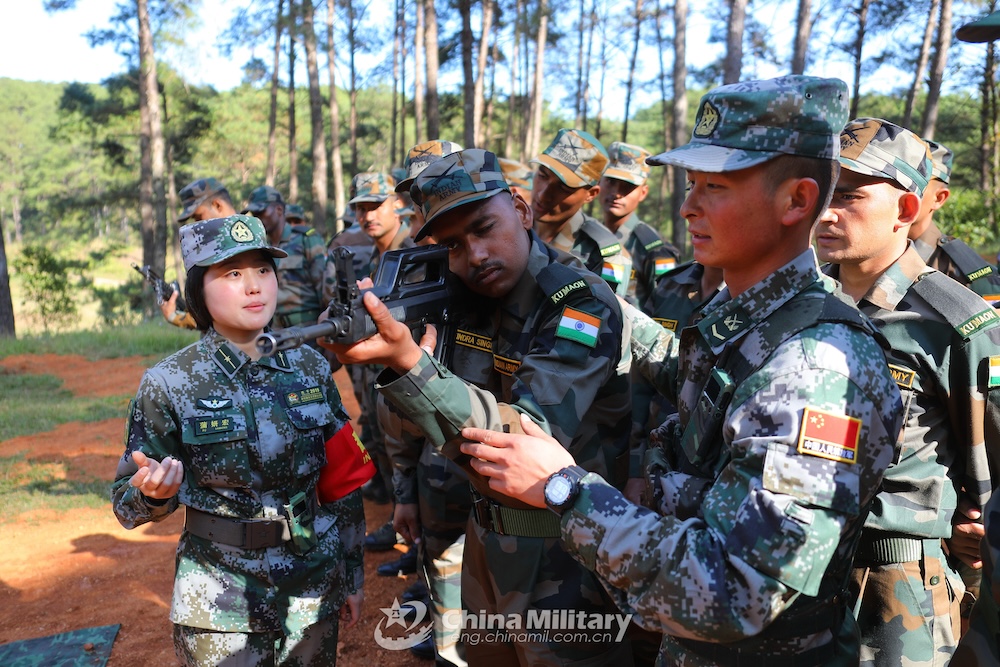
Indian and Chinese troops during a 2019 exercise
India-China confrontation and the logic of containment
The now recently superannuated Director General of India’s Indo-Tibetan Border Police (ITBP) Shatrujeet Kapur revealed in a statement cited by the Hindustan Times on 22 October 2026, that Indian and Chinese troops have repeatedly navigated standoffs along the Line of Actual Control (LAC), related to the border dispute. Kapur also opined on the proliferating technical capabilities of the Chinese side and how low-cost improvised technologies such as Unmanned Aerial Vehicles (UAV) could still be a worthwhile investment for India to counter the threat from Beijing.
Kapur also highlighted the raising of ITBP’s elite Shaurya Commando unit which is needed for high-altitude special operations in what is one of the most challenging terrains in the world. While Kapur highlighted the tactical dimension of the standoffs and border tensions, these Chinese incursions must also be understood as moves in a much deeper strategic contest between New Delhi and Beijing. India’s Ministry of External Affairs (MEA) spokesperson Randhir Jaiswal confirmed in a statement during a press interaction on 23 October 2026 that talks were underway with China to resolve the friction when “Chinese troops deviate from the previously agreed patrolling practices, the situation in the India-China border areas periodically becomes disturbed”.
While going by the diplomatic language used by India gives us a view that it’s a bilateral risk management exercise, however it is likely abundantly clear to the policymakers behind the scenes that these so called deviations from previously agreed patrolling practices are micro aggressions meant to contain India’s attention and resources on a major national security frontier. The commitment of troops, material, funds, and attention to deter any incursions by China on India’s eastern frontier gives Beijing a strategic pressure point with which it can influence India’s response in the broader geopolitical arena. Without the freedom to commit its resources fully to some other theatre or cause, India remains a relatively constrained power that can’t challenge China’s rise and its incursive activities in the smaller states in India’s northeastern periphery.
While the strategy is not without effect on India, it is a double-edged sword that also affects Beijing and its forces who need to maintain a substantial amount of resources to exert this kind of pressure on India in the first place. Furthermore, they have to maintain force levels strong enough to counter any hypothetical reprisals by India in case of a conflict breaking out thereby constraining Beijing’s own ability to commit all of its resources to another theatre or cause.
Pakistan’s expanding alliance footprint complicates India’s Indo-Pacific vision
Turkey, Qatar, Pakistan, and Indonesia have signed a Memorandum of Understanding (MoU) focused on cooperating on defence manufacturing, military research and development (R&D), training, and technical cooperation. According to a report by the state owned Qatar News Agency, the pact called the Badar MoU was signed on 21 October 2026 in Doha, Qatar’s capital. Indonesia’s inclusion in this alliance is a major concern for New Delhi, as India views its strategic location near the Straits of Malacca as a significant geographic advantage that could be used to monitor or control the movement of any external naval powers entering the Indo-Pacific region. The ability to blockade a relatively narrow approach is a boon to any regional navy, especially with the disparity in fleet size, capabilities as well as budgets driving the firepower and numbers of the Indian Navy’s combatants against their main rival the Chinese People’s Liberation Army Navy (PLA-N). Pakistan’s military and strategic cooperation with China exacerbates the point, further adding weight to Beijing’s own complex posturing in striking alliances with South East Asian states as well as intimidating them for access to maritime resources in other regions closer home, such as the South China Sea. Alongside Indonesia, another state that is perhaps an even more difficult vector of adversarial influence in the region for India is the Maldives which, alongside its cooperation with China and anti-India rhetoric under the incumbent government of Mohammed Muizzu, has signed over 20 new MoUs with Pakistan in October 2026 alone, according to a press release by the Maldives President’s Office.
Poland: Possible key partner in India’s quest for self-reliance in maintaining Russian-origin military platforms
At the conclusion of Polish Prime Minister Donald Tusk’s visit to India from 21-23 October 2026, Warsaw and New Delhi issued a joint statement, vowing to cooperate on “defence innovation” and other strategic areas, according to a report by All India Radio. India and Poland’s defence and security establishments have one thing in common with regard to their arsenals and inventories – they were both historically of Soviet and Russian origin. However, in the 21st century, this dependence has become a strategic vulnerability for India as it navigates a world where its interests align more closely with the United States (US) and the Group of Seven (G-7) countries.
Indian forces still depend on platforms such as the MiG 29 UPG air superiority fighters and the T-72 Main Battle Tanks (MBT). These platforms were among those Poland managed to maintain, overhaul, and upgrade according to its needs until the end of the base airframe or chassis’s lifespan remained serviceable, without any assistance or support from Russia. This expertise could be a major value addition for India and its quest for self-reliance. As the Indian Air Force’s squadron strength is declining, the Indian Army needs every chassis it can field in an increasingly attritional world of threats on the modern battlefield.
India’s newly-announced civil defence network and the homeland security question
India’s Ministry of Home Affairs (MHA) has drawn up plans for a countrywide civil defence network. This network is supposed to be staffed by over 60,000 volunteers and will be trained by the Indian Army which purportedly falls under the Ministry of Defence and has the most suitable regimen that can bring any able-bodied individual up to serviceable basic training standards. According to a report by All India Radio, the structure is supposed to complement the existing national security structures and forces already raised and functioning inside the country and are not seen as a replacement. India relies on its armed paramilitary forces under the umbrella classification of the Central Armed Police Forces (CAPF), including the Indo-Bhutan Border Police (ITBP), the Central Industrial Security Force (CISF), the Assam Rifles, the National Security Guards (NSG), and the Central Reserve Police Force (CRPF), among others, for various functions.
While all of these forces are capable of carrying out the duties envisioned for the new civil defence volunteers, they are already deployed for many other critical national security functions throughout the country. It is however unclear if these volunteers will receive conventional firearms training on par with CAPFs or if they will serve in roles similar to how India’s National Disaster Relief Force (NDRF) is set up and operates. The Indian Army also has the Territorial Army troops who serve as volunteers and can be called in for active service in the regular Army as and when national security needs arise. It is highly likely that the new Civil Defence volunteer structure and force is likely to be an amalgamation of these services as well as their training and service paradigms.
Submarine cables as a potential casualty of the Iran-US war
Iran has reportedly put international connectivity in its crosshairs as a measure to deter strikes against it by the US and Israel, according to a report by Reuters. Submarine cables, which connect the various parts of the internet, have a high attrition rate due to several factors including benign reasons like maritime traffic dropping anchors, fishnets snagging them, or purposeful sabotage by unscrupulous actors. However, being critical infrastructure belonging to several entities, countries, and governments these are not the responsibility of any one actor, but are often treated as a common good for which many parties are responsible. While the traditional model in peace time has been for companies or consortia of companies responsible for maintaining and owning these cables to keep ships on the ready for repair work and restoring connectivity, the outages as a result of deliberate military and combatant action hasn’t been tested in a conflict, and whether restoration efforts will be blocked by combatants also remains to be seen.
Check these out
1. Soutik Biswas. (2026, September 3). Is India’s internet boom running into an undersea problem? BBC. https://www.bbc.com/news/articles/cx2r2mzelxko
2. Bill Boothby. (2017). Space Weapons and the Law. International Law Studies.
https://digital-commons.usnwc.edu/ils/vol93/iss1/6/
3. James Kraska. (2026). The Second Tanker War. International Law Studies..
https://digital-commons.usnwc.edu/ils/vol109/iss1/
4. Krzysztof Iwanek. (2019, November 11). The Russo-Indian AK-203 Venture: A Case Study in Defense Pragmatism? The Diplomat.
https://thediplomat.com/2019/11/the-russo-indian-ak-203-venture-a-case-study-in-defense-pragmatism/
5. Vishnu Som and Shiv Aroor. (2026, October 31). North Korea’s Secret Cyberwar On India | Ctrl Alt Defence Ep 63, YouTube podcast. https://www.youtube.com/watch?v=93uIJjIEzzo
6. Vishnu Som and Shiv Aroor. (2026, October 24). India’s Submarines: Sunk By System? | Ctrl Alt Defence Ep 62, YouTube podcast. https://www.youtube.com/watch?v=ct7gvhuz7JI
