

Polls and prediction markets are converging on a Democrat majority for the House of Representatives. The Senate will be a close fight and is currently tilting blue.
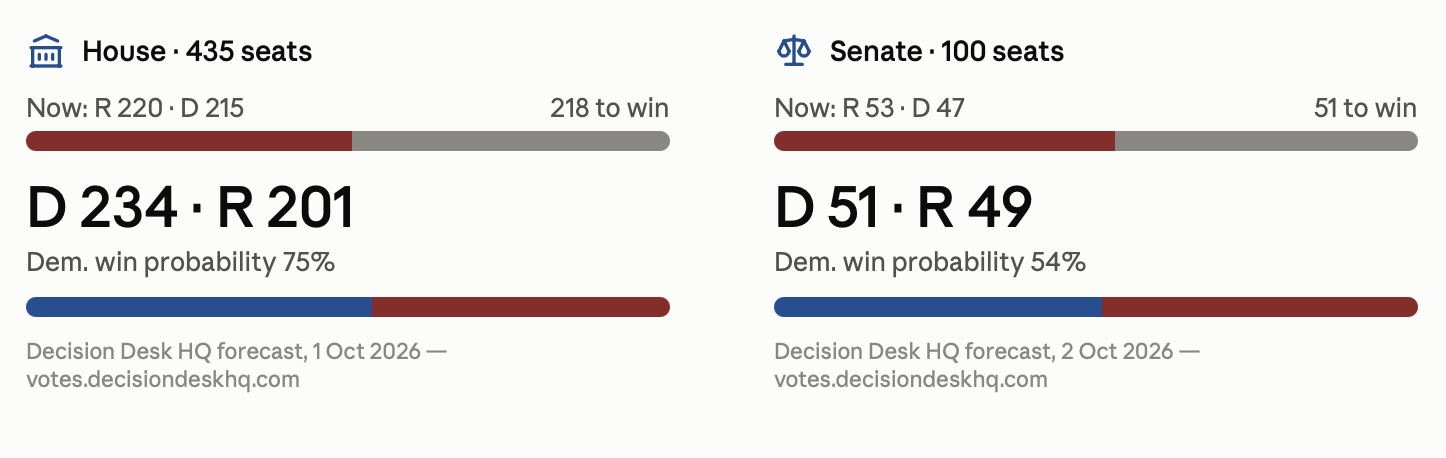
Source: This graphic is AI generated using data from https://votes.decisiondeskhq.com/forecast/2026/house
The mid-terms are a battle for control of the House of Representatives, a third of the Senate and governorships of 36/50 states. The party in the White House losing the mid-terms is par for the course. The mid-terms are a referendum on the sitting president and President Trump’s approval ratings have been sinking consistently in the last year.
On November 3, an electoral map re-drawn after a bitter redistricting fight will be tested for the first time by an electorate angry about affordability but unconvinced by either party’s answer for it.
For India, especially in the shadows of the Graham Act, the more useful question is not who wins but which hands take over the big committees.
For the world, 2026 will give a window into trends heading towards the 2028 general election; the first one in 12 years without Donald Trump on the ballot.
1. Who takes over the committees and what to expect
2. What the Democrats can realistically deliver
Despite both chambers of Congress being under one party, the efficacy of the body will be stunted if the White House sits with the opposition. The President can veto any bill that lands on his desk and the only way to undo it is by a Congressional override which requires 2/3rds majority. For either party, such numbers are highly unlikely in next month’s election.
An administration which has consistently undermined Congress, even when its own Party is in a majority and has expanded the scope of executive actions to an unprecedented level, is unlikely to cooperate with a Democrat House or Senate.
Realistically, the Democrats will be able to achieve limited gains such as:
Subpoenas and hearings: With leadership of all major committees, the Democrats will gain subpoena power and can conduct public investigations where Trump officials will be examined by a hostile opposition. Investigations will explore corruption charges against the Trump administration (and family), allegations of misconduct against ICE, intentions and procedures behind Operation Absolute Resolve which captured Nicolas Maduro in a predawn raid, and the business-to-government cooperation in oil sales post the raid in Venezuela. Also likely to be investigated is the war in Iran, big tech monopolization, regulation of AI diffusion and data center build-out, and the ever lingering specter of the Epstein files. Congress has subpoena powers but these investigations are not trials, and thus do not carry punishments like jail time. They do, however, garner information and create headlines which could carry into the primaries for the Presidential election.
Spending guardrails: The most plausible win is the campaign against “pocket rescissions,” where the White House proposes cancelling approved funds so late in the year that they expire. The Government Accountability Office (GAO) has ruled that the latest cancellation of $810 million by the Trump White House is unlawful. In 2025, a foreign aid spending package was frozen with the same tool. Current Republican Appropriations Chair Collins has hinted at curbing this as well, so a Democrat-led House with some Republican votes could get this done.
Conditions on defence spending: Reporting requirements on spending in the Iran war could subsequently lead to some limits being imposed.
Judicial confirmation blockade: A Democrat Judiciary Committee can stall judges and nominees without needing any Republican votes. So far, the only checks on the Trump administration have been dealt by the courts. Democrats will hold the power to insulate this branch from becoming more Red.
3. White House actions Congress cannot stop
Tariffs and sanctions: The Supreme Court, not Congress, struck down the emergency (IEEPA) tariffs. The Section 232 national security tariffs and the Section 301 tariffs remain in effect. Congress can overturn a 232 action with a disapproval resolution, but it has rarely tried to do so. Currently, seven Section 232 Congressional investigations remain outstanding.
The Iran war and sanctions: The authority to order military operations rests with the president. The new sanctions law adds to his toolkit rather than limit it.
4. Redistricting today for more redistricting tomorrow
Typically, American states redraw their voting district lines only once every ten years, right after the census. In principle, it is similar to India’s delimitation exercise. Recently, both parties broke that rule and redrew maps in between censuses. Texas went first in 2025, shifting five districts to favour the Republicans. Missouri, Ohio, and North Carolina followed with smaller redrawing. California also hit back with its own redrawing.
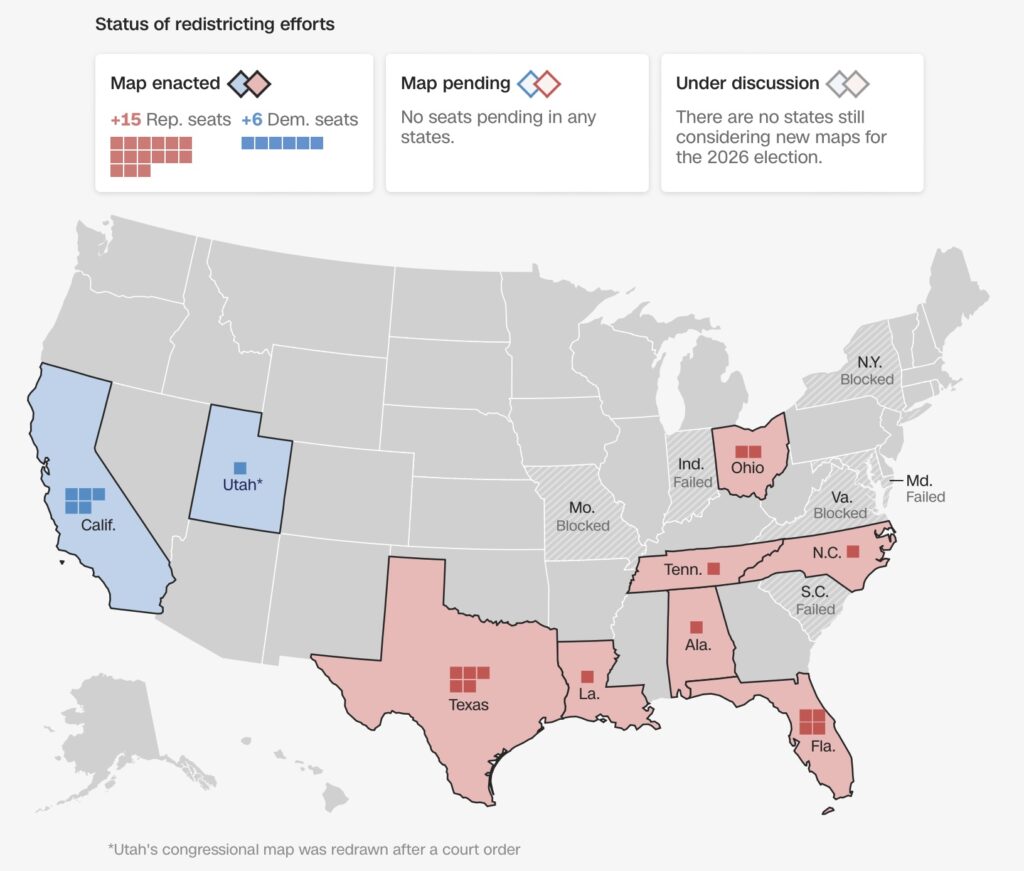
Source: https://edition.cnn.com/politics/state-redistricting-maps-vis
On paper, the mid-decade redistricting wave gave the Republicans a 4-to-5 seat advantage. If the intent of redistricting was to retain control of the House, it is failing. But if the intent was to lose with a smaller margin, that seems to be on track.
Redistricting was never intended to be aimed at just 2026. There are many states that are yet to deploy this tool. Some attempted and failed. Some lacked the votes or the trifecta necessary to execute this. Very few took the constitutional route of waiting for the census or the neutral path of an independent commission. After this election, there will likely be a second wave of redistricting in states where any party is able to secure the trifecta. While the new map is locked till 2030, this second wave could completely redraw the vote count for beyond.
5. States that could shape 2028
Governors control certain issues that Congress does not, such as state taxes and expansion of Medicaid. They also become the most electorally tested people in their party, making them presidential candidates if they manage to garner a national profile.
Currently, 26 of the 50 governors are Republicans and 24 are Democrats. Current polling data shows Democrats leading in 23 to the Republicans 22 with the rest polling within the margin of error, see blow.
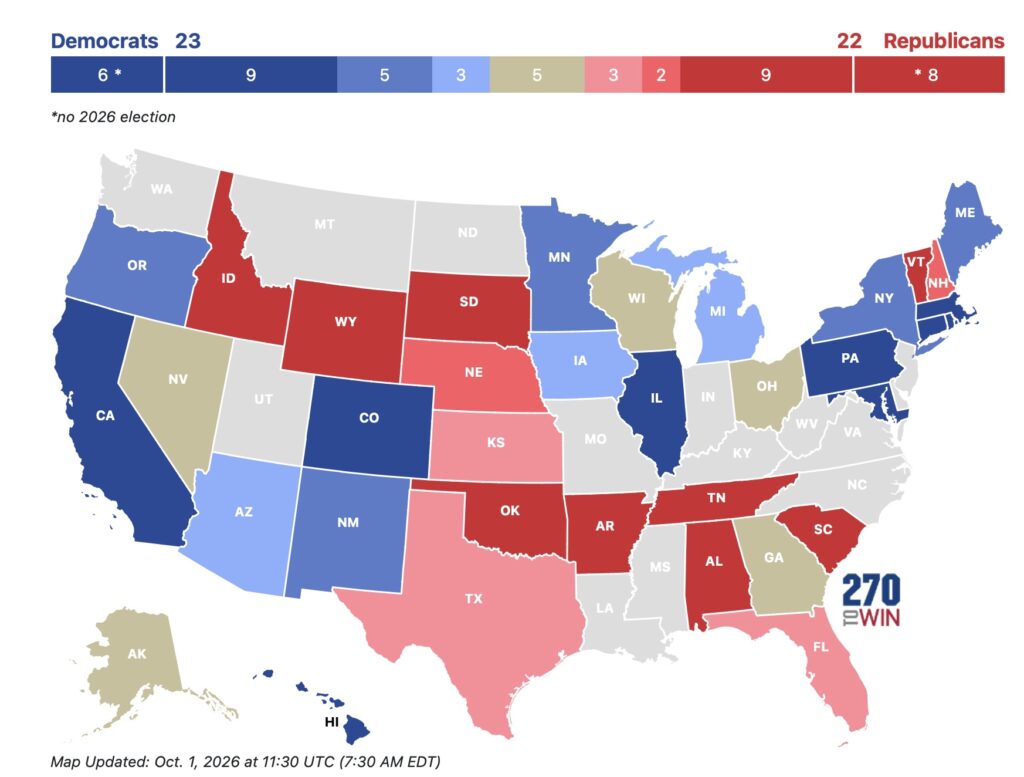
Source: https://www.270towin.com/2026-governor-election/consensus-2026-governor-forecast
There were seven swing states in 2024 and Trump won all of them. The simplest path for the Democrats is to win back Pennsylvania, Michigan, and Wisconsin, which add up to 44 electoral votes. Of these, Michigan and Pennsylvania are tracking solid blue, but Wisconsin is the one to watch.
A Democrat win in the currently-purple Ohio and gains in the red-but-shaky Georgia would suggest those states are expandable. Fissures in Texas or Florida vote blocks would be an early indicator of whether the Latino vote is shifting. But, these trends should not be over-extrapolated. The mid-terms mostly measure the sitting president’s approval rating. Trump’s approval rating is in the 30s. Current trends may indicate Democrats regaining control of Congress and some states but that does not count out a Republican victory in 2028. A GOP wave in 2010 was followed by Obama’s reelection in 2012.
As a result of the redistricting fight, the focus this year is not simply on who wins the governorships but on which states can secure the trifecta of both legislative chambers and the governorship to redraw the maps that escaped the last wave. Beyond redistricting, trifecta states will also decide the new rules of ballot processing, voter ID, and certification, thus dictating the way elections will be conducted in 2028 and beyond.
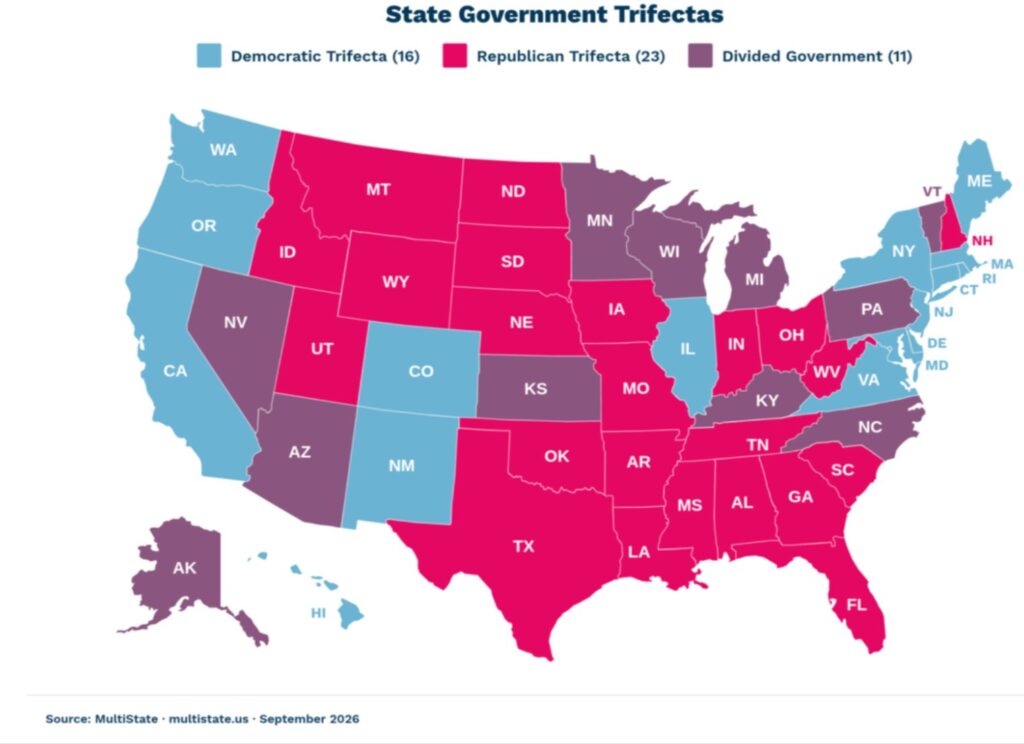
Democrats have focused on the state legislatures to regain a redistricting advantage for 2028. Michigan and Arizona use independent commissions, so a trifecta there does not mean new maps. Wisconsin, Pennsylvania, and Nevada are where legislative control could matter more.
Trends to watch for 2028
1. Low Republican turnout: is Trump's pull at the polls fading or is he still the only draw?
Since Donald Trump came down the golden escalator in 2015, he has exercised an extraordinary level of control over American politics. His strength came from a unique ability to bring out voters in large numbers, especially those who typically do not show up at the polls.
These voters, while loyal to Trump, didn’t show up as strongly in the mid-terms of 2018 or 2022, contributing to the Republicans losing ground in those elections. They seem to be displaying low enthusiasm this time around as well.
Trump’s campaign team is now planning an aggressive travel schedule through October, visiting both competitive and safe Republican states. Their theory is that his personal involvement can still move people, even indirectly. Nobody knows yet whether this plan will work.
If the current turnout rates hold through November, it would be one of the clearest signs yet that Trump’s political coalition depends entirely on him personally, not on the Republican Party as a whole. For 2028, that could mean Trump’s endorsement of his own successor may ensure campaign financing but may not guarantee a popular vote victory.
2. Affordability is the top issue but neither party has won the argument on it
Cost of living is by far the number one concern for voters this year. Historically, Republicans were trusted more than the Democrats to handle the economy. That’s no longer true. For the first time since 2012, the Democrats hold a 7-point average lead on what are functionally the same issue, inflation and the cost of living,
Even if the Democrats win both chambers of Congress, and the Republicans the White House, neither side will have full power to actually fix affordability. That means affordability stays the top issue heading into 2028, with both parties spending the next two years trying to blame each other for the lack of progress. Whichever party can convincingly claim credit for lower prices by 2028, even partially, will have a major advantage in that election.
3. A record number of military veterans are running as Democrats
This year, 752 veterans are running for Congress, the highest ever recorded, and 47% more than in 2024. Of them, 294 are contesting as Democrats, which is the highest number and the highest share of Democrat veteran candidates ever tracked. Women veterans especially have surged even more sharply, up 137% from 2024, and most of them are also Democrats.
Military service carries a lot of credibility in moderate or conservative-leaning districts. Democrats have historically struggled with the perception of being weak on national security. Recruiting veteran candidates is a way to push back on that perception, and it’s the same strategy Democrats used successfully in 2018 when veteran candidates helped them retake the House.
the Democrats are also competing for the working-class, culturally moderate voters that the Republicans built their 2024 coalition around.
4. The retirement wave. Congress is emptying out faster than it has in over 30 years.
By the time the primary season ended for this election, close to 100 sitting members of Congress: 83 in the House and 16 in the Senate, had already announced they wouldn’t run again this year. That’s the largest number of lawmakers choosing to leave at once since 1992.
Retirements normally happen for ordinary reasons like age, a better opportunity, or wanting to spend time with family. Some of that is happening here too. Some also retire to seek higher office. But the anomaly this year is that many have implied their retirement is due to their disagreements with their own party or because of how slowly things move in Congress. More Republicans than Democrats are retiring overall.
An open seat, where no incumbent is running, is almost always easier for the opposing party to win than a seat where someone is defending their own record. So this wave of retirements isn’t just a sign of dysfunction in Washington; it will cause more competitive races than there would otherwise be, adding to the pressure already on the Republicans this cycle and the next.