
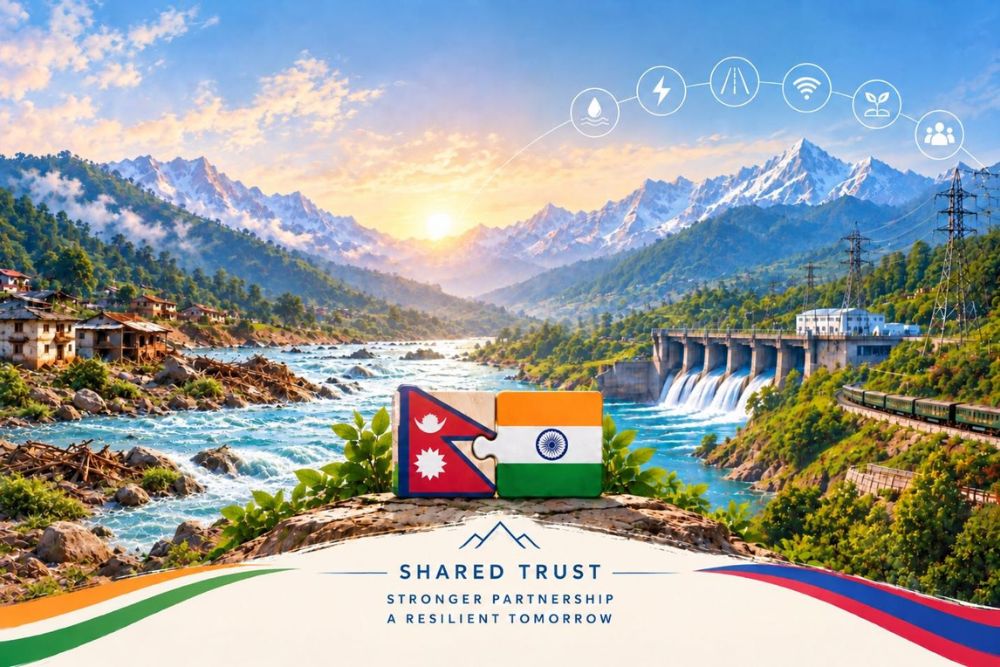
Abstract
India and Nepal are entering a rare and fragile window in their relationship, opened by a change of government in Kathmandu and sharpened, tragically, by the glacial flood that struck Nepal’s Trishuli valley in August 2026. This paper argues that the two countries have outgrown the old measures of partnership – a hydropower dam here, a head of state visit there – and now need strong institutions that can outlast any single administration. It situates that argument within the broader literature on small state and large state asymmetry, reading India–Nepal relations alongside Nepal’s documented pattern of hedging between India and China and against the recurring history of Indian economic coercion, most severely the 2015-2016 blockade. It then examines the energy relationship in close detail, contrasting the expansion of cross-border transmission capacity in 2026 with the same year’s emergency reversal of power flows after the damage to a dozen Nepali hydropower plants due to floods, before turning to three further themes that cut across the relationship’s traditional silos: the paradox of an open border that is both lifeline and liability, the unresolved question of who pays and who gains from shared resources (read against the Indus Waters Treaty as a comparative case in transboundary water diplomacy), and the emerging challenge of digital and artificial intelligence sovereignty. It closes by considering the generation that will inherit whatever the two countries build now, and by proposing that the relationship’s success should finally be measured in those terms. Lastly, the paper also elaborates on a few more lines of reasoning. It suggests specific institutional frameworks and a preliminary order for their establishment, rather than merely advocating for ‘institutions over projects’. It incorporates three sectoral threads: migration, health, and defence, that sit close to the lived experience of the relationship. This does not negate the main argument of the paper that India and Nepal need sustainable institutions and not a patchwork of initiatives. This makes the assertion rather difficult to argue against.
Introduction: A River Remembers
On the morning of 26 August 2026, a slab of ice and rock broke free from the glacier atop Langtang Lirung and dammed the Lhende River below. When the blockage gave way minutes later, it sent a surge of ice, rock, and water tearing through Nepal’s Rasuwa district; seismometers as far away as Europe registered the impact, and early reports mistook the tremor for a magnitude 4.4 earthquake before the US Geological Survey traced it to the landslide itself (AJLabs, 2026; Landslide Hazards Program, 2026). By the time the water settled, it had erased the Rasuwagadhi border crossing between Nepal and China, buried whole villages along a 72 kilometre stretch of the Trishuli River, and carried the bodies of some victims hundreds of kilometres downstream into India where the same river system, renamed the Gandak as it crosses the border, had already prompted flood warnings in Bihar and Uttar Pradesh (Awale, 2026; Singh, 2026a). More than a thousand people were confirmed dead within days, with thousands still missing, and at least 65,000 people, nearly a third of them children, were left needing emergency shelter, water, and care (CNN, 2026; UNICEF Australia, 2026).
Balendra Shah, Prime Minister of Nepal, said there was no doubt that climate change had contributed to the disaster (CNN, 2026). He was almost certainly right, and the observation matters well beyond Nepal’s borders. The Trishuli feeds into the Narayani, which feeds into the Gandak, which crosses into Bihar. A glacier collapsing in the high Himalayas is not a sole Nepali catastrophe. It is a shared hydrological event with a shared risk and it lands, sooner or later, on India’s side of an open and largely undefended border. If there was ever a case for treating the relationship between these two countries as more than a sum of separate transactions, it surfaced that week in the mud of the Trishuli.
This paper takes that as its starting point, though not its only one. Ten days before the flood, Nepal and India convened the second edition of their Strategic Dialogue in New Delhi, opened by India’s Foreign Secretary, Vikram Misri, and jointly organised by the Ananta Aspen Centre and the Centre for Social Innovation and Foreign Policy (ANI, 2026). Conducted substantially under the Chatham House Rule, the dialogue produced no communiqué, but it produced something arguably more useful: an unusually candid map of where the relationship is stuck, where it is moving, and where India and Nepal – despite decades of talks about brotherhood – still want genuinely different things. This paper draws on that dialogue, cross-checked wherever possible against independent public sources, to sketch what the next chapter of India-Nepal relations might look like if the two countries are honest about where the relationship is stuck, where it is moving and where their interests still genuinely diverge.
The Old Playbook, and why it no Longer Works
For most of the last seventy years, the India-Nepal relationship has been narrated in units small enough to photograph: a summit handshake, a ribbon cut to inaugurate a transmission line, the signing of a treaty whose anniversary someone will later invoke as evidence of enduring friendship. The habit runs deep. Analysts and officials in both capitals have long measured the health of the relationship by which capital a new Nepali prime minister visits first, New Delhi or Beijing, as though foreign policy were a matter of etiquette rather than strategy.
That habit has run its course for two reasons. The first is structural. Nepal’s political order has been genuinely reordered since 2025. A youth-led uprising, discussed at length later in the paper, swept aside a sitting government, installed and then replaced an interim administration, and delivered a parliament shaped by a party led by a former Kathmandu mayor with little patience for the old diplomatic choreography (Britannica, 2025). Whatever else that upheaval means, it has loosened the grip of the visit-counting habit on both sides. The second reason is substantive. The Trishuli flood, the stalled Pancheshwar project examined later, and the quiet arrival of artificial intelligence (AI) into the region’s cyber and information space are not problems that a single project or a single treaty can resolve. They require standing institutions: data-sharing arrangements, joint early-warning systems, and dispute-resolution mechanisms that function between crises rather than only after them. The argument of this paper is simple to state and harder to build: India and Nepal now need an ecosystem of institutions rather than a portfolio of projects, and the next chapter of the relationship should be judged by whether that ecosystem gets built.
Asymmetry, Hedging, and the Weight of History
It is tempting, and common, to write about India and Nepal in the vocabulary of family: brotherhood, roti-beti ka rishta, an open border as proof of shared blood. That vocabulary is not exactly wrong, but it obscures a harder structural fact that the academic literature on small-state situations states more bluntly. Nepal is, in the language of international relations scholarship, a textbook case of a small state locked in an asymmetric relationship with a much larger neighbour, one whose foreign policy options are shaped less by choice than by geography and dependence (Johny, 2024). Landlocked between two nuclear-armed powers, with over 90 percent of its third-country trade historically routed through Indian territory, Nepal has spent decades practising what scholars of the region call hedging: leaning toward India when it must, courting China when it can, and avoiding a firm commitment to either that would leave it exposed (Johny, 2024). This is not indecision. It is a rational strategy for a state with limited leverage, and any analysis of the relationship that treats Nepali caution or outreach to Beijing as ingratitude rather than as a predictable feature of asymmetric interdependence, misses the point.
The 2015-2016 blockade discussed in the following pages, is the starkest illustration of what that asymmetry can mean in practice, but it was not an aberration. It was the fourth time since 1962 that India had used its control over Nepal’s access to the sea as an instrument of pressure, and the memory of each episode compounds the next (Chauhan, 2017). This history matters for a paper arguing that the relationship should move toward deeper institutions, because institutions built on top of an unaddressed power imbalance tend to entrench that imbalance rather than soften it. The more honest starting point, and the one this paper adopts, is that enduring partnership between an asymmetric pair of states is possible; the Indus Waters Treaty examined later on is proof of that, but only if the larger power accepts real constraints on its own freedom of action, and the smaller power is given more than an open border and a hydropower royalty in return for its cooperation.
Four Themes
From Projects to Partnership
Energy is the clearest illustration of the shift already underway. In January 2024, India and Nepal signed a 25-year power trade agreement committing India to import up to 10,000 megawatts of Nepali hydroelectricity over the following decade, a deal explicitly framed by both governments as a long-term partnership rather than the seasonal, seller-by-seller arrangements that preceded it (Sharma, 2024). The number itself is almost beside the point. What matters is the shift in grammar from a transaction that must be renegotiated every dry season to a standing relationship with rules both sides can plan a decade around.
The same logic applies, less happily, to trade. India’s own network of new free trade agreements (FTA) is reshaping regional value chains, and Nepal has an interest in understanding how it might plug into them rather than watch from outside. More ambitiously, discussion at the recent dialogue returned repeatedly to the idea that the two countries should revisit deeper economic integration, building forward from the 1960 Treaty of Trade and Transit that first opened Nepal’s access to Indian ports and third-country markets, toward a genuine common market in goods, services, and capital. This is not a modest proposal, and it cannot be made honestly without acknowledging why Nepal has hesitated. Nepal’s economy remains structurally dependent on India for transit to the sea, a dependency that scholarship on India–Nepal relations describes as a textbook case of asymmetric interdependence in which the smaller state’s vulnerability is not incidental but built into the geography of the relationship itself (Johny, 2024). That dependency has been used as leverage before. India imposed undeclared trade and transit restrictions on Nepal in 1962, 1970, and 1989, and again, most severely, from September 2015 to February 2016, when months of disruption at the border soon after a devastating earthquake drove real GDP growth for the fiscal year down to roughly 0.6 percent and pushed inflation to 12 percent as fuel and medicine shortages rippled through the economy (IMF, 2017). India never formally admitted to imposing a blockade, attributing the stoppage to protestors at the border, but the pattern was familiar enough that Indian scholarship on the episode has since read it as one instance in a longer history of using economic pressure to shape Nepali politics, a history that complicates any assumption that deeper integration will simply be a story of mutual benefit (Chauhan, 2017). Any renewed push toward a common market will have to reckon honestly with that history rather than paper over it with the language of brotherhood.
The Power Grid in 2026: Ambition meets Aftermath
The energy relationship has, in fact, been moving simultaneously on two tracks, and reading them together says more about the partnership’s real texture than either does alone. The first track is expansionary. At the 13th meeting of the Nepal–India Joint Steering Committee in mid-2026, the two countries agreed to lift the ceiling on Nepal’s electricity exports from 1,200 MW, a figure that had included a 40 MW carve-out for Bangladesh, to 1,650 MW, routed through the Dhalkebar–Muzaffarpur and the nearly complete Dhalkebar–Sitamarhi transmission lines (Poudel, 2026). Detailed project reports were approved for a further Motihari–Nijgadh line, intended to unlock additional exports by the mid-2030s, and for upgrading the ageing Muzaffarpur–Dhalkebar corridor with high-temperature, low-sag conductors that can simply carry more current without new towers (Poudel, 2026). Two more corridors, linking Inaruwa to New Purnea and Lamki Dodhara to Bareilly, were formalised between India’s POWERGRID and the Nepal Electricity Authority the previous October (All India Radio, 2025; Kafle, 2025). The logic behind all of this is straightforward: Nepal’s installed capacity has reached roughly 4,400 MW against its domestic demand of about 2,400 MW, which means that without export capacity a meaningful share of Nepal’s own hydropower is simply spilled, generated and wasted for want of a wire to carry it (Poudel, 2026).
The second track is remedial, and it arrived with brutal timing. The Trishuli disaster of 26 August 2026 damaged or destroyed twelve power projects, among them Upper Trishuli 1, Rasuwagadhi, Rasuwa-Bhotekoshi, Langtang Khola, Chilime and Maillung Khola, at an estimated cost of Rs. 134.69 billion to the energy sector alone, according to Nepal’s own Rapid Damage and Needs Assessment (Giri, 2026). The country that had spent the first half of the year negotiating for more room to export power to India spent September asking India for electricity. India approved up to 654 MW of emergency exports through December, 600 MW down the Muzaffarpur–Dhalkebar line and a further 54 MW through the smaller Tanakpur–Mahendranagar link specifically to cover Nepal’s winter shortfall, while the damaged plants are rebuilt (Giri, 2026; Singh, 2026b). An Indian Power Ministry official was careful to note that the diversion would have no discernible effect on India’s own domestic supply, a small but telling detail: for India, this was a rounding error; for Nepal, it was the difference between a stable winter grid and rolling shortages layered on top of a national tragedy (Singh, 2026b).
Read side by side, these two tracks make the argument of this paper more concrete than any abstract call for partnership could. A relationship built only around exportable megawatts is, definitionally, a fair-weather relationship, generous when the rivers run high and silent when they do not. The test of whether India and Nepal have actually built an energy partnership, rather than a seasonal trading arrangement, is not the headline figure of 1,650 MW or the long-run ambition of 10,000 MW. It is whether the emergency reversal in September 2026 becomes a footnote in a larger story of resilience or the first sign that neither side has yet built the redundancy a genuinely shared grid would need. It is also worth noting, in the interest of precision rather than pessimism, that a further tranche of new power purchase agreements, reportedly in a band of 800-1,200 MW, remains under review rather than signed as of this writing, with Nepal’s own Ministry of Energy, Water Resources and Irrigation confirming that volume and price terms are not yet public (Sharma, 2026). The figure of 10,000 MW that anchors the long-term framework is a ceiling under negotiation, not a number already banked, and the article’s optimism about it should be calibrated accordingly.
The Border: Asset and Anxiety
No feature of the relationship carries more sentimental weight, or more operational risk, than the open border. It is the reason a Nepali labourer can find work in Lucknow without a visa, the reason pilgrims cross freely to Pashupatinath and Varanasi, and the reason two economies remain woven together at the level of the household rather than merely the treasury. It is also, participants at the Dialogue argued, the route through which traffickers, smugglers, and increasingly cyber fraud networks move with equal ease. The consensus that emerged from those discussions was unambiguous: the answer is not a fence. Physical barriers have failed to solve comparable problems on India’s borders with Bangladesh and in Jammu and Kashmir, and a fence here would punish the very border communities whose daily life depends on crossing freely, while doing little to stop determined criminal networks.
The more promising, if less visually satisfying, answer is institutional: faster intelligence sharing, better coordination between India’s Sashastra Seema Bal and Nepal’s Armed Police Force, and technology that can distinguish a commuting labourer from a trafficking operation without treating both as equally suspect. There is a symbolic dimension to this as well. The 1950 Treaty of Peace and Friendship, the foundational document of the relationship, has been the subject of scholarly and political argument in Nepal for decades, criticised for provisions, notably an expectation of consultation before dealing with third countries, that read to many Nepali commentators as compromising an independent foreign and defence policy (Nayak, 2010). It is worth noting that the same scholarship complicates any simple narrative of Nepali grievance: Nayak’s (2010) analysis in Strategic Analysis argues that Nepal has, on balance, drawn more practical benefit from the treaty than India has, even as it has fuelled resentment about the relationship’s optics. India has periodically agreed in principle to revise the treaty; Nepal has never quite settled on what a revised version should say. A relationship serious about moving past bilateralism might finally finish that unfinished business, replacing an instrument built for 1950 with one built for the world both countries actually live in now, an update of the substance rather than of merely the language.
Who Pays, Who Gains
Underneath the diplomatic warmth sits a set of stubbornly unresolved financial questions and nowhere are they more visible than at Pancheshwar. Envisioned under the 1996 Mahakali Treaty as a 5,040-megawatt hydropower and irrigation project on the river that forms much of the India–Nepal border, Pancheshwar remains, three decades later, without a finalised detailed project report. The sticking point is not engineering. It is the allocation of benefits: India, as the larger downstream user, stands to receive a greater share of irrigation and flood-control value, while Nepal argues that the water itself, not merely the electricity generated from it, is a resource whose worth has never been fairly priced into the deal (Giri & Tamang, 2026). Talks resumed in earnest in 2026 after a four-year hiatus, a sign of intent, but not yet of resolution.
It is worth pausing on a comparison that the Pancheshwar impasse invites but rarely receives. The Indus Waters Treaty signed in 1960 between India and Pakistan under World Bank mediation, is routinely held up as transboundary water diplomacy’s great success story: it allocated the basin’s western rivers to Pakistan and its eastern rivers to India and survived three wars and six decades of hostility between the two countries (Aamer, 2025; Blue, 2026). Yet in April 2025, India suspended its participation in the treaty following a terrorist attack it attributed to Pakistan, demonstrating that even the most durable bilateral water arrangement can be unwound unilaterally the moment a government decides the political cost of doing so is acceptable (Blue, 2026). The implications for Pancheshwar are less reassuring than might be expected. A finished, detailed project report and a signed benefit-sharing formula would be genuine progress but the Indus case shows that treaty durability ultimately rests on political will that can evaporate, and not on the elegance of the legal text. If India and Nepal want an energy and water partnership sturdier than the one India and Pakistan built, the design will need to anticipate political shocks explicitly, rather than assume goodwill as a given permanent factor.
A subtler version of the same problem shows up in trade. Nepali exporters routinely lose time and revenue to India’s Bureau of Indian Standards (BIS) certification process, an unglamorous piece of bureaucratic requirement that nonetheless functions as a real ceiling on how much cross-border commerce can grow even when the diplomatic weather is fair. And at the most local level, informal cross-border trade in everyday goods, footwear, garments, and household items sits in an uncomfortable grey zone: a genuine livelihood for economically poor border districts on both sides but also, participants at the dialogue noted, a leakage that formal statistics barely capture. The honest position is probably not to criminalise this trade but to distinguish it clearly from organised smuggling and regulate accordingly – a distinction the two governments have discussed but not yet operationalised.
Sovereignty in the Age of AI
The newest and least resolved issue concerns technology. India has offered Nepal something unusual in the history of technology diplomacy: not a licence to rent India’s digital public infrastructure, but the underlying model – digital payments and digital identity systems that Nepal can build, own, and govern for itself. India’s own experience gives the offer some credibility. A 2016 World Bank study estimated that Aadhaar-enabled elimination of duplicate and fraudulent beneficiaries could save India roughly $ 11 billion dollars every year, a figure Indian officials have cited widely since, and a subsequent World Bank assessment prepared for the G20 in 2023 credited India’s direct benefit transfer architecture with approximately $ 33 billion dollars in actual savings to date (Tribune News Service, 2023; World Bank, 2016). The figure deserves a caveat this paper’s own source material has itself supplied: journalists who examined the 2016 report found that even a senior World Bank official had privately described it as far from an unqualified endorsement of the technology, cautioning that digital identity systems amplify the capacity of governments for both service delivery and surveillance in roughly equal measure, and that their benefits depend heavily on the accountability of the institutions running them (Thaker, 2022). That caveat should travel with the offer to Nepal. Whether Kathmandu can absorb India’s digital public infrastructure model on its own terms, with its own accountability safeguards, rather than becoming quietly dependent on India’s rails and India’s bandwidth, is an open question that deserves more scrutiny than it has so far received.
A genuinely new frontier raised at the dialogue and worth far more attention than it has had, concerns artificial intelligence (AI). Safety systems built to catch harmful or manipulative prompts are trained overwhelmingly on English-language data, which means, participants argued, that the same guardrails are measurably easier to circumvent in Hindi, Nepali, or other regional languages. If true, and it is a claim worth independent verification rather than blind acceptance, it has real implications for misinformation, fraud, and even weapons-related risk across South Asia, and it argues for a dedicated India–Nepal channel of researchers working on multilingual AI safety, not as an afterthought to the digital partnership but as a core part of it.
The Next Generation
Every theme we have discussed so far will ultimately be judged by people not yet in the room where these decisions are made. The numbers are not encouraging. India’s own labour data shows youth accounting for 83 percent of the country’s unemployed as of 2022, with the share of unemployed youth holding a secondary or higher education degree nearly doubling since 2000, evidence of a growing mismatch between what India’s education system produces and what its economy is currently able to absorb (ILO & IHD, 2024). Nepal’s version of the same frustration erupted more visibly. In September 2025, protests led overwhelmingly by Generation Z, initially sparked by a government ban on major social media platforms but fuelled by a deeper anger at corruption and nepotism, brought down the government of K. P. Sharma Oli within five days at a cost of at least 76 lives (Britannica, 2025). An interim government under former Chief Justice Sushila Karki, chosen in part through an online vote conducted on Discord, governed until elections in March 2026 delivered a decisive majority to Balendra Shah, the rapper-turned-mayor whose Rastriya Swatantra Party had campaigned explicitly against the old political class (Britannica, 2025).
It would be too neat to draw a straight line from Nepal’s uprising to India’s employment statistics, and this paper does not attempt to do so. But the two facts sit in the same regional space and the Dialogue’s participants were right to treat them as connected rather than coincidental. A relationship that offers young Nepalis only hydropower royalties and border security, and young Indians only the promise of eventual growth, is not offering either generation very much. Programmes such as India’s proposed Startup Partnership Network with Nepal are a beginning, but the more honest test is whether either country can turn education into employment fast enough to matter to the people currently protesting, migrating, or simply losing patience.
Convergence and Divergence
It would flatter neither country to pretend their interests are identical. India wants predictability above almost everything else: a stable investment climate for its hydropower and infrastructure capital; a border secure enough that it does not become a channel for infiltration or financial crime; and a Nepal whose provinces, not only its capital, are engaged directly in the relationship. Nepal wants something closer to dignity: a partnership judged by outcomes for its own citizens rather than by monuments to its neighbour’s generosity, room to maintain relationships with other powers without being read as disloyal, and a fairer accounting of what it actually earns from the resources India increasingly depends on.
These are not irreconcilable goals, but they are not the same goals wearing different clothes either, and a paper that pretends otherwise would be doing exactly what this paper has argued against: substituting warm language for honest accounting. The more useful posture, for policymakers on both sides and for anyone writing about them, is to hold the convergence and the divergence in the same sentence, rather than resolving the tension prematurely in either direction.
1. From Prescription to Design: Formalising the Link
1.1 Three organisational structures to establish a common position
A significant portion of the relationship is now managed through regular mechanisms: the Nepal-India Joint Steering Committee which adjusts transmission limits, the Strategic Dialogue itself, and ministerial visits. A compact, enduring secretariat, collaboratively financed and accountable to both foreign ministries instead of a singular ministry, could preserve the institutional knowledge that presently resets with each governmental transition in Kathmandu or every reorganisation in South Block, and could be assigned the specific duty of monitoring commitments made during events such as the Strategic Dialogue until their execution.
A collaborative early alert mechanism for glacial lake and rapid floods, and a Nepal-centric counterpart tailored explicitly for glacial lake outburst floods rather than adapted from a riverine flood model intended for flatlands. This model represents a constrained, viable, and necessary establishment that the two nations could agree upon during the forthcoming Strategic Dialogue rather than postponing it until the next glacier collapses.
The institutional dynamics of the partnership predominantly hinge on the executive branch of both parties, which is the segment most susceptible to the “visit-counting” rationale that the paper critiques. A permanent assembly comprising members of the Indian Parliament and the federal and provincial legislatures of Nepal convening on a predetermined annual schedule, rather than on an irregular basis, would foster a relationship with a constituency that transcends individual administrations and establish a conducive platform for the provincial interaction outlined subsequently.
1.2 A basic sequence
Not all elements can be constructed simultaneously, and the preceding paper’s evidence indicates a natural progression. Among the three warning systems, the GLOF early-warning mechanism is the least contentious politically: it tackles a shared and contemporary disaster, has an established precedent in the India–Bangladesh data-sharing agreement, and does not necessitate the re-evaluation of sovereignty-sensitive matters like the 1950 Treaty. This should be the primary initiative people enrol in, preferably during the current political opportunity rather than the subsequent one. The secondary priority is a collaborative secretariat, precisely because it will be the entity accountable for guaranteeing the initial pledge is genuinely executed, rather than merely proclaimed and overlooked, as the foundational document itself observes in its commentary on the yet-to-be-constructed Pancheshwar project. The parliamentary forum represents the most significant long-term investment and is the most challenging to establish speedily as it depends on ongoing commitment from legislators on both sides who have traditionally lacked the motivation to regard the connection as their personal obligation. It is pragmatically a project for the second term, yet the foundational structure may be established at this moment.
2. Absence of Sectoral Components
2.1 Migration and remittances: The barrier representing the unspoken connection
The primary focus of the preceding paper is the open border concerning security and trafficking issues. This diminishes its economic significance. In contrast to Nepal’s migration to the Gulf and Malaysia, which necessitates a labour permit, the open border with India renders Nepali migration statistically unrecorded. Estimates on the population of Nepalis employed in India fluctuate significantly, ranging from approximately 700,000 to perhaps 3 million. However, in 2017, Nepal sent over $ 3.02 billion in remittances to India, surpassing the roughly $ 1.02 billion that came in the opposite direction. The open border does not necessarily represent unilateral reliance.
Additionally, India dispatches workers to Nepal: the 2021 Nepali census indicates that around 97 percent of Nepal’s immigrant demographic is comprised of Indians. Unofficial assessments suggest that the resident Indian populace in Nepal is approximately 4 million, comparable to the unofficial estimate of Nepalis residing in India. This is also the context in which the expenses associated with the relationship are least discussed. This unrestricted border omits India-bound migration from these safeguards, and Nepali migrants to India predominantly engage in the underground economy, lacking the labour licenses, welfare provisions, or life insurance mandates established for Nepal’s Gulf-bound labourers.
2.2 Health collaboration: Transitioning from crisis management to enduring capability
The narrative of the preceding paper culminates with energy and infrastructure. Health collaboration warrants its own emphasis, as calamities like the Trishuli flood generate urgent medical demands, significant casualties, threats of waterborne illnesses, and displaced individuals in need of shelter and assistance, besides the fact that the health systems of the two nations are already informally interconnected through patient transfers that Indian hospitals in border cities such as Lucknow, Varanasi, and Patna have historically accommodated. A structured system for international medical evacuation during disasters, collaborative epidemic-response protocols due to the mutual and predominantly unregulated disease load associated with open borders, as previously mentioned in relation to HIV, and official acknowledgement of Nepali patients’ access to Indian public health services would transform an informal, makeshift dependency into a well-resourced, accountable institution, likely linked to the joint secretariat suggested in Section 1.1.
2.3 Defence institutional connections: The Gorkha issue as an on-going matter
Any discourse regarding India-Nepal institutions would be incomplete without acknowledging the oldest institutional connection which is currently the most clearly fractured. For almost eight decades after Independence, recruitment of Gorkhas for the Indian Army has been governed by the 1947 Tripartite Agreement between India, Nepal, and the United Kingdom, allocating Gorkha regiments between Indian and British forces and providing Nepali recruits with equal pay, pension, and service conditions. However, this has been non-operational since 2022. Nepal has halted recruitment drives for the Indian Army’s Gorkha regiments due to India’s Agnipath plan, a four-year service model that is predominantly non-pensionable and is viewed by Kathmandu as a violation of the Tripartite Agreement. Approximately 12,000 Gorkha troops have concluded their duty in India without any successors.
By mid-2026, prominent individuals from both sides, such as a former Indian Chief of Defence Staff and Nepal’s foreign minister, were articulating nearly identical phrases to characterise the stalemate three years later: recruitment is exclusively contingent upon the conditions of Agnipath, leaving the decision to Nepal’s government. Simultaneously, Britain has taken steps to enhance its Gurkha contingent, declaring the establishment of a new Kings Gurkha Artillery in 2025 comprising 400 personnel, while the recruitment process on the Indian side remains stagnant. This is not just a little annoyance. The Gorkha regiments are one of the most prominent, enduring, and esteemed links between the two nations, woven into the identities of both armed forces in a manner that no commercial pact or power line could ever match. Their quiet stagnation exemplifies the same failure scenario detailed in the previous paper, when a fundamental institution regulating relationships is permitted to decay in the absence of a formal process for renegotiation prior to its collapse.
A collaborative review committee aimed at revising the Tripartite Agreement, a proposal suggested by at least one retired Nepali general, represents a necessary yet unremarkable institutional remedy that ought to be prioritised in any forthcoming agenda, not due to its immediate strategic importance like Pancheshwar or the industrial corridor, but because its oversight subtly undermines the foundational goodwill of the relationship.
3. Establishing the Foundation of Evidence
3.1 Federalism as untapped resource
The primary document advocates for the active participation of “provinces, not solely its capital” in the relationship, although it fails to examine the actual benefits of Nepal’s federal framework. The 2015 constitution designated Nepal as a three-tier federal republic, with seven provinces, each possessing an elected provincial legislature and, theoretically, legislative power at the provincial tier, alongside federal and local governance. Research on the transition indicates a federalism that remains predominantly centralised: provinces continue to rely financially on federal allocations, and analyses of the system reveal ongoing limitations in capacity and ambiguous delineation of power among the three levels, a trend evident even in emergencies, where coordination during Covid reverted to centrally-managed District Administration Offices despite provinces having constitutional obligations.
This is crucial to India’s engagement. Regions like Madhesh and Koshi have common borders with India and possess the cultural, linguistic, and economic connections that the main document ascribes to the overall relationship, frequently to a greater extent than Kathmandu. However, India’s institutional interaction with Nepal, beyond the consulates, is predominantly federal-to-federal. A substantial partnership that can endure beyond any single administration in Kathmandu ought to regard Nepal’s provinces as an underutilised gateway.
Economic collaboration treaties, disaster management coordination, and the parliamentary forum suggested in Section 2.1 could all be designed to directly incorporate Nepal’s provincial assemblies. This would help broaden the institutional scope of the relationship and link it to the border communities that experience the relationship firsthand, rather than solely to the political elite in Kathmandu.
3.2 What are the genuine opinions of Nepalis? The public sentiment
The concluding assertion of the preceding paper, which posits that the relationship ought to be evaluated by the succeeding generation, would be enhanced by insights into the current beliefs of that generation and their progenitors. The data is limited, although coherent. A public opinion poll involving over 230 residents from Kathmandu’s primary tourist and educational centres, carried out in January 2025, revealed that India continues to exert greater influence than China. Across almost all dimensions of soft power and perceived significance for Nepal’s economic advancement, Nepalis predominantly favour a restriction of China’s influence in trade, investment, and developmental assistance rather than its extension into other sectors.
A comparable differentiation was observed in an earlier survey, indicating that the Nepali populace’s sentiment toward India remains rooted in cultural and religious ties. The obvious adverse effects of political tensions, the 2015 blockade, border disputes, and the Agnipath impasse have not helped improve Nepali sentiments. This was also asserted in the youth-centric session of the second edition of the India-Nepal Strategic Dialogue in August 2026. This public affection contrasting with elite discord is an evidence supporting, rather than undermining, the institutional thesis of this research. If genuine popular goodwill toward India exists in Nepal but lacks a formal mechanism for expression, it is an untapped resource in the bilateral relationship pointing to the importance of establishing institutions that can institutionalise sentiment into active engagement rather than allowing the relationship to be dictated solely by high-level conflicts over hydropower projects and recruitment initiatives. Subsequent iterations of this study ought to incorporate opinion surveys from both nations extending beyond Kathmandu to include India’s bordering states to serve as a fundamental element in the institutional framework of the relationship rather than a mere afterthought invoked solely for convenience.
Conclusion
The Trishuli flood offered a brutal yet clear illustration of what this paper has tried to argue in more abstract terms: India and Nepal are already bound together by forces that neither treaty nor tradition fully anticipated, and the quality of their partnership will be tested not at the next summit but in the quieter work of building institutions that functioned long before and will function long after the next crisis arrives. Hydropower megawatts and border kilometres will remain useful units of measurement for engineers and negotiators. They are not, this paper has argued, the right units for judging whether the relationship itself is succeeding. That judgment belongs, in the end, to the generation on both sides of the border who will inherit whatever India and Nepal choose to build now, while the window for building it is still open.
None of the aforementioned four arguments refute the primary assertion of the paper. The suggested institutional structures and order transform a broad guideline into a matter that may be placed on an agenda. The three supplementary sectoral threads, that is, migration, health, and the deteriorating Gorkha arrangement – alongside the federal and public-opinion data, converge toward the identical conclusion reached by the original document along an alternative pathway. The forthcoming phase of the relationship will be evaluated more by its foundations than by its peaks, focusing on the subtle, unremarkable mechanisms that can maintain stability between them.
A note on sourcing: This paper draws from the outcomes of the 2nd India-Nepal Strategic Dialogue. The authors are policy analysts at the Ananta Centre.
Bibliography
Aamer, F. (2025, August 7). The Indus Waters Treaty: South Asia’s most durable accord faces a tough test. Asia Society Policy Institute [originally published in 9Dashline.] https://asiasociety.org/policy-institute/indus-waters-treaty-south-asias-most-durable-accord-faces-tough-test
Adhikari, J., Rai, M.K., Baral, C., Subedi, M. (2023). Labour Migration from Nepal: Trends and Explanations. In: Rajan, S.I. (Eds) Migration in South Asia. IMISCOE Research Series. Springer, Cham. https://doi.org/10.1007/978-3-031-34194-6_5
AJLabs. (2026, August 27). Satellite images show destruction from Nepal-Tibet floods. Al Jazeera. https://www.aljazeera.com/news/2026/8/27/satellite-images-show-destruction-from-nepal-tibet-floods
All India Radio. (2025, October 29). India, Nepal sign agreements to boost power cooperation and cross-border transmission. https://www.newsonair.gov.in/india-nepal-sign-agreements-to-boost-power-cooperation-and-cross-border-transmission
Ananta Aspen Centre & Centre for Social Innovation and Foreign Policy. (2026, August 18). Second India–Nepal Strategic Dialogue [Conference proceedings]. New Delhi, India.
ANI. (2026, July 16). India-Nepal Joint Steering Committee reviews hydropower, power trade and transmission projects. https://www.aninews.in/news/world/asia/india-nepal-joint-steering-committee-reviews-hydropower-power-trade-and-transmission-projects20260716012907/
Asian News International. (2026, August 19). Foreign Secretary addresses 2nd India-Nepal Strategic Dialogue, interacts with Nepalese youth and dignitaries. ANI News. https://aninews.in/news/world/asia/foreign-secretary-addresses-2nd-india-nepal-strategic-dialogue-interacts-with-nepalese-youth-and-dignitaries20260819045142/
Awale, S. (2026, September 1). In Nepal’s Tragedy, a Warning for a Warming World. TIME. https://time.com/article/2026/09/01/flood-deaths-trishuli-tibet-himalayas-china-nepal/
Bhole, O. (2025, March 25). Balancing the Himalayan neighbours: Unpacking Nepal’s public perception of India and China. Organisation for Research on China and Asia. https://orcasia.org/article/1110/balancing-the-himalayan-neighbours-unpacking-nepals-public-perception-of-india-and-china
Blue. (2026, June 9). Water-as-a-weapon: The silent geopolitics of transboundary river basins. Blue Water Intelligence. https://bwi.earth/water-as-a-weapon-silent-geopolitics-transboundary-river-basins/
Britannica. (2025, September 9). 2025 Nepalese Gen Z protests. Britannica. https://www.britannica.com/event/2025-Nepalese-Gen-Z-Protests
Chauhan, R. (2017, June 19). Flexing economic muscle: India’s use of economic coercion. In India in Transition. Center for the Advanced Study of India, University of Pennsylvania. https://casi.sas.upenn.edu/iit/rishikachauhan
CNN. (2026, September 1). September 1-2, 2026 – Warning signs were visible ahead of Nepal-China floods, report says. https://www.cnn.com/2026/09/01/world/live-news/nepal-china-flood
Defence Standard. (2026, August 5). No waiver for Gurkhas from Nepal in recruitment to Indian Army: former CDS. https://defencestandard.com/gurkha-recruitment-agnipath-scheme-nepal/
Deshpande, S. (2023, July 5). No Gorkha recruitment into Indian Army 3rd time in a row amid India-Nepal deadlock over Agnipath. ThePrint. https://theprint.in/defence/no-gorkha-recruitment-into-indian-army-3rd-time-in-a-row-amid-india-nepal-deadlock-over-agnipath/1656123/
Giri, A. & Tamang, S.. (2026, August 7). Nepal, India seek breakthrough in stalled Pancheshwar project. The Kathmandu Post. https://kathmandupost.com/national/2026/08/07/nepal-india-seek-breakthrough-in-stalled-pancheshwar-project
Giri, A. (2026, September 14). India approves additional 654 MW power exports to Nepal. The Kathmandu Post. https://kathmandupost.com/money/2026/09/14/india-approves-additional-654-mw-power-exports-to-nepal
Gupta, A. (2023, March 2).Economic-political developments in Nepal: Looking back at 2022 and the way forward. Vivekananda International Foundation. https://www.vifindia.org/2023/march/02/economic-political-developments-in-nepal-looking-back-at-2022-and-the-way-forward
India Sentinels. (2026, June 8). On Gorkha Agniveer issue, Nepal’s foreign minister Khanal says ‘if India wants, we can discuss.’ https://www.indiasentinels.com/diplomacy/on-gorkha-agniveer-issue-nepals-foreign-minister-khanal-says-if-india-wants-we-can-discuss-7424
International Labour Organization & Institute for Human Development. (2024). India Employment Report 2024: Youth employment, education and skills. International Labour Organization.
International Monetary Fund. (2017, March 27). IMF Executive Board Concludes 2017 Article IV Consultation with Nepal [Press Release No. 17/100]. https://www.imf.org/en/News/Articles/2017/03/27/PR17100-Nepal-IMF-Executive-Board-Concludes-2017-Article-IV-Consultation
Johny, E. (2024). Foreign policy strategies of Nepal between China and India: Bandwagon or hedging. International Politics. https://doi.org/10.1057/s41311-024-00560-1
Kafle, L. (2025, October 30). Nepal, India sign accords to construct two cross-border transmission lines. Rising Nepal Daily. https://risingnepaldaily.com/news/70305
Landslide Hazards Program. (2026, August 27). 2026 Nepal Debris Avalanche and Flash Flood. U.S. Geological Survey. https://www.usgs.gov/programs/landslide-hazards/science/2026-nepal-debris-avalanche-and-flash-flood
Nayak, N. R. (2010). India–Nepal Peace and Friendship Treaty (1950): Does it Require Revision? Strategic Analysis, 34(4), 579–593. https://doi.org/10.1080/09700161003802778
Padmanabhan, K. (2026, August 3). Gorkha recruitment rests with Nepal, Agnipath only route to join Indian Army, says ex-CDS Chauhan. ThePrint. https://theprint.in/off-the-cuff/gorkha-recruitment-rests-with-nepal-agnipath-only-route-to-join-indian-army-says-ex-cds-chauhan/3003784/
Poudel, K. (2026, July 28). Nepal-India Energy Trade: A Significant Agreement. New Spotlight Magazine https://www.spotlightnepal.com/2026/07/28/nepal-india-energy-trade-significant-agreement/
Rafferty, J. P. (2026, September 16). Nepal floods of 2026. Britannica. https://www.britannica.com/event/Nepal-floods-of-2026
Reddy, R.K. (2026, July 14). A survey of public opinion in Nepal: India and China in competition. (Organisation for Research on China and Asia https://orcasia.org/article/376/a-survey-of-public-opinion-in-nepal-india-and-china-in-competition/
Sharma, P. (2024, January 10). Long-term Power Purchase Agreement: A Win-win Deal for Nepal and India (ISAS Brief No. 1091). Institute of South Asian Studies, National University of Singapore. https://www.isas.nus.edu.sg/papers/long-term-power-purchase-agreement-a-win-win-deal-for-nepal-and-india/
Sharma, P. (2026, August 27). Nepal’s 2026 Hydropower Export Agreements with India Under Review: What We Know So Far. Nepal Database. https://www.nepaldatabase.com/nepals-2026-hydropower-export-agreements-with-india-under-review-what-we-know-so-far
Singh, R.. (2026a, August 27). From Rasuwa to Bihar: How Nepal’s flash floods can travel into India. Business Standard. https://www.business-standard.com/india-news/nepal-flash-floods-india-impact-bihar-uttar-pradesh-alert-river-warning-126082700600_1.html
Singh, S.P. (2026b, September 14). India to export 654 MW power to Nepal for 18 hours a day till December end. Business Standard. https://www.business-standard.com/external-affairs-defence-security/news/india-to-export-654-mw-power-to-nepal-18-hours-a-day-till-december-end-126091400388_1.html
Thaker, A. (2022, July 21). Emails from a World Bank official reveal why India shouldn’t brag about $11 billion Aadhaar savings. Quartz. https://qz.com/india/1519209/why-india-cant-cite-world-bank-to-brag-about-aadhaar
Tribune News Service. (2023, September 8). World Bank terms India’s digital growth transformative. The Tribune https://www.tribuneindia.com/news/business/world-bank-terms-indias-digital-growth-transformative-542504
UNICEF Australia. (2026). Nepal explainer: What happened, who’s affected and how UNICEF is helping. https://www.unicef.org.au/nepal-floods-explainer
World Bank. (2016). World Development Report 2016: Digital Dividends. World Bank Group. https://www.worldbank.org/en/publication/wdr2016
