
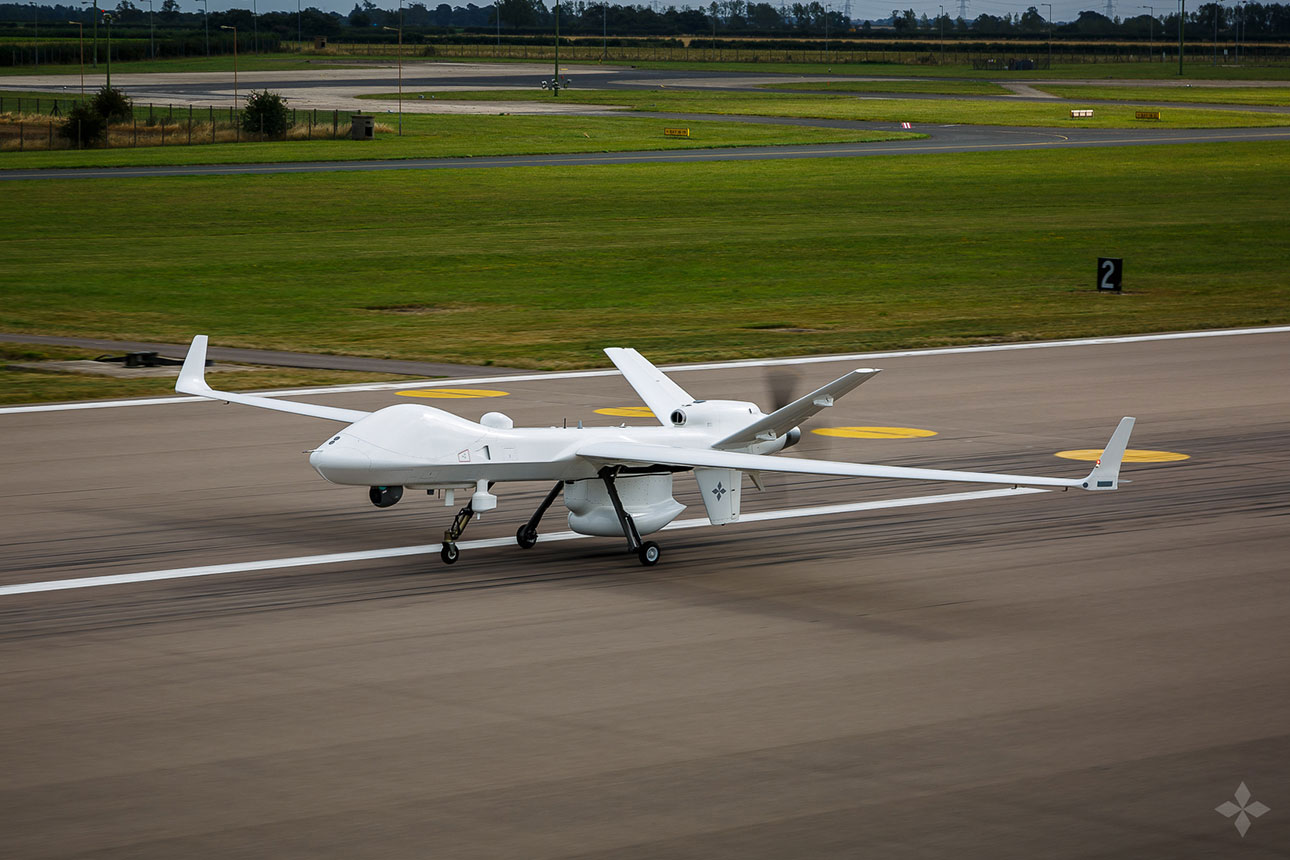
General Atomics MQ-9B
As geopolitical tensions mount, ongoing conflicts globally have cradled battlefield innovation. Ananta’s Command Chain reviews the security and defence-centric developments that are shaping warfare’s evolution. In this edition we analyse the new lease for MQ9B drones India has signed up for, the claimed substantial loss of US drones in the Iran war, the Trump administration’s displeasure with EMALS, the rise of robotic canines in infantry combat, and the Indian Air Force’s Golden Arrows in a popular web series.
A new lease for Indian Navy’s MQ9B Sea Guardians
India’s Ministry of Defence (MoD) signed a deal for leasing two US-origin General Atomic MQ9B Sea Guardian unmanned aircraft for a duration of 30 months. According to a report by DD News, the deal is going to cost Indian taxpayers INR 19.43 billion and will be a shot in the arm for the Indian Navy’s maritime surveillance and patrol capabilities in the High Altitude and Long Endurance (HALE) configuration.
According to another report in The Hindu, India had already signed a deal for outright acquisition of 31 MQ9B aircrafts in October 2024 which will be delivered in 2029-2030. Furthermore, the August 2026 lease agreement is also not the first of its kind as the Indian Navy had signed a similar agreement in 2020 for the same number of the same aircraft, which has been consistently extended to ensure that the Indian Navy is able to receive a constant stream of surveillance data from these assets.
The 2020 agreement was also reportedly under the stipulations of a Contractor Owned and Contractor Operated (COCO) model, which came in handy as General Atomics had to replace one of the two aircraft when it was lost in a mishap while conducting a routine mission. Had the aircraft been one from the batch that India will own outright, it would have been written off as a permanent loss and there would be no replacement by the Original Equipment Manufacturer (OEM).
India and the US share a national security interest in keeping tabs on China’s People’s Liberation Army Navy (PLA-N) forces, assets, and activities in the region. India also has an intelligence and defence data sharing agreement with the US in the form of the 2020 Basic Exchange and Cooperation Agreement (BECA) pact between the two countries, which likely facilitates this access on a mutual basis between India and the US.
The lease has also come under criticism from voices arguing for the acquisition of India’s homegrown platforms with a similar role, such as the DRDO TAPAS which some argue would benefit massively from funding injection and would become long-term solutions in fulfilling a role that is only going to see its need proliferate in the coming years. However, given India’s dependence on maritime lanes for carrying almost all of its trade, it is essential that the country’s forces have the ability to monitor these lanes across the vast swathes of the Indo-Pacific littoral. While TAPAS maybe a long-term solution, choosing between funding it and acquiring the MQ9B is not the right framing for India’s national interest. The most optimal framing should be to pursue both; MQ9B for the short term and TAPAS or related developments for the future to serve alongside the Sea Guardians as complementary platforms.
Putting the US’s UAV losses against Iran in perspective
The high attrition rate of unmanned platforms in modern standoff combat has always been an acceptable cost but as manned platforms gradually become less and less central to conflict, it is unlikely to become the yardstick by which force levels and belligerents’ ability to continue may be judged. According to a report by the Washington Post, the US has lost around 45 airframes or 25% of its inventory of the MQ-9 family of Unmanned Aerial Vehicles (UAV)s, since combat operations against the Islamic Republic of Iran began on 28 February 2026. While the claim has not been directly addressed by the Pentagon or the US Government, it has little significance in the US’s ability to continue operations against Iran.
While a notable dent in its inventory, the MQ-9 platform is one of many with overlapping capabilities in the overall US arsenal. Furthermore, while there is concern over the number of precision guided munitions the US defence industry can manufacture in volumes required for sustaining high-intensity combats that standoffs in modern battle purportedly required since the widespread use of relatively cheap unmanned offensive platforms beginning with the Nagorno-Karabakh conflict between Azerbaijan and Armenia in 2020, it is not about attrition rates or production numbers but about escalation.
While US President Donald Trump has repeatedly claimed that Iran’s offensive capabilities are neutralised or nearly neutralised, Tehran continues to demonstrate with its strikes against US forces and bases in Gulf States that those claims may be exaggerated. However, given that the US has a substantive depth of magazine to also continue strikes intermittently, signals that it merely has to remove constraints on its deterrent forces elsewhere to bring forth force levels that may be too much for even Tehran’s forces which do not operate on the command of a central authority that has been decapitated multiple times by Washington, but on standing orders for prolonged conflict precisely like the one unfolding against the US and Israel. This situation won’t be without consequence for the US. Such a concentration of forces in West Asia will leave its presence in other strategically important theatres such as the East China Sea spread thin, giving other US adversaries a window of opportunity to execute a military misadventure that may propel the world towards yet another conflict.
Trump loses steam on EMALS
According to a US presidential memorandum released on 13 August 2026, the Trump administration is concerned about “a series of shipbuilding setbacks stemming from overly complex designs and iterative design change procedures, which have resulted in cost growth, delays, and cancellations.” The primary target identified by the document’s text which represents all that is causing these troubles are the Electromagnetic Aircraft Launch System (EMALS) and Advanced Weapons Elevators (AWE), which are the primary design features of the US Navy’s new Gerald R. Ford Class Aircraft Carriers. While these platforms are cutting edge and no other country including China has been able to perfect them, they do come with a steep learning curve and are expensive compared to the systems that preceded them. The memorandum’s text directs the US Secretary of War and his subordinate the Secretary of the Navy to plan how the EMALS and AWE systems can be replaced with their predecessors from the US Navy’s decades old Nimitz class aircraft carriers. These old platforms, which were powered by relatively simpler to build and maintain steam catapults and hydraulic systems, are likely seen by the Trump administration as more relevant to the US’s national security goals.
According to a report in The Guardian, citing President Trump’s words from a Time magazine interview, he is deeply sceptical of digital systems such as EMALS and thinks they are too complicated, and has a favourable view of tried and tested analog technologies such as the steam catapult which has been used since around the time when aircraft-carrying cruisers became a mainstay as every consequential navy in the world transitioned from battleships with large artillery guns to airpower and guided missile platforms.
However, this sudden shift in favour of the old steam catapult technology complicates things for US security partners such as India, which has been consulting on a navy to navy level from the transfer and acquisition of EMALS and other aircraft carrier-related technologies. With the US government officially losing confidence in its own advance systems, India may be in a difficult position as the merits of the system and its technical capabilities might be vetted but the optics may prove a disaster if New Delhi becomes an export customer of the platform which the US administration itself rejects for its forces which are backed by a far larger defence budget and industrial wherewithal for upkeep and maintenance of the technology.
Quadruped robots and the new era of infantry combat
In the Republic Day celebrations in West Bengal in 2025, the Indian Army displayed its new acquisition, the quadruped robots that resemble canines, officially designated Multi Utility Legged Equipment (MULE) named Sanjay. According to a report by India Today, at the time the Indian Army had inducted 100 such robots into various formations and units for a variety of functions, including for explosive ordinance disposal, chemical, biological, and nuclear warfare-related operations. While the use of battlefield robots and unmanned systems has been proliferating in armed forces around the world, it has been most pronounced in the active ground conflict between Ukraine and Russia. Both Moscow and Kiev have fielded ground-based autonomous systems to assist their infantry forces engaged in trench warfare and at risk of being wounded, incapacitated or even being unnecessarily killed in combat that resembles the senseless slaughter of World War I. Just as the great war was a catalyst for the invention of the armoured vehicle and more particularly the Main Battle Tank (MBT), the Ukraine war has seen the first widespread use of auxiliary robots assisting troops for ordnance disposal, carrying ammunition and supplies, as well as in suicide attacks where these robots, guided with explosive charges strapped to them, are directed at the enemy mirroring the suicidal charges of Japanese soldiers in World War II. However, neither tracked nor wheeled platforms possess the versatility of the human feet to navigate complex terrains that require a lot of manual intervention by the troops they accompany and are essentially remotely piloted by humans. While modern algorithms are consistently lowering the dexterity and skill needed for guiding these robots they are still far from mirroring a biological being. However, as technology makes advances in pattern recognition and Artificial Intelligence (AI), the day is not far when combat between ground forces deemed too costly for human losses may be conducted by these platforms.
Forces on the silver screen
The Netflix series Operation Safed Sagar is perhaps the most positively received depiction of the Indian armed forces on the silver screen. The series covers real events around the Indian Airforce’s No. 17 Squadron, Golden Arrows, equipped with the legendary MiG 21. The series takes some liberties and is not a perfect technical depiction but it comes very close to realism in depicting combat operations as well as minor details that became part of the IAF’s culture even if not in the time period it is depicting.
A scene showing two MiG 21 aircraft conducting aerial reconnaissance and capturing imagery in an arduous journey through a valley in Jammu and Kashmir is probably the most iconic moment that will stay with audiences. While a little exaggerated for dramatic effect, the technique used for navigating through the terrain is not too far removed from what Squadron 17 fighter pilots did in real life. Furthermore, the series shows several characters wearing what appears to be a Timex Expedition MF13 ana-digi wrist watch which, although remembered as a common choice by IAF fighter pilots, didn’t become available in the retail market until 2005, making it impossible for the watch to have been worn by real life IAF personnel in 1999 when the events of the series take place. Minor nitpicking aside, the series is perhaps a good template for filmmakers to emulate for depicting India’s armed forces at work.
Check these out
Press Information Bureau. (n.d.). The Story of the Indian Air Force: A Journey Through Time. Government of India.
https://www.pib.gov.in/PressNoteDetails.aspx?NoteId=153257&ModuleId=3®=48&lang=2Manjeet S. Pardesi. (2020). The Indian Navy’s doctrinal evolution: Between deterrence and denial. In The Routledge Handbook of Indian Defence Policy. https://www.taylorfrancis.com/chapters/edit/10.4324/9780429352386-18/indian-navy-doctrinal-evolution-manjeet-pardesi
Dinakar Peri. (2024, September 24). Army inducts robotic mules; drones, high-altitude tents under evaluation. The Hindu. https://www.thehindu.com/news/national/army-inducts-robotic-mules-drones-high-altitude-tents-under-evaluation/article68675123.ece
Mansur Mirovalev. (2026, August 10). ‘Like the movies’: How Ukraine’s ground robots are changing rules of war. Al Jazeera. https://www.aljazeera.com/news/2026/8/10/like-the-movies-how-ukraines-ground-robots-are-changing-rules-of-war
