
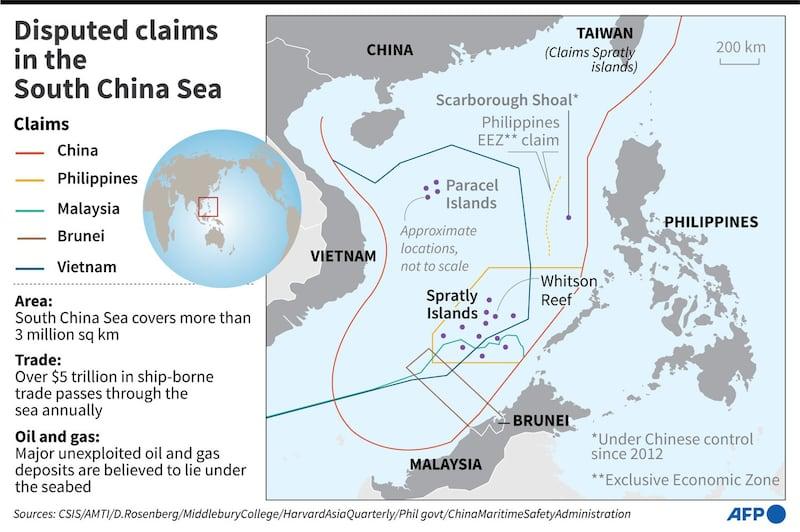
Figure : Claims in the South China Sea
Source: https://www.rfa.org/english/news/vietnam/southchinasea-name-02072022145513.html
Credit: AFP
Abstract
On 12 July 2016, an arbitral tribunal constituted under Annex VII of the United Nations Convention on the Law of the Sea (UNCLOS) ruled that China’s historic-rights claims within its nine-dash line were incompatible with the Convention, and that none of the disputed features in the Spratly Islands could generate an exclusive economic zone (PCA, 2016a). The tribunal did not, and was not asked to, resolve the underlying question of territorial sovereignty. This paper considers that award as a hinge point rather than an endpoint. It reconstructs the tribunal’s central findings and the decade of alliance-building that has followed China’s rejection of them, then widens the lens in two directions. First, it asks what the 2026 crisis in the Strait of Hormuz, where a state has attempted to control passage through an international strait by force, suggests about the durability of the rules-based maritime order the 2016 award depends on, and whether that crisis reopens the tribunal’s own findings to reinterpretation. Second, it asks whether smaller states in maritime disputes with larger neighbours, India and the Philippines among them, would be better served by pressing for multilaterally negotiated settlements rather than relying on bilateral arbitration that a stronger party can simply reject, and what the decades-long, post-1945 codification of the modern law of the sea suggests about how long that kind of settlement actually takes. Its central argument is that international law under UNCLOS can produce a binding, durable statement of legal rights even against a state that refuses to participate, but that statement does not compel compliance on its own. What has filled the gap between legal victory and physical control over the past decade is not stronger enforcement of the award itself, but a denser layer of bilateral and minilateral security arrangements built in its name. Technical and procedural details of the arbitration are presented in Appendix A.
1. Introduction
Public discussion on the South China Sea dispute often collapses two distinct legal questions into one: who owns the islands, reefs, and shoals scattered across the sea; and what maritime rights, meaning territorial seas, exclusive economic zones (EEZs), and continental shelves, those features can lawfully generate. The 2016 arbitral award in Philippines v. China addressed only the second question. The tribunal, constituted under Annex VII of UNCLOS and administered by the Permanent Court of Arbitration (PCA) in The Hague, ruled unanimously that China’s historic-rights claims within the nine-dash line were incompatible with UNCLOS to the extent they exceeded the entitlements the Convention allows, and that China had violated the Philippines’ sovereign rights within its EEZ (PCA, 2016a).
This paper treats the award not as an isolated legal event but as a hinge point in a longer strategic story. Section 2 tries to understand why the sea matters materially. Section 3 traces the historical and legal roots of the dispute. Section 4 covers the arbitration itself, with the full procedural timeline and submissions are presented in Appendix A. Section 5 examines the award’s substantive findings. Sections 6 and 7 turn to what has happened since: the persistence of the enforcement gap and the alliance-building strategy the Philippines has pursued in response. Section 8 draws out the analytical tensions the case exposes. Section 9 widens the lens, testing the award’s framework against the Strait of Hormuz crisis, the question of whether multilateral settlement would serve smaller claimant states better than bilateral arbitration, and the lessons of the post-1945 codification of the law of the sea. Section 10 concludes.
Sections 6 and 7 also draw on a briefing discussion given by the Philippines’ Ambassador to India, H.E. Josel F. Ignacio, in New Delhi on 21 July 2026. The discussion titled “Lines Drawn in the Water: Ten Years of the PCA Ruling on the South China Sea” was hosted by the Ananta Centre. Ambassador Ignacio characterised international law as “the constant” amid shifting alliances and changing governments (Ananta Centre, 2026; ANI, 2026), a framing consistent with the great equaliser language long used by Filipino officials such as former Foreign Secretary Albert del Rosario, to describe the value of the award to a smaller state facing a larger power (AP / Fox News, 2016; Manhit, 2015; ANI / The Tribune, 2026). He described the Philippines’ Mutual Defence Treaty with the United States (US) as a binding legal obligation rather than a discretionary political assurance characterised Washington’s regional posture as shifting from that of a security guarantor toward a security coordinator, and situated the Philippines’ growing defence relationship with India, including the BrahMos missile sale (Ozberk, 2022), within the same strategy of building overlapping partnerships rather than relying on a single guarantor. Claims drawn specifically from that discussion are identified as such below; claims that can be independently documented are cited to primary legal texts and published sources.
2. Why the South China Sea Matters
Why does a stretch of ocean carry so much geopolitical weight? Part of the answer is simple geography: the South China Sea is the maritime bridge between the Indian Ocean and Northeast Asia, and ships have no real alternative but to squeeze through pinch points like the Strait of Malacca to make that crossing. That single fact of position, more than any claim to the resources beneath the water, is what turns a regional dispute into a global one.
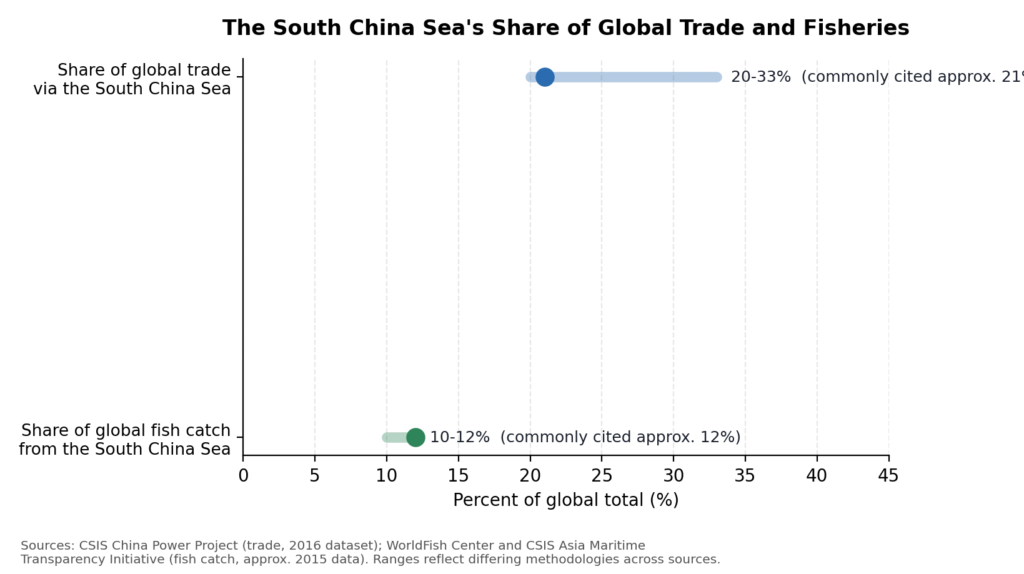
Geography alone doesn’t explain the numbers attached to the sea, and those numbers turn out to be less settled than they first appeared. Pin down how much trade passes through, and the answer shifts depending on what you’re counting and when. The CSIS China Power Project worked from shipping route data, vessel tracking, and bilateral trade records to arrive at a 2016 figure of about 21 percent of global trade by value, close to US$ 3.4 trillion (China Power Project, 2026). Switch to a shipping volume approach instead, and the share climbs toward a third of global shipping. Neither number is wrong; they’re just measuring different things. UN Trade and Development’s (UNCTAD) baseline, that roughly 80 percent of world trade moves by sea, is the scale against which both estimates have to be read.
Fisheries tell a similar story of rough consensus with fuzzy edges. Drawn from 2015 data, WorldFish Center and the CSIS Asia Maritime Transparency Initiative (AMTI) converge on a figure of 10 to 12 percent of the global catch (Christensen & Pauly, 1991; South China Sea Expert Working Group, 2017), and AMTI adds that over half the world’s fishing vessels work these waters, sustaining the livelihoods several million people that rarely show up in formal statistics.
What Figure 1 is really doing, then, is showing two ranges rather than two numbers, each tagged to the organisation behind it, instead of flattening into a false precision. This choice makes a point beyond the data itself: no one disputes that the South China Sea matters immensely but how much it matters depends entirely on what you decide to measure, and how.
3. Historical and Legal Roots of the Dispute
3.1 Competing Historical Claims
The Philippines government traces part of its claim through treaties of the Spanish and American colonial eras. The Treaty of Paris of 1898, which ended the Spanish-American War, drew boundary lines around most of the Philippines archipelago; Scarborough Shoal and the Spratly Islands fell outside those lines. Former Filipino Supreme Court Justice Antonio Carpio and the Philippine Department of Foreign Affairs have argued that the Treaty of Washington of 1900, which ceded to the United States “any and all islands belonging to the Philippine archipelago lying outside” the Paris lines, extended to Scarborough Shoal and the Spratlys as well, and they point to Spanish-era maps, including the Murillo Velarde map of 1734 and the Carta General del Archipielago Filipino of 1875, as supporting evidence (Carpio, 2020; Talosig-Bartolome, 2025; Carpio, 2025).
Chinese commentary directly disputes this reading. An opinion piece in China Daily has argued that Spain never incorporated Scarborough Shoal or the Spratlys into its colonial administration in the first place since it regarded them as uninhabitable and of no economic value, and that neither the treaties of 1898 nor 1900 mention them by name for that reason (Xu, 2021). The disagreement is therefore not just about what the treaties say, but about what Spain actually governed at the time. This is a live historical and legal argument between the two governments, not a matter the Tribunal of 2016 resolved. The Tribunal deliberately avoided ruling on sovereignty so neither reading of the treaties carries the weight of an arbitral finding.
3.2 The Evolution of China's Dashed-Line Claim
China’s dashed-line claim originated in 1947 when the Kuomintang (Nationalist) government published the “Location Map of the South Sea Islands,” showing an eleven-dash line enclosing most of the South China Sea. After the Communist victory in the Chinese civil war in 1949, the People’s Republic inherited the claim. In the early 1950s two dashes in the Gulf of Tonkin were dropped as a gesture toward Vietnam, producing the nine-dash line still in use today (Beech, 2016).1
UNCLOS, adopted in 1982, came into force in 1994 and was signed by China, the Philippines, and Vietnam among many other states. China ratified UNCLOS in 1996 (JC History Tuition, 2022). The Tribunal’s central legal question, discussed in Section 5, was whether China’s historic-rights claim could coexist with, or override, the zonal system of rights that UNCLOS establishes.
3.3 Early Confrontations: Mischief Reef, 1992-1996
The Mischief Reef episode is best understood less as an isolated incident than as a template. When American forces closed their Philippines bases in 1992, they ended a military footprint that had shaped the Philippines’ security policy for most of the 20th century. What filled that space became visible three years later: in early 1995, Manila found that Beijing had quietly erected structures on Mischief Reef, a feature that sits well within the Philippines’ own claimed EEZ but is submerged at high tide (JC History Tuition, 2022; Farolan, 2021). China’s initial explanation, that these were simple shelters for its fishermen, gave the move a plausible, low-stakes cover story even as it established a physical foothold. The Philippines protested through diplomatic channels, ASEAN issued a joint expression of concern that March, and the two countries spent the rest of the decade sparring over fishing-related detentions without resolving the underlying standoff.
The value of Mischief Reef for this paper isn’t as a starting date to pin down, but as a case study in method: a small, easily deniable presence, justified afterwards with an explanation that shifted as changing circumstances required; and once attention moved elsewhere that initially small presence began to grow. This same pattern shows up again at Scarborough Shoal in 2012 and, on a far larger scale, in the island-building China carried out between 2013 and 2016. Both these are examined in the sections that follow.
3.4 ASEAN's Declaration on the Conduct of Parties (2002)
The confrontations of the mid-1990s contributed to negotiations that produced the ASEAN-China Declaration on the Conduct of Parties in the South China Sea (DOC), signed on 4 November 2002 at the 8th ASEAN Summit in Phnom Penh by China and all ten ASEAN member states (ASEAN, 2002; CIL, 2002). The DOC is explicitly non-binding: parties committed to self-restraint, including avoiding the occupation of previously unoccupied features, and to work toward an eventual, legally binding Code of Conduct. More than two decades later, that Code of Conduct has still not been concluded, which is itself indicative of how weak voluntary restraint has been proven as a substitute for binding rules.
3.5 Mischief Reef: From Shelters to Militarised Island
Mischief Reef illustrates the trajectory from low-level occupation to full militarisation. Chinese structures there expanded from modest stilt shelters in 1995 to a multi-storey concrete installation and, following large-scale dredging and reclamation between roughly 2013 and 2016, to an artificial island with a runway and radar infrastructure (AP / Fox News, 2015). The 2016 Tribunal separately classified Mischief Reef as a low-tide elevation within the Philippines’ EEZ and continental shelf, a status that, under UNCLOS, cannot generate any independent maritime zone regardless of what has been built on top of it.2 The legal and actual stories therefore diverge sharply: China’s engineering capability transformed the reef beyond recognition, while its legal status under the award did not change at all.
3.6 The Scarborough Shoal Standoff (2012)
The immediate trigger for the Philippines’ decision to pursue arbitration was the Scarborough Shoal standoff. On 8 April 2012, a Philippine surveillance aircraft spotted eight Chinese fishing vessels inside the shoal’s lagoon (Green, et. al, 2017). The Philippines naval vessel BRP Gregorio del Pilar subsequently dispatched a boarding party and reported finding illegally harvested giant clams, corals, and sharks aboard (Ratner, 2013). A ten-week standoff followed. According to Philippines’ accounts and contemporaneous reporting, senior US and Chinese officials brokered a mutual withdrawal in June 2012; Philippine vessels left the shoal but Chinese government vessels remained thus producing a de facto transfer of control (Pham, 2024).
A different account of these events comes from Fu Ying’s own memoir. As the Chinese vice foreign minister who led Beijing’s side of the back-channel talks with Manila’s envoy, she writes that government vessels from both sides had already left the shoal’s lagoon by early June 2012, and argues that it was the Philippines’ continued ambitions over the feature, not any Chinese reversal, that kept the standoff unresolved (Fu, 2012). This contrasts with the account favoured by Filipino officials and external researchers such as the CSIS Asia Maritime Transparency Initiative, who describe a US-brokered mutual withdrawal that China agreed to and then failed to honour (AMTI, 2017). The precise sequence of who agreed to what therefore remains contested between the two governments’ own narratives, not merely a matter of incomplete reporting. What is not disputed is the outcome: Chinese vessels remained in practical control of the shoal, Philippines’ vessels did not, and Manila treated the episode as proof that bilateral diplomacy with China had reached a dead end. That conclusion, more than the disputed details of the withdrawal itself, is what drove the shift to arbitration the following year.
4. The Arbitration: Claims, Jurisdiction, and Proceedings
The Philippines formally initiated arbitration under Part XV and Annex VII of UNCLOS on 22 January 2013 (Jus Mundi, 2016). China rejected the notification and declined to participate in the proceedings, though it issued a position paper in December 2014 explaining its objections (U.S.-CESRC, 2016). Manila’s submissions, 15 in total and reproduced by category in Appendix A, fell broadly into four groups: (i) the source and validity of China’s claimed maritime entitlements; (ii) the legal status of specific reefs and shoals as islands, rocks, or low-tide elevations; (iii) the lawfulness of specific Chinese actions, including interference with Philippines’ fishing and resource rights; and (iv) whether China had aggravated the dispute during the arbitration itself, notably through large-scale island-building.
China’s central jurisdictional objection was that the dispute was, in substance, about territorial sovereignty – a matter UNCLOS arbitration cannot adjudicate – and, alternatively, that any UNCLOS-related issues formed part of a maritime boundary delimitation, a category China had explicitly excluded from compulsory arbitration in a declaration in 2006. The Tribunal rejected this classification, stating that determining whether an entitlement exists in the first place is a legally distinct question from delimiting a boundary between overlapping entitlements (PCA, 2015; PCA, 2016b). This distinction between the existence and delimitation of maritime rights was decisive in establishing jurisdiction and remains one of the award’s most cited doctrinal contributions because it gives other small claimant states a template for bringing entitlement questions to arbitration without having to resolve a full-fledged boundary dispute first.
On 29 October 2015, the Tribunal issued its Award on Jurisdiction and Admissibility, and on 12 July 2016 it issued its unanimous final award on the merits (PCA, 2016a; Ridderhof, 2016). Under UNCLOS Annex VII procedures, one party’s non-appearance does not prevent a properly constituted tribunal from proceeding, provided it satisfies itself as to jurisdiction and the merits of the claims, which the tribunal did. The full procedural timeline appears in Appendix A.
5. The 2016 Award: Central Findings
5.1 Historic Rights versus UNCLOS
At the core of the ruling sits a fairly narrow legal move with very major consequences: the Tribunal treated UNCLOS as the limit of what any historic claim could still mean once the Convention took effect (PCA, 2016a). Its reasoning worked backward from the nature of the sea itself. Before UNCLOS existed, nothing in the South China Sea beyond a coastal state’s territorial waters belonged to anyone in particular; those waters were the high seas, open to any state’s ships and fishing fleets. On the basis of that reading, China’s long history of activity in the area was never evidence of an exclusive right; it was simply China exercising the same open-access freedoms every other state already had. Once UNCLOS came into force and replaced that open-access regime with a defined system of zones and entitlements, any claim to historic rights, sovereignty, or resource jurisdiction inside the nine-dash line lost its legal footing wherever it went beyond what the Convention itself allows.
This reasoning does more than settle this dispute. It forecloses a strategy available in principle to any coastal state: ratifying UNCLOS while quietly holding onto broader historical claims the Convention doesn’t recognise. By tying entitlement strictly to what UNCLOS grants, the Tribunal effectively closed that door, not just for China, but as a matter of general principle for any state carrying a pre-Convention claim wider than its treaty-based rights.
5.2 Article 121: Islands, Rocks, and Low-tide Elevations
A large portion of the award turns to the classification of maritime features under UNCLOS Article 121, which sorts features into three tiers – islands, rocks, and low-tide elevations, according to whether they can sustain human habitation or an independent economic life.3 The precise definitions and the maritime zones each tier can generate are set out in Appendix A.3; what matters here is the standard the Tribunal applied and what it decided.
The Tribunal applied a demanding standard for human habitation that required the ability to sustain a stable community for whom it is a genuine home, not merely rotating military garrisons or externally supplied outposts, and a similarly demanding standard for economic life needing actual, ongoing exploitation of resources rather than their mere presence. Applying this standard even to Itu Aba (Taiping Island), the largest natural feature in the Spratlys and the one most plausibly capable of supporting habitation, the Tribunal found that none of the Spratly Islands, individually or collectively, could generate an EEZ or continental shelf.4
The practical weight of the award rests almost entirely on this single finding. Delimiting a maritime boundary normally requires a tribunal to weigh two overlapping entitlements against each other and draw a line between them, a process UNCLOS arbitration is not even empowered to undertake between states that haven’t agreed to it. The Tribunal avoided that problem entirely, but not by drawing a boundary; it did so by ruling that one side of the potential overlap never existed in the first place. Because none of the Spratly features qualified for an EEZ of its own, there was no competing Chinese zone left to delimit against. The Philippines’ entitlement could simply be mapped on its own terms, a result functionally equivalent to winning a boundary dispute without the Tribunal ever having to adjudicate one (Guilfoyle, 2016).
5.3 Reclamation Cannot Manufacture Legal Rights
The Tribunal also held that a feature’s legal classification is fixed by its natural, pre-modification condition: land reclamation cannot convert a low-tide elevation into an island, nor can engineering convert a rock into a fully entitled island under Article 121 (PCA, 2016a). This finding limits the legal significance of China’s large-scale dredging and construction programme, concentrated between roughly 2013 and 2016, which physically transformed several reefs including Mischief Reef, Subi Reef, and Fiery Cross Reef, without altering their underlying legal status.5 The practical consequence is that China’s engineering investment in these features buys military and logistical value, as discussed in Section 6, but not legal entitlement.
5.4 Findings on Unlawful Conduct and Environmental Harm
The Tribunal further found that China had violated the Philippines’ sovereign rights concerning fishing, oil exploration, and resource exploitation within the latter’s EEZ, and that Chinese law-enforcement vessels had operated dangerously around Scarborough Shoal (PCA, 2016a). On the environment, the Tribunal found that China had breached its UNCLOS obligations by harvesting endangered species including giant clams and corals of the kind documented during the standoff in 2012, caused environmental damage associated with island-building, and failed to prevent harmful fishing practices by vessels under its jurisdiction (HSF Kramer, 2016). These findings matter analytically because they show the award was not just a boundary-and-entitlement ruling; it also established a documented record of specific conduct which gives the Philippines a factual basis for diplomatic protest and public argument that does not depend on China ever accepting the Tribunal’s jurisdiction.
6. The Enforcement Gap: A Decade of Non-compliance
Ten years on, China’s answer to the ruling hasn’t moved: reject it, and keep doing what it was already doing. Beijing called the award null and void within days and has never accepted the tribunal’s jurisdiction since (U.S.-CESRC, 2016). Reclamation, coast guard patrols, and militia activity around the Spratlys and Scarborough Shoal have carried on largely unchanged, ruling or no ruling.
What’s worth noticing is how deliberately that gap is used rather than just endured. China’s conduct in the South China Sea has consistently stayed below the threshold that would count as an armed attack – coast guard vessels and fishing militias rather than warships, water cannon and blockade rather than open engagement. That’s not incidental. A tribunal ruling has real force against a state worried about being seen as a treaty breaker or as an aggressor; it has almost none against a state that never frames its own actions in those terms to begin with. By keeping its activity within the language of routine maritime law enforcement, China denies the ruling the one thing it needs to bite: a clear, escalatory violation that would force other governments to respond as though the rules had actually been broken. The 2026 Hormuz crisis, discussed later in this paper, shows the opposite case: a well-established rule was broken outright by force and even that produced sanctions rather than compliance. If open defiance draws no more than condemnation, then quiet, deniable defiance was never going to draw any response at all.
Manila’s response to that shortcoming has been partly rhetorical. “The award further affirms our collective belief that right is might and that international law is the great equalizer among states,” former Foreign Secretary Albert del Rosario said when the ruling came, a line Philippine officials have leaned on ever since, both before and after 2016 (AP / Fox News, 2016; Manhit, 2015). A decade of evidence suggests the phrase was wrong in the way del Rosario meant it and right in a sense he probably didn’t. It did not equalise anything materially; China’s navy, coast guard, and construction capacity dwarf the Philippines’ as much today as it did in 2016. But the ruling did function as a kind of currency, a fixed, internationally legible statement of who was in the right, that the Philippines has spent steadily ever since to recruit the correct partners and hardware, the EDCA expansion, the BrahMos purchase, the trilateral and quadrilateral arrangements covered in Section 7, that it could never have built on the strength of its own navy alone. The equalising, in other words, didn’t happen in the waters off Scarborough Shoal; it happened in the diplomatic and defence relationships the award gave Manila the pathway to build.
7. Alliances, Access Arrangements, and Minilateralism
The Philippines’ 1987 constitution constrains the reestablishment of permanent foreign military bases. In response, Manila has developed access arrangements, including the Enhanced Defence Cooperation Agreement with the US and a reciprocal access arrangement with Japan that allow foreign forces to use facilities that formally belong to the Philippines. The US commitment to the Philippines rests on the Mutual Defence Treaty of 19516 – a binding, legal instrument rather than a discretionary political assurance.
Since 2022, Philippine-US-Japan cooperation has taken an increasingly formal minilateral shape. The three countries held their first trilateral leaders’ summit on 11 April 2024 (Model Diplomat, 2026; Langel, 2024) and days earlier, on 6 April 2024, the US, Japan, the Philippines, and Australia issued a joint statement announcing a Maritime Cooperative Activity within the Philippine EEZ, an arrangement commentators have since nicknamed the “Squad” (Haldar & Sharma, 2024). These arrangements sit alongside, rather than replace, the bilateral US-Philippines alliance and they are explicitly designed to be more resilient to changes in any country’s leadership than a purely bilateral relationship would be.
India’s role in this architecture has grown mainly through bilateral defence trade rather than through a standing regional grouping. In January 2022, the Philippines signed a US$ 375 million contract with India’s BrahMos Aerospace for three batteries of the BrahMos shore-based anti-ship missile system, India’s first major export sale of the system (Ozberk, 2022). The first battery was delivered in April 2024 and the second in April 2025, along with training and logistics support for Filipino forces (Pasricha, 2024; Naval Technology, 2025). India has separately expanded its Act East Policy and its maritime cooperation with ASEAN states more broadly, and it participates in the Quad alongside the US, Japan, and Australia. However, no standing India-Philippines-Japan trilateral security framework of the kind that exists between the US, Japan, and the Philippines has yet been established.
Read together, these arrangements point to an Indo-Pacific security order that is becoming less centred on a single hub-and-spokes structure built around Washington and organised more around overlapping, flexible groupings, some purely bilateral, some trilateral or quadrilateral, that can be assembled around a specific problem such as Chinese coast guard pressure near Second Thomas Shoal (Hornat, 2023). The strategic logic is straightforward: a state that cannot compel China to comply with an arbitral award can still raise the cost and visibility of Chinese coercion by ensuring that other capable states have a direct stake in the outcome.
Similar Awards, Different Outcomes: The India-Bangladesh Maritime Dispute
A useful point of comparison for assessing state behaviour towards international adjudication is the Bay of Bengal Maritime Boundary Arbitration of 2014 between Bangladesh and India. In that case, decided by a PCA tribunal on 7 July 2014 (PCA, 2014), two years before the Philippines v. China award, India accepted a ruling that awarded Bangladesh roughly four-fifths of the disputed maritime area (about 19,467 of 25,602 square kilometres) (Rahman, 2021), an outcome unfavourable to India on several points. Both governments subsequently affirmed their commitment to abide by the result (Burke, 2014). This is a genuine and documented contrast with China’s rejection of the 2016 award. It should, however, be read carefully rather than as a simple tale of morality: the two cases differ in the type of dispute involved (one was a bilateral boundary delimitation between neighbours of relatively similar regional standing, and the other an entitlement and conduct case brought by a much smaller state against a major power), and in what each government stood to lose by accepting the outcome. The comparison is informative about the two governments’ general position vis-à-vis arbitration but it does not by itself predict how either government will behave in a dispute that directly affects core strategic interests.
8. What the Case Reveals
Several tensions run through the dispute discussed in the preceding sections, and they are more useful as analytical lenses than as loose ends to be tied.
Law versus enforcement: The Philippines has a comprehensive legal victory yet China retains the material capacity to obstruct the other’s activities at sea. The lesson is that a favourable ruling can change the legal terrain permanently but may not change the balance of force on the waters at all.
Sovereignty versus entitlement: The award clarified the maritime entitlements that particular maritime geographical features can generate without determining which state has sovereignty over these features. This means the ruling narrows the disputed area dramatically for practical purposes, while leaving the deeper, more emotionally and politically charged sovereignty question untouched and unresolved for the indefinite future.
Restraint-based diplomacy versus binding adjudication: DOC 2002 relies on voluntary self-restraint with no enforcement mechanism in contrast to the binding, if unenforced, award of 2016. The two decades between the DOC and the still-unfinished Code of Conduct suggest that voluntary restraint among unequal parties tends to erode rather than evolve into binding commitment over time.
Physical transformation versus legal classification: Reclamation changes the facts on the water but not a man-made feature’s underlying legal status. This gap between engineering and law is precisely why China has continued building even after losing on the law: the construction serves military and administrative purposes that do not depend on the tribunal’s approval.
Alliance dependence versus alliance uncertainty: Southeast Asian states are deepening their reliance on US and partner security commitments even as they debate the durability of American regional priorities. The Philippines’ answer to that uncertainty has been to multiply the number of partners it depends on rather than rely on any single guarantee.
Taken together, these tensions suggest that the South China Sea dispute is not adequately described as a single China-Philippines quarrel. It is a layered problem involving codified law (UNCLOS and the award of 2016), material power (China’s continued presence and construction activities), politics of alliances (with the US, Japan, Australia, India, and others), and weak regional institutions (ASEAN’s DOC and the still-unfinished Code of Conduct). Any assessment that looks at only one of these layers will overstate either how much the award of 2016 changed or how little it mattered.
9. Wider Currents: Hormuz, Compliance, and the Lessons of History
In the preceding sections, the South China Sea dispute has been treated as a predominantly self-contained case. But the rules-based maritime order that the award of 2016 depends on has been tested other than in the South China Sea, and so it is worth asking what a very different, ongoing crisis elsewhere says about the durability of that order, and what history suggests about how such disputes can be resolved permanently.
9.1 A Different Kind of Test: War, not Entitlement
Since 28 February 2026, the Strait of Hormuz has been the site of an armed conflict between Iran and a US-Israeli coalition. Iran responded to strikes on its territory, including the killing of its supreme leader, by attacking neutral merchant shipping, laying naval mines, and declaring the Strait closed to vessels it deemed unfriendly (Wikipedia, 2026a). In May 2026, Iran went a step further by establishing a Persian Gulf Strait Authority (PGSA) and asserting authority over transit through the Strait that overlaps Omani and UAE territorial waters, along with a scheme to charge transit fees (Wikipedia, 2026b). The US responded with an aerial campaign against Iranian naval assets, a naval blockade of Iranian ports from April 2026, and escort operations intended to restore commercial transit. The US Treasury directly sanctioned PGSA (Coote, 2026), and the UN Security Council, in Resolution 2817 of 11 March 2026, condemned Iran’s attacks on shipping in the Strait (Caner & Baruch, 2026).
This legal problem is different from the one the award of 2016 addressed. The South China Sea case turned on peacetime questions of classification of features and historic rights under UNCLOS. Hormuz turned on the transit passage regime for straits used for international navigation, a rule most international lawyers treat as binding customary law even on Iran and the US, neither of whom has ratified UNCLOS, couched in the law of naval warfare that governs conduct once an armed conflict is underway (Deligiannis-Virvos, 2026; Nevitt, 2026). Multiple neutral vessels have been struck and the Strait has at different points in time been effectively closed to shipping, developments widely described as violations of that transit passage regime rather than a lawful reassertion of coastal state authority.
There’s a real distinction hiding in that question, and it’s worth studying it in detail rather than answering with a simple ‘yes’ or ‘no’. One state has, in fact, tried to claim exactly that kind of extended authority: Iran’s assertion over waters extending into Oman’s and the UAE’s territorial waters, coupled with charging transit fees and threats to board noncompliant vessels, is a genuine attempt to patrol beyond its own sovereign territory (Bernard, 2026; Coote, 2026). But the reaction to that attempt tells its own story. Even governments that usually avoid confronting Tehran declined to accept it and the practical response has been sanctions, not acquiescence, which suggests this isn’t a case of the rules being quietly stretched but more a case of the rules being tested and holding.
The US and allied naval presence in the Strait is a different animal altogether, even though it also involves foreign ships operating well beyond their own coastlines. Washington and its partners aren’t laying claim to any authority over the waters themselves; the blockade and escort activity is aimed at keeping the existing freedom-of-navigation regime intact against Iran’s attempt to override it. That’s a defensive posture towards an established rule, not a competing assertion of sovereignty, and it maps much more closely onto the freedom-of-navigation patrols the US already runs in the South China Sea than onto anything resembling Iran’s claim.
9.2 Does Hormuz reopen the PCA Award to Reinterpretation?
Not directly. The award of 2016 concerned the classification of maritime features under Article 121 and the status of historic-rights claims in peacetime. The Hormuz dispute on the other hand concerns Part III of UNCLOS, the regime governing straits, and also raises issues that in wartime are addressed by the law of naval warfare. These are different provisions of the same convention, tested in different circumstances, and a ruling on one does not formally bind or unsettle the other.
There is, however, an indirect effect worth mentioning. If a state can defy a transit passage rule that is more firmly established in customary international law than the historic-rights doctrine the 2016 Tribunal rejected, and can sustain that defiance for months under sanctions and near-universal condemnation, it invites a harder question: how much practical weight does any UNCLOS-based ruling carry against a state willing to accept the political and economic cost of ignoring it. In that narrower sense, Hormuz is less a legal reinterpretation of the PCA’s findings than a live stress test of the proposition, discussed in Section 6, that legal validity does not by itself produce compliance. It reinforces rather than overturns this paper’s argument about the South China Sea; it simply supplies a second, starker data point.
9.3 Joint Settlement as an Alternative Compliance Model
One response to the gap between validity and compliance is to ask whether smaller claimant states, India and the Philippines among them, should press for jointly negotiated, multilateral settlement of maritime boundary questions rather than rely on bilateral arbitration that a stronger party can simply reject.
The case for doing so is straightforward. A bilateral arbitration binds only the parties before the tribunal and a state that rejects the tribunal’s jurisdiction, as China did, bears little cost beyond reputational damage. A multilaterally negotiated settlement spreads the political cost of non-compliance across every government with a stake in the outcome, and is correspondingly harder for any one state to ignore without wider diplomatic consequences.
The case against treating this as a simple fix is just as straightforward, and the Philippines’ experience confirms it. ASEAN’s Declaration on the Conduct of Parties of 2002, discussed in Section 3.4, was itself an attempt at a jointly negotiated framework, and the binding Code of Conduct it was meant to result in, remains unresolved more than two decades later. Multilateral processes move at the pace of their most reluctant participant and a stronger power with no urgency to conclude an agreement can use that pace to its advantage and continue to alter the facts on the ground, as China did through island-building, while negotiations proceeded. Joint settlement is a genuinely difficult terrain not because the underlying idea is wrong but because it trades the speed and doctrinal precision of arbitration for a legitimacy that takes years or decades to build, if it is ever concluded at all.
Look at what Manila has actually done since 2016, and the answer isn’t really “arbitration or alliances,” it’s both running simultaneously. The award gave the Philippines a fixed, binding statement of its rights that doesn’t depend on anyone else agreeing to it. Alongside that, Manila has spent the past decade stacking up bilateral and minilateral defence commitments (discussed in Section 7) that make ignoring Chinese pressure progressively more costly and more visible to external observers. Neither piece does the other’s job: the ruling supplies the legal ground to stand on, the partnerships supply the practical friction that raises China’s price for pushing anyway. Waiting instead for a full multilateral settlement, the kind of outcome that historically takes a generation or more to negotiate, was never a realistic substitute for either.
9.4 Lessons from the Post-1945 Codification of the Law of the Sea
The modern law of the sea was itself born from exactly this kind of unresolved tension between unilateral claims and a multilateral order and the decades it took to settle offers a useful, if sobering, comparison.
On 28 September 1945, President Truman proclaimed US jurisdiction over the natural resources of the continental shelf adjoining its coast – a unilateral claim made in the absence of any treaty authorising it.7 Other coastal states, particularly in Latin America and later around the Persian Gulf, quickly issued similar claims, some extending up to 200 nautical miles, producing exactly the kind of overlapping, contested maritime maps that needed to be sorted out. That process took time. The Geneva Conventions on the Law of the Sea of 1958 codified rules on the continental shelf and the high seas that were direct outcomes of the Truman Proclamation.8 In 1969 the International Court of Justice (ICJ), ruling on overlapping continental shelf claims between Germany, Denmark, and the Netherlands in the North Sea Continental Shelf Cases, endorsed the same “equitable principles” language Truman’s proclamation had used for resolving boundaries with neighbouring states.9 The comprehensive framework did not arrive until the Third UN Conference on the Law of the Sea, a negotiation among more than 150 states that went on from 1973 to 1982 and produced UNCLOS which came into force only in 1994, nearly half a century after Truman’s original claim.10
Two lessons follow. First, a durable settlement of a maritime order has historically come through comprehensive, multilaterally negotiated codification rather than through any single ruling, but that codification took decades and was itself preceded by years of unilateral assertions and unresolved disputes, a pattern not unlike the current South China Sea dispute. Second, judicial rulings and multilateral codification are not competitors so much as complementary over a long enough timeline: the equitable principles the ICJ applied in 1969 were later absorbed into UNCLOS’s own text. Applied to the present dispute, this suggests that the 2016 award and any eventual ASEAN-China Code of Conduct need not be rival paths; a Code of Conduct that incorporates rather than sidesteps the award’s findings on feature classification would be the same kind of consolidation that turned Truman-era unilateralism into the Convention of 1982. China has so far shown no willingness to negotiate on these terms, which is precisely why the alliance-based strategy described in Section 7, and not multilateral codification, has been the Philippines’ actual recourse over the past decade.
10. Conclusion
The South China Sea arbitration of 2016 demonstrates both the power and the limits of international law in an asymmetric geopolitical dispute. By finding China’s historic-rights claims incompatible with UNCLOS and by sharply restricting the capacity of the disputed Spratly features to generate exclusive economic zones, the Tribunal clarified the maritime geography of the South China Sea and strengthened the Philippines’ legal position in a way that is now effectively permanent: no future tribunal is likely to revisit these Article 121 classifications from scratch (PCA, 2016a). Yet a decade of continued Chinese construction, patrolling activity, and rejection of the ruling shows that legal clarity has not translated into behavioural compliance, and there is no realistic path by which the award itself will force that compliance.
What the decade since 2016 actually shows is a substitution effect: the Philippines has not been able to convert its legal victory into direct leverage over Chinese conduct so it has instead converted that same legal victory into diplomatic capital by using it to justify and accelerate a wider set of security partnerships that were not previously available to it. This includes the Enhanced Defence Cooperation Agreement’s expansion to the BrahMos purchase from India and the new trilateral and quadrilateral arrangements with the US, Japan, and Australia. None of these partnerships depends on China accepting the award; all of them are easier to justify politically, both to the Filipino public and to partner governments, because the award exists.
The ongoing Strait of Hormuz crisis, examined in Section 9, does not change this picture so much as generalise it. A rule of customary international law considerably more settled than the historic-rights doctrine the 2016 Tribunal rejected, has been violated by force for months at real cost to global trade, with correspondingly limited practical consequence for the violator beyond sanctions and condemnation. The lesson for smaller claimant states is not that arbitration is worthless, but that it was never going to be self-enforcing, and that the post-1945 history of the law of the sea, in which today’s binding UNCLOS framework took nearly 50 years of unilateral claims, judicial rulings, and multilateral negotiation to emerge, suggests no shortcut is available. A joint, multilaterally settled boundary regime may be the more durable long-term goal for disputes like the Philippines’ and India’s, but it is not a substitute for the harder, slower work already underway: pairing a strong legal finding with a widening circle of partners willing to treat that finding as worth defending.
The broader implication for other small and mid-sized states in case of maritime disputes with larger neighbours is correspondingly modest but real. International law under UNCLOS Annex VII can produce a binding, carefully reasoned, and durable statement of legal rights even against a state that refuses to participate in the process. That statement will not by itself compel compliance from a materially stronger opponent. Its practical value lies in what it enables afterward: a stronger claim to make in diplomatic forums, a documented record of the other side’s conduct, and a clearer basis on which third countries can choose to align themselves. The South China Sea case, a decade on, is best understood not as a story of law failing against power, nor as a story of law defeating power, but as a story of law and power operating on different timelines with the legal outcome fixed in 2016 and the political and strategic consequences still unfolding.
References
Ananta Centre. (2026, July 21). Lines Drawn in the Water: 10 Years of the PCA Ruling on the South China Sea, [briefing discussion with H.E. Josel F. Ignacio, Ambassador of the Philippines to India, New Delhi]
ANI / The Tribune. (2026, July 21), ‘We now only have to resolve sovereignty questions,’ says Philippines Envoy to India Ignacio as he outlines hope for South China Sea, The Tribune. https://www.tribuneindia.com/news/world/we-now-only-have-to-resolve-sovereignty-questions-says-philippines-envoy-to-india-ignacio-as-he-outlines-hope-for-south-china-sea/
ANI. (2026, July 21). ‘Non-Compliance Exposes States, Not Limitations of International Law,’ Says Philippines Envoy to India Ignacio on South China Sea Ruling. https://www.aninews.in/news/world/asia/non-compliance-exposes-states-not-limitations-of-international-law-says-philippines-envoy-to-india-ignacio-on-south-china-sea-ruling20260721141930/
ASEAN . (2002) Declaration on the Conduct of Parties in the South China Sea. Jakarta: ASEAN Secretariat.
Associated Press / Fox News. (2016, July 13). South China Sea ruling hailed as equalizing small countries, Fox News. https://www.foxnews.com/world/south-china-sea-ruling-hailed-as-equalizing-small-countries
_____. (2015, February 10). Philippines protests China’s land reclamation in another disputed reef, Fox News. https://www.foxnews.com/world/philippines-protests-chinas-land-reclamation-in-another-disputed-reef-in-south-china-sea
Beech, H, (2016, July 19). Just Where Exactly Did China Get Its Nine-Dash Line From?, Time. https://time.com/4412191/nine-dash-line-9-south-china-sea/
Bernard, L. (2026, June 29). Iran’s Strait of Hormuz claim must not become a precedent. EastAsiaForum. https://eastasiaforum.org/2026/06/28/irans-strait-of-hormuz-claim-must-not-become-a-precedent/
Burke, N. (2014). Annex VII Arbitral Tribunal Delimits Maritime Boundary Between Bangladesh and India in the Bay of Bengal. ASIL Insights, 18(20). https://asil.org/insights/volume-18-issue-20/
Caner, T. & Baruch, P. S, (2026).,The Strait of Hormuz as a Key Theater of War: The Legal Dimension. INSS Insights, 20. https://www.inss.org.il/publication/hormuz-legal/
Carpio, A.T. (2020, July 30). Inventor of China’s nine-dash line, Inquirer.Net, Philippine Daily Inquirer. https://opinion.inquirer.net/132244/inventor-of-chinas-nine-dash-line
_____. (2025, September). China’s mother of all lawfares against the Philippines, Rappler. https://www.rappler.com/voices/thought-leaders/opinion-china-mother-all-lawfares-against-philippines/
Centre for International Law, (2002). 2002 Declaration on the Conduct of Parties in the South China Sea. National University of Singapore). https://cil.nus.edu.sg/databasecil/2002-declaration-on-the-conduct-of-parties-in-the-south-china-sea/
China Power Project. (2026). How Much Trade Transits the South China Sea?, ChinaPower, Center for Strategic and International Studies. https://chinapower.csis.org/much-trade-transits-south-china-sea/
Christensen, V.; Pauly, D. (1991). The South China Sea: Analyzing fisheries catch data in an ecosystem context, WorldFish. https://worldfishcenter.org/publication/south-china-sea-analyzing-fisheries-catch-data-ecosystem-context
Coote, D. (2026, May 26)., U.S. sanctions Iran’s new Hormuz authority amid strait talks. UPI. https://www.upi.com/Top_News/US/2026/05/28/Trump-sanctions-Persian-Gulf-Strait-Authority/3191779951846/
Deligiannis-Virvos, K. (2026, May 6). The Closure of the Strait of Hormuz by Iran: Considerations over the Law of the Sea and Law of Naval Warfare. Opinio Juris. https://opiniojuris.org/2026/05/06/the-closure-of-the-strait-of-hormuz-by-iran-considerations-over-the-law-of-the-sea-and-law-of-naval-warfare/
Farolan, R,J. (2021, May 17). Mischief Reef –where it all started, Inquirer.Net, Philippine Daily Inquirer.. https://opinion.inquirer.net/140311/mischief-reef-where-it-all-started
Fu, Y. (2012). Seeing the World 2, Chapter 5, “Huangyan Dao: What Actually Happened in 2012.” Excerpted at scspi.org.
Green, M. Hicks, K., Cooper, Z., Schaus, J. & Douglas, J. (2017, May 22). Scarborough Shoal Standoff, Counter-Coercion Series. Washington DC: Asia Maritime Transparency Initiative, Center for Strategic and International Studies. https://amti.csis.org/counter-co-scarborough-standoff/
Haldar, S. & Sharma, A. (2024, May 24). Squad and the Rise of Minilateralism in the Indo-Pacific, Raisina Debates. New Delhi: Observer Research Foundation. https://www.orfonline.org/expert-speak/squad-and-the-rise-of-minilateralism-in-the-indo-pacific
Hornat, J. (2023). “Beyond the Hub and Spokes: The Networking Logic and the Operationalization of US Indo-Pacific Strategy.” Asian Affairs, 54(4), 647–669.
HSF Kramer. (2016, July 20). Final Award Published in the South China Sea Arbitration. Public International Law Notes, Herbert Smith Freehills Kramer. https://www.hsfkramer.com/notes/publicinternationallaw/2016-07/final-award-published-in-the-south-china-sea-arbitration
JC History Tuition. (2022, November 22). What is the Mischief Reef Incident?, https://www.jchistorytuition.com.sg/what-is-the-mischief-reef-incident-south-china-sea-dispute-notes/
Jus Mundi (2016). The South China Sea Arbitration, Award, 12 July 2016. https://jusmundi.com/en/document/decision/en-the-south-china-sea-arbitration-the-republic-of-philippines-v-the-peoples-republic-of-china-award-tuesday-12th-july-2016
Langel, T. (2024, May 29). A New Trilateral for the Indo-Pacific: Japan, the Philippines, and the United States. New Delhi: Indian Council of World Affairs. https://www.icwa.in/show_content.php?lang=1&level=3&ls_id=10930&lid=6947
Manhit, D. (2015, November 8). “International Law the ‘Great Equalizer’,” Inquirer.net. Philippine Daily Inquirer.. https://opinion.inquirer.net/90141/international-law-the-great-equalizer
Model Diplomat (2026, June 22). US-Japan-Philippines Trilateral. https://modeldiplomat.com/learn/glossary/trilateral-us-japan-philippines [Disclaimer: according to the Model Diplomat website, their content is AI created. The date provided here is the last date of update.]
Naval Technology. (2025, April 21). India delivers second batch of BrahMos missile system to Philippines. https://www.naval-technology.com/news/india-second-brahmos-missile-philippines/
Nevitt, M. (2026, March 15). Legal and Operational Issues in the Strait of Hormuz: Transit Passage Under Fire. Just Security. https://www.justsecurity.org/133996/legal-operational-strait-hormuz-transit-passage/
Ozberk, T. (2022, January 28). “BrahMos – Philippine deal becomes official,” NavalNews. https://www.navalnews.com/naval-news/2022/01/brahmos-philippines-deal-becomes-official/
Pasricha, A. (2024, April 23). Amid China tensions, India delivers supersonic cruise missiles to Philippines. VOA. https://www.voanews.com/a/amid-china-tensions-india-delivers-supersonic-cruise-missiles-to-philippines-/7581242.html
Permanent Court of Arbitration (2014). Bay of Bengal Maritime Boundary Arbitration (Bangladesh v. India), PCA Case No. 2010-16. The Hague: Permanent Court of Arbitration. https://pca-cpa.org/cn/cases/18/
Permanent Court of Arbitration. (2015, October 29). South China Sea Arbitration (Republic of the Philippines v. People’s Republic of China), PCA Case No. 2013-19, Award on Jurisdiction and Admissibility,
Permanent Court of Arbitration. (2016a, July 12). South China Sea Arbitration (Republic of the Philippines v. People’s Republic of China), PCA Case No. 2013-19, Award.
Permanent Court of Arbitration. (2016b, July 12)..The South China Sea Arbitration [press release]. https://pca-cpa.org/en/news/pca-press-release-the-south-china-sea-arbitration-the-republic-of-the-philippines-v-the-peoples-republic-of-china/
Pham, L. (2024, April 26). Scarborough Shoal Was a Refuge for Filipino Fishermen. Then Chinese Boats Moved In, Radio Free Asia / BenarNews. https://www.rfa.org/english/news/southchinasea/south-china-sea-04262024085452.html
Rahman, M. K. (2021). The Bangladesh/India Maritime Boundary Arbitration: The Issues and Challenges of Implementation. ResearchGate. https://www.researchgate.net/publication/348325099_The_BangladeshIndia_Maritime_Boundary_Arbitration_The_Issues_and_Challenges_of_Implementation
Ratner, E. (2013, November 21). Learning the Lessons of Scarborough Reef, The National Interest. https://nationalinterest.org/feature/learning-the-lessons-scarborough-reef-9442
Ridderhof, R. (2016, July 12). The South China Sea Arbitration (12 July 2016), PCA Case No. 2013-19. Peace Palace Library. https://peacepalacelibrary.nl/blog/2016/south-china-sea-arbitration-12-july-2016-pca-case-no-2013-19
South China Sea Expert Working Group (2017), A Blueprint for Fisheries Management and Environmental Cooperation in the South China Sea, Center for Strategic and International Studies. https://www.csis.org/analysis/blueprint-fisheries-management-and-environmental-cooperation-south-china-sea
Talosig-Bartolome, M. (2025, October 7). DFA reasserts sovereignty over Scarborough Shoal, Kalayaan Islands amid China’s treaty-based claims, BusinessMirror. https://businessmirror.com.ph/2025/10/07/dfa-reasserts-sovereignty-over-scarborough-shoal-kalayaan-islands-amid-chinas-treaty-based-claims/
U.S.-China Economic and Security Review Commission. (2016, July 12). South China Sea Arbitration Ruling: What Happened and What’s Next, https://www.uscc.gov/research/south-china-sea-arbitration-ruling-what-happened-and-whats-next
Wikipedia (2026b). 2026 Strait of Hormuz Crisis. https://en.wikipedia.org/wiki/2026_Strait_of_Hormuz_crisis
Xu X. (2021, May 12). China’s territorial claims in the South China Sea backed by Reliable Historical Evidence, ChinaDaily. https://www.chinadaily.com.cn/a/202105/12/WS609b359ea31024ad0babd5d0.html
Appendix A: Technical and Procedural Details of the 2016 Award
A.1 Procedural Timeline
22 January 2013: The Philippines files its Notification and Statement of Claim, initiating arbitration under Part XV and Annex VII of UNCLOS.
2013-2014: China declines to participate; in December 2014 it issues a position paper setting out its jurisdictional objections without formally appearing before the Tribunal.
29 October 2015: The Tribunal issues its Award on Jurisdiction and Admissibility, rejecting China’s objections and confirming it has jurisdiction over the majority of the Philippines’ submissions.
2015-2016: The Tribunal hears argument and evidence on the merits.
12 July 2016: The Tribunal issues its unanimous and final Award on the Merits.
A.2 The Philippines’ Submissions, by Category
The Philippines put 15 individual submissions to the Tribunal. They are grouped here, as the Tribunal itself grouped them, into four categories.
Source of rights: whether China’s maritime entitlements in the South China Sea may extend beyond what UNCLOS permits, and whether China’s claims to sovereign rights, jurisdiction, and historic rights within the nine-dash line are contrary to UNCLOS.
Status of features: whether Scarborough Shoal, Mischief Reef, Second Thomas Shoal, Subi Reef, Gaven Reef, McKennan Reef, Hughes Reef, Johnson Reef, Cuarteron Reef, and Fiery Cross Reef are rocks or low-tide elevations incapable of generating an exclusive economic zone or continental shelf, and whether Mischief Reef and Second Thomas Shoal, in particular, fall within the Philippines’ own EEZ and continental shelf.
Lawfulness of Chinese conduct: whether China unlawfully interfered with Philippine fishing, petroleum exploration, and navigation; failed to prevent its nationals from harvesting endangered species; and operated law-enforcement vessels in a manner that created serious risk of collision.
Aggravation of the dispute: whether China’s construction of artificial islands, large-scale reclamation, and restriction of Philippine access undertaken after the arbitration commenced, unlawfully aggravated and extended the dispute.
A.3 UNCLOS Article 121: Three-tier Classification of Maritime Features
Article 121 sorts naturally formed maritime features into three categories, each carrying different entitlements.
Island: a naturally formed area of land surrounded by water, above water at high tide, and capable of sustaining human habitation or an economic life of its own. A qualifying island generates a 12-nautical-mile territorial sea, a further 12-nautical-mile contiguous zone, a 200-nautical-mile EEZ, and a continental shelf extending at least 200 nautical miles and potentially to 350 nautical miles under specified geological conditions.
Rock: above water at high tide but unable to sustain human habitation or an independent economic life. Under Article 121(3), a rock generates only a 12-nautical-mile territorial sea; it cannot generate an EEZ or continental shelf.
Low-tide elevation: a naturally formed area of land surrounded by and above water at low tide but submerged at high tide. A low-tide elevation generates no territorial sea, EEZ, or continental shelf of its own, and is not subject to appropriation or sovereignty claims in the manner of land territory though it may fall within the territorial sea or EEZ generated by a nearby island or mainland coast.
The Tribunal’s finding that none of the Spratly Islands, taken individually or as a group, meets the island standard is what allowed it to identify Philippine EEZ areas without first delimiting a boundary against a competing Chinese entitlement since no such entitlement was found to exist.
Wikipedia, “Nine-Dash Line,” summarising Republic of China’s Ministry of Foreign Affairs’ materials (2016) and scholarly accounts of the 1947 “Location Map of South Sea Islands.”↩︎
PCA Case No. 2013-19, Award of 12 July 2016, findings on Mischief Reef as a low-tide elevation↩︎
PCA Case No. 2013-19, Award of 12 July 2016, findings under UNCLOS Article 121 on islands, rocks, and low-tide elevations, including the classification of Itu Aba (Taiping Island).↩︎
Ibid.↩︎
PCA Case No. 2013-19, Award of 12 July 2016, findings on Mischief Reef as a low-tide elevation.↩︎
Mutual Defense Treaty Between the Republic of the Philippines and the United States of America, signed 30 August 1951.↩︎
Proclamation No. 2667, Policy of the United States with Respect to the Natural Resources of the Subsoil and Sea Bed of the Continental Shelf, 28 September 1945; EBSCO Research Starters, “Truman Proclamations.”↩︎
] EBSCO Research Starters’ “Truman Proclamations” on the 1958 Geneva Conventions on the Law of the Sea and the Third UN Conference on the Law of the Sea (1973 to 1982).↩︎
North Sea Continental Shelf Cases (Federal Republic of Germany v. Denmark; Federal Republic of Germany v. Netherlands), International Court of Justice, Judgment, 1969; discussed in Springer Nature, “Continental Shelf: From the Truman Proclamation to the Law of the Sea Convention.”↩︎
See fn 10.↩︎